India Remains Committed To Best Interests Of People Of Bangladesh: MEA On Hasina Verdict

Steering clear of controversy while “noting the verdict” of the Bangladesh ICT, India on Monday evening said that “as a close neighbour, India remains committed to the best interests of the people of Bangladesh, including in peace, democracy, inclusion and stability in that country”.
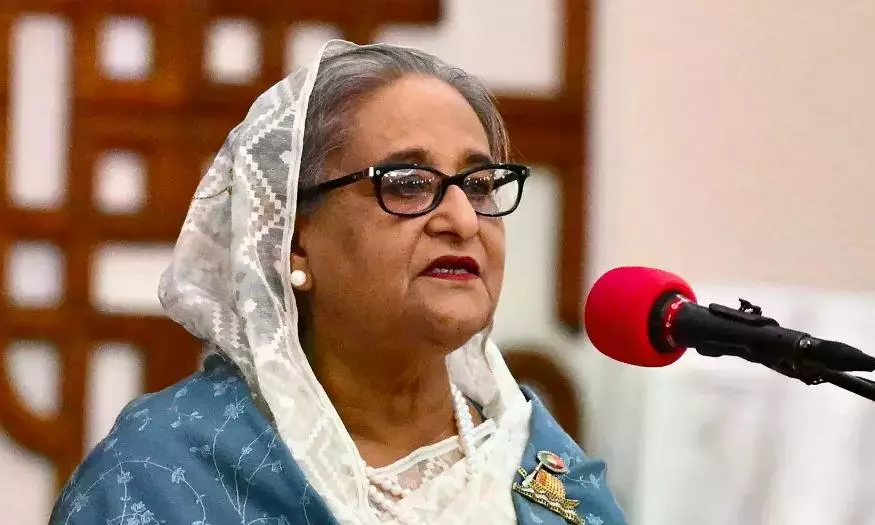
New Delhi:Bangladesh’s former Prime Minister Sheikh Hasina was on Monday sentenced to death in absentia by a special tribunal in Dhaka for “crimes against humanity” over her government's crackdown on student-led protests last year. In its verdict that followed a months-long trial, the country’s International Crimes Tribunal (ICT) described the 78-year-old Awami League chief as the “mastermind and principal architect” of the violent repression that killed hundreds of protesters. Ms Hasina was deposed from power and had fled to New Delhi in August last year, where she continues to stay in exile. Dismissing the verdict as “biased and politically motivated”, Ms Hasina was quoted in media reports as saying that the judgment has been made by a “rigged tribunal established and presided over by an unelected government with no democratic mandate”. She also “challenged the interim government to bring these charges before the International Criminal Court (ICC) in The Hague” (in the Netherlands).
Steering clear of controversy while “noting the verdict” of the Bangladesh ICT, India on Monday evening said that “as a close neighbour, India remains committed to the best interests of the people of Bangladesh, including in peace, democracy, inclusion and stability in that country”. It added that it would “always engage constructively with all stakeholders to that end”.
Apart from Ms Hasina, Bangladesh’s former home minister and close aide Asaduzzaman Khan Kamal, was also sentenced to death in absentia by a tribunal for crimes against humanity during last year's student uprising. It also ordered the confiscation of all his movable and immovable properties in favour of the state. The tribunal also sentenced former inspector-general of police Chowdhury Abdullah Al-Mamun, who turned state’s witness, to five years of imprisonment in the same case.
Soon after the verdict, Bangladesh’s interim government asked India to hand over both Ms Hasina and Mr Kamal. According to media reports, a letter addressed to India from the Bangladesh foreign ministry read: “Providing refuge to these individuals, who have been convicted of crimes against humanity, by any other country would be a highly unfriendly act and a disregard for justice.” Further, according to the state-run BSS news agency, the Bangladesh foreign ministry was quoted as saying in a statement: “We urge the Indian government to immediately hand over these two convicted individuals to the Bangladeshi authorities.”
India is expected to ignore Bangladesh's demands for the extradition of Ms Hasina, who has always been a strong pro-India leader. New Delhi has also been upset with the Yunus-led interim government in Dhaka for its perceived patronage of anti-India radical elements. Dhaka has also looked the other way when it came to attacks on the minority Hindu population of the country in the wake of Ms Hasina's ouster from power in August last year. According to media reports, the bilateral extradition treaty between both nations stipulates that an extradition request can be turned down if it is deemed to be “politically motivated”. According to these reports, Article 8 of the treaty also provides for rejection of any extradition request if it does not meet the ends of justice or if there is no bona fide intent.
Reading out the judgment before a heavily guarded courtroom in Dhaka, the Bangladesh ICT said the prosecution proved beyond a reasonable doubt that Ms Hasina was behind the deadly crackdown on student-led protests in July-August last year. A UN rights office report had earlier estimated that up to 1,400 people were killed during the month-long agitation, known as the July Uprising. Ms Hasina was handed the death penalty for ordering the use of deadly force against unarmed protesters, making inflammatory statements and authorising operations that led to the killing of several students in Dhaka and surrounding areas. The three-member bench, while delivering the verdict, said the sentences reflected “the gravity of the coordinated violence unleashed on unarmed civilians”.
In her reaction, Ms Hasina added: “I wholly deny the accusations that have been made against me in the ICT… They are biased and politically motivated. In their distasteful call for the death penalty, they reveal the brazen and murderous intent of extremist figures within the interim government to remove Bangladesh’s last elected Prime Minister, and to nullify the Awami League as a political force”. Ms Hasina, who was earlier declared a fugitive by the court in her country, said she was not afraid to face her “accusers” in a proper tribunal where the evidence can be weighed and tested fairly.
Ms Hasina said millions of Bangladeshis toiling under the “chaotic, violent and socially regressive” administration of Muhammad Yunus “will not be fooled by this attempt to short-change them of their democratic rights”. She said: “They can see that the trials conducted by the “so-called ICT were never intended to achieve justice or provide any genuine insight into the events of July and August 2025”. Rather, their purpose was to "scapegoat" the Awami League and to “distract the world's attention” from the failings of Yunus and his ministers, she charged. “Under his aegis, public services have fallen apart. Police have retreated from the country's crime-ridden streets and judicial fairness has been subverted, with attacks on Awami League adherents going unpunished," she alleged. Ms Hasina added: “Hindus and other religious minorities are assaulted, and women's rights are suppressed. Islamic extremists inside the administration, including figures from Hizb-ut-Tahrir, seek to undermine Bangladesh's long tradition of secular government. Journalists are locked up and menaced, economic growth has stalled, and Yunus has delayed elections and then banned the country’s most longstanding party (Awami League) from participating in those elections,” she alleged.
“I mourn all the deaths that occurred in July and August of last year, on both sides of the political divide. But neither I nor other political leaders ordered the killing of protesters. I comment further on the substance of the charges below. But first I note that I was given no fair chance to defend myself in court, nor even to have lawyers of my own choice represent me in absentia,” she said. Despite its name, there is “nothing international about the ICT; nor is it in any way impartial”, Ms Hasina added.
The verdict comes just three months before parliamentary elections in Bangladesh, to be held in February, in which Ms Hasina’s Awami League has been barred from contesting. The ICT, originally set up to try hardened collaborators of Pakistani forces during the 1971 Liberation War, was amended by the interim government headed by Nobel laureate Muhammad Yunus to bring leaders of the earlier government, including Ms Hasina, under its jurisdiction. Most Awami League leaders have either been arrested or have fled the country since the collapse of Sheikh Hasina’s government.
