Leaders also exchange views on global issues.
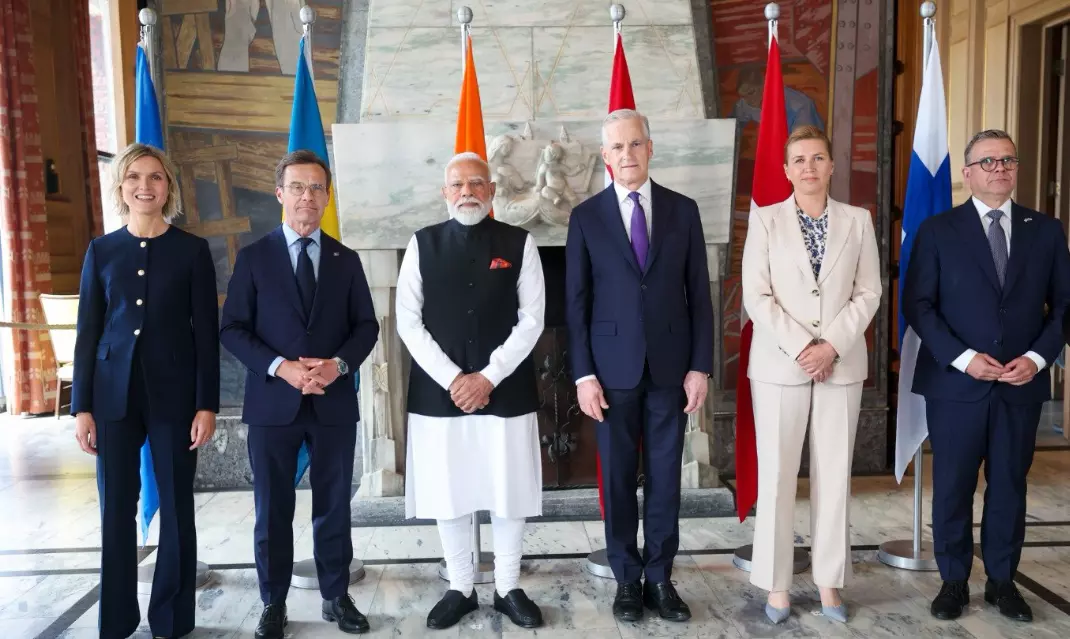
New Delhi: After collective talks with the Prime Ministers of Norway, Sweden, Denmark, Iceland and Finland at the third India-Nordic summit in the Norwegian capital of Oslo on Tuesday, Prime Minister Narendra Modi announced the elevation of ties to a “green technology and innovation strategic partnership” reflecting a “shared commitment to sustainability, innovation and green growth”.
Modi said that India and the Nordic nations will continue to work together to strengthen the rules-based global order amidst the era of global tensions and conflict.
During the talks, India and the five Nordic nations “discussed opportunities for collaboration in trade and investment, blue economy, circular economy, digital infrastructure, digitalisation and artificial intelligence, climate action and energy security, fighting pollution, water, research and education, talent mobility, healthcare, space & geospatial sectors and defence," a joint statement issued later read. It also “acknowledged investment opportunities including 100 per cent FDI being offered to Nordic defence firms in Indian defence industrial corridors”.
At the talks, the Prime Minister declared that there should be “no compromise and no double standards” globally when it comes to fighting terrorism. He had earlier thanked the Nordic nations for their support to India after the Pahalgam terror attack last year.
While also calling out the menace of cross-border terrorism, the joint statement “condemned in the strongest terms the terrorist attack in Pahalgam, Jammu and Kashmir, on April 22, 2025, and the terror incident near Red Fort in New Delhi on November 10, 2025.”
Norway’s PM Jonas Gahr Støre, Swedish PM Ulf Kristersson, acting Danish PM Mette Frederiksen, Finland’s PM Petteri Orpo, and Iceland’s PM Kristín Frostadóttir also made brief remarks during which it was declared that Finland will host the fourth edition of the India-Nordic Summit at Helsinki. Ms Frederiksen, meanwhile, hailed India as one of the biggest powers of the world.
In his media remarks, Modi said India would benefit from Iceland’s expertise in geothermal and fisheries and Norway’s experience in the blue economy and Arctic research. Likewise, Swedish expertise in defence and advanced manufacturing, Finland’s expertise in telecom and digital technology and Danish experience in cybersecurity and health technology will team up with Indian talent for a new future and a unique strategic partnership.
The Prime Minister pointed to the benefits of India inking (in 2024) the trade and economic partnership agreement (TEPA) with the four member states of the European Free Trade Association (EFTA) that include Norway and Iceland, which came into effect in October last year, as well as the India-European Union (EU) free trade agreement (FTA) inked in January this year with the 27-nation EU that includes Denmark, Finland and Sweden. He said that in the past decade, bilateral trade had increased four times while investment from the Nordic nations in India had increased by 200 per cent.
The six leaders emphasised that the India-EU FTA and India-EFTA TEPA “could support economic security and resilience through diversifying critical value chains and opening new markets”.
New Delhi said that at the summit, the Prime Minister “called for greater Nordic investments in areas such as the green transition, blue economy, shipbuilding, green shipping, renewable energy, water and defence” and also “invited Nordic countries to explore opportunities to set up a presence in Gift City, Gujarat”.
The Nordic countries “appreciated India’s ambitious renewable energy targets and conveyed support for flagship initiatives such as Mission LiFE and the leadership group for industry transition”, New Delhi added.
The Prime Minister said India and the five Nordic nations will continue to push for peace, a rules-based global order and multilateralism in the wake of the Russia-Ukraine and West Asia conflicts.
“The leaders underscored their shared interest in fostering a resilient global order based on international law, democracy, freedom, gender equality and rule of law. They discussed international peace and security, including the conflicts in Europe and West Asia, and emphasised the importance of multilateral cooperation and reform of global governance institutions,” New Delhi said later in a separate statement.
The joint statement declared: “On Ukraine, leaders expressed concern over the ongoing war, which continues to cause immense human suffering and carries global consequences. They will continue to support efforts towards the achievement of a comprehensive, just and lasting peace through dialogue and diplomacy, based on the principles of the UN Charter and international law."
Regarding Palestine, the leaders called on all parties to respect the ceasefire and uphold their obligations under international law. They reiterated their concern over the humanitarian situation and emphasised the need for safe, sustained, and unhindered humanitarian assistance throughout Gaza, the joint statement declared.
”The leaders expressed deep concerns over the situation in West Asia/Middle East and its global effects. They welcomed the ceasefire announced on April 8. They underlined the importance of de-escalation and reiterated that all issues must be resolved through dialogue and diplomacy. They also called for freedom of navigation and global flow of commerce through the Strait of Hormuz…” the joint statement added.
On the Indo-Pacific, the joint statement stated. “The leaders agreed to strengthen cooperation in the field of maritime security. They reinforced their commitment to promoting a free, open, peaceful and prosperous Indo-Pacific, in accordance with international law, including the UNCLOS. In this regard, they looked forward to joint activities through bilateral dialogues as well as the Indo-Pacific Oceans Initiative (IPOI).”
“The leaders further emphasised the need of undertaking initiatives to improve connectivity between the Nordic and the Indo-Pacific regions, including in line with the continued development of the India-Middle East-Europe Economic Corridor," the joint statement added.