India Closely Monitoring Developments In Neighbourhood And Beyond As Global Security Order Undergoes Major Transformation

"India is continuously monitoring developments in our region and beyond along with their broader strategic implications," Mr Singh said after witnessing an aerial display.
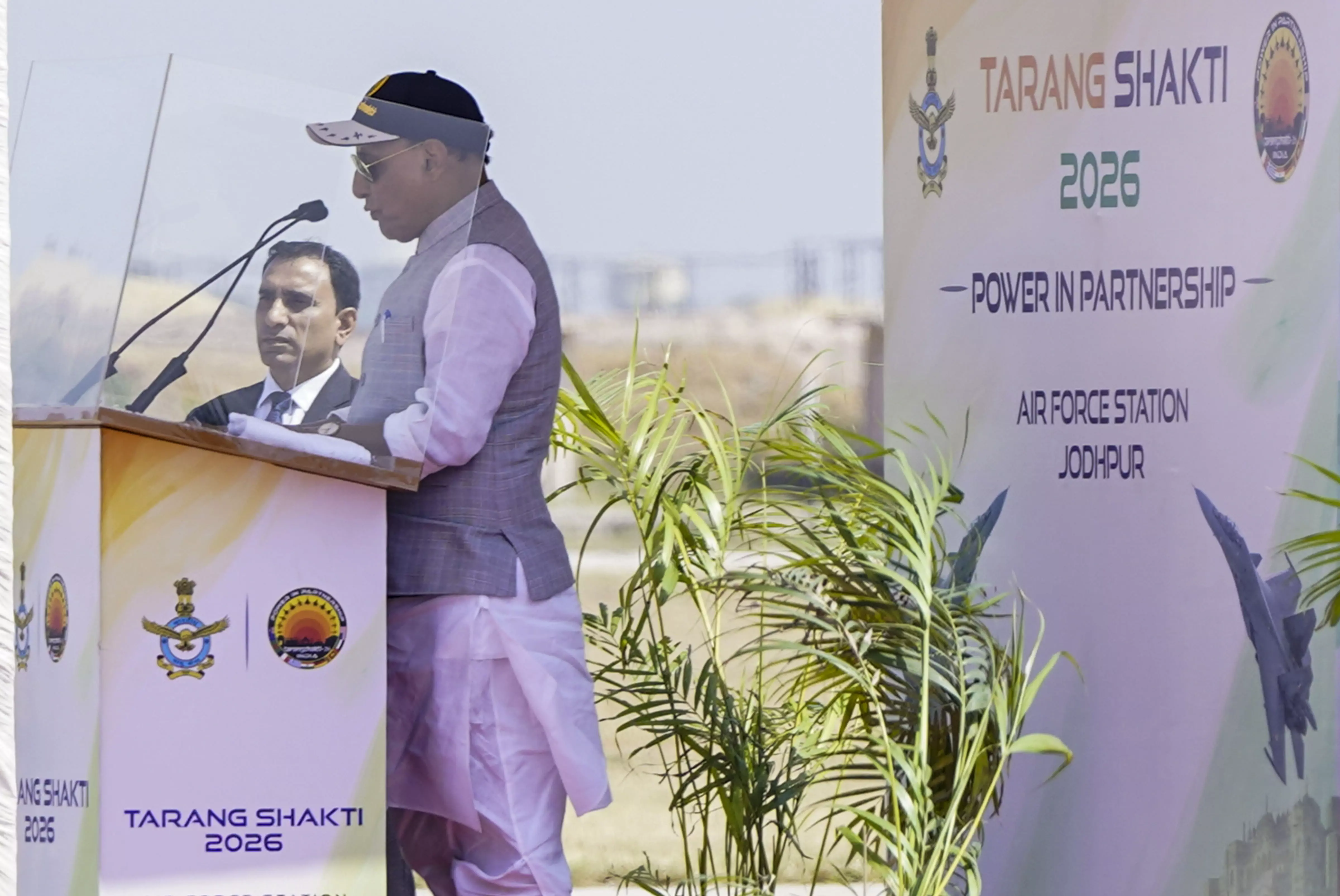
New Delhi:Defence Minister Rajnath Singh on Saturday said India was closely monitoring developments in its neighbourhood and beyond, along with their strategic implications, as the global security order undergoes a major transformation and new forms of warfare reshape the battlefield.
Addressing Exercise Tarang Shakti 2026 at Jodhpur Air Force Station, Mr Singh said the established world order was rapidly changing, even as the contours of the emerging order remained uncertain. He said the Indian armed forces were undergoing a fundamental transformation — structurally, materially and strategically — guided by the vision of Atmanirbhar Bharat.
"India is continuously monitoring developments in our region and beyond along with their broader strategic implications," Mr Singh said after witnessing an aerial display.
He said the established world order was rapidly changing while the shape of the future order was yet to emerge. "India's vision of Atmanirbhar Bharat does not mean isolation from the world. It means developing domestic capacity to design, develop, manufacture, maintain and upgrade critical defence technologies," he said.
The defence minister said modern warfare is becoming increasingly complex with rapid technological changes and the emergence of new areas of conflict.
He said the growing role of non-state actors, threats to critical trade routes and sealanes, and the use of new technologies added to uncertainties in the global security environment.
"Modern warfare is getting more complex with new technological changes, expansion of weapon domains and the addition of new elements. It is no longer confined to land, sea and air. It now spans space, cyber, the electromagnetic spectrum and the information domain. Surprise and deep uncertainty have become a new normal. Accompanied by these is the rising influence of non-state actors from the battlefield. Critical trade routes, vital sea lanes and vulnerable points are actively being weaponised," Mr Singh said.
He said artificial intelligence is reshaping decision support, electronic warfare demands, and absolute spectrum control.
"We are facing a situation where the older established world order is fast disappearing while the shape of the future order is yet to emerge," the minister said.
He said the volatile security situation required countries to remain constantly alert.
Referring to changes in military operations, Mr Singh said drones and unmanned systems had altered the speed, scale and nature of warfare.
He said military strength, in the future, would depend less on the number of platforms a country possessed and more on how quickly it could gather information, understand a situation, take decisions and act.
"Speed, precision, information and integration are now the true defining attributes," he said.
Mr Singh said India recognised the need for self-reliance in defence years ago, knowing that no country could sustain a prolonged war without the ability to produce its own weapons and critical technologies.
The defence minister referred to the Tejas fighter aircraft, Dhruv, Rudra and Prachand helicopters, the Light Utility Helicopter and the Akash air defence system as examples of India's growing indigenous defence capabilities.
He said India is developing these capabilities not only to meet its own requirements but also to become part of trusted global defence supply chains.
"Our ambition is not to manufacture equipment. It is to design, innovate, integrate and deliver," he said.
Earlier, Mr Singh, accompanied by the Chief of Air Staff and other senior officers, witnessed an aerial display featuring various aircraft formations and performances by the IAF's Sarang helicopter display team and Surya Kiran aerobatic team.
Exercise Tarang Shakti 2026, being held from September 26 to October 12 under the theme "Power in Partnership", involves air forces from seven countries -- Australia, the United States, the United Arab Emirates, France, Germany, Sri Lanka and Bangladesh.
