EAM: India For Peace, Dialogue In West Asia

9 March 2026 12:08 PM IST9 March 2026 12:08 PM IST
Jaishankar emphasizes India's commitment to energy security and managing risks in a volatile market.
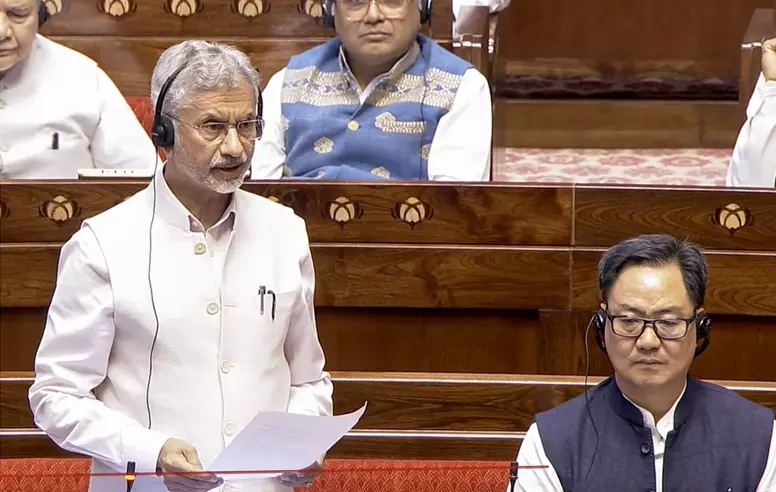
New Delhi: External Affairs Minister S Jaishankar, left, speaks in the Rajya Sabha during the Budget session of Parliament, in New Delhi, Monday, March 9, 2026. (Sansad TV via PTI Photo)
New Delhi: India is in favour of peace (in West Asia) and urges a return to dialogue and diplomacy and “advocates de-escalation, restraint and ensuring the safety of civilians”, external affairs minister S. Jaishankar told Parliament on Monday. He added that the “well-being and security of the Indian community in the region is our priority” and that India’s “national interest, including energy security and trade flows, will always be paramount”.
Jaishankar said the “government remains committed to ensuring that fully, taking into accountability, costs and risks of the energy markets and the interests of the Indian consumer has and will always be the overriding priority”. Jaishankar’s statement in the Lok Sabha was marred by loud sloganeering and protests by Opposition members who entered the Well of the House.
In a statement read out in both Houses of Parliament on the Middle East situation, the EAM said Iran had requested India for permission on February 28 for “three ships in the region to dock at our ports” which was accorded the very next day on on March 1. (One of the Iranian ships) IRIS Lavan actually docked on March 4 in Kochi, the minister said, adding: “The crew is currently in Indian naval facilities. We believe that this was the right thing to do and the Iranian foreign minister has expressed his country’s thanks for this humane gesture.”
The EAM’s revelation the Iranians requested for permission for three ships to dock which was given has triggered speculation on what happened to the other two ships. It may be noted that on March 4, one Iranian ship IRIS Dena, sailing at the south of Sri Lanka, was blown up and sunk by a US submarine while another Iranian ship IRIS Booshehr was subsequently escorted by the Sri Lankan Navy to safety at the island nation. Curiously, just two days ago at the Raisina Dialogue here, Jaishankar had said the Iranians had sought permission “for one of their ships” to dock at an Indian port as it was facing some problems. He had said India had granted permission and had termed it the “humane” and “right thing” to do.
He pointed to “attacks on merchant shipping where Indian nationals often constitute a large proportion of the crews” and added: “We have sadly already lost two Indian mariners and one remains missing in such incidents. I know that the House joins me in condoling their deaths.”
Jaishankar said Indian “diplomats have also worked hard to assist stranded transit passengers in hubs like Dubai, Doha and Abu Dhabi and have facilitated international border crossings for Indian nationals, including from UAE to Oman and from Qatar, Kuwait and Bahrain to Saudi Arabia.” He said “wherever there has been a partial opening of air space, we have approved and undertaken commercial flights, including non-scheduled flights, to enable the return of Indian passengers” and that as per estimates, as of March 8, “almost 67,000 of our nationals have done so”.
Jaishankar also informed both Houses that many Indian nationals had disregarded the Indian government’s earlier advisories issued from January onwards to leave Iran. “Once the conflict commenced, the Indian embassy has facilitated the relocation of several Indian students in Tehran to places outside Tehran. An advisory update with emergency contact helplines was issued on March 3, 2026. Similarly, facilitation was extended to pilgrims for their internal movement. Indian nationals who were in Iran for business reasons were assisted to cross over to Armenia and return home. The embassy in Tehran remains fully operational, in fact on the highest alert.”
The Indian embassy in Tehran issued a fresh advisory warning Indian nationals against trying to cross the Iran border by road without coordinating with the embassy. It stated: “Indian nationals are hereby advised not to approach any of the land borders of Iran for travel outside the country without prior coordination with the embassy. Any movement towards land border points should be undertaken only after obtaining explicit guidance from the embassy. It may be noted that the embassy will not be in a position to extend assistance once individuals have exited Iranian territory and are unable to enter the third country concerned.”
In his statement, the EAM said: “I rise to apprise this august House of recent developments in West Asia that are a cause of deep concern to all of us. As hon’ble members are aware, this round of conflict started on 28 February 2026. It has witnessed not only fighting between Israel and the United States on one side and Iran on the other, but also attacks on a number of Gulf states. There have been numerous casualties, including at the leadership level in Iran, as well as destruction of infrastructure in the region… It is also imperative that the sovereignty and territorial integrity of all states in the region be respected.”
He added: “While any development that negatively impacts peace and security in the world is deeply troubling, this ongoing conflict is an issue of particular concern for India. We are a neighbouring region and understandably, have obvious stakes that West Asia remain stable and peaceful. There are almost one crore Indian citizens who live and work in the Gulf nations. In Iran too, there are a few thousand Indians who are there for study or for employment. The region is key to our energy security and includes many important suppliers of oil and gas.”
“Given the gravity of the situation, the Cabinet Committee of Security met on March 1 under the chairmanship of the Prime Minister. It was briefed on the airstrikes in Iran and the subsequent attacks in several Gulf countries. The CCS was concerned over the safety and security of the Indian community in the region. It also focused on the implications for regional security and for economic and commercial activities.”
He also said the government has maintained close contact with the relevant countries. “The Prime Minister himself has spoken to the UAE President, Emir of Qatar, the Crown Prince of Saudi Arabia, Crown Prince of Kuwait, King of Bahrain, Sultan of Oman, King of Jordan and the Prime Minister of Israel. In each case, we received assurances that the well-being of the Indian community would be a priority for the host government. I have similarly been in close touch with my counterparts in these countries. Insofar as the United States is concerned, we have maintained regular contacts through diplomatic channels. While attempts have been made, contacts with Iran at the leadership level are obviously difficult at this time. I have, however, spoken to foreign minister Araghchi on February 28 and March 5. We will continue these high-level conversations in the coming days.”
( Source : Deccan Chronicle )

Next Story