India Accounted for Nearly One-Third of Global GDP at the Beginning of Common Era: FM

FM says empowering every state is vital for investment, growth and inclusive development
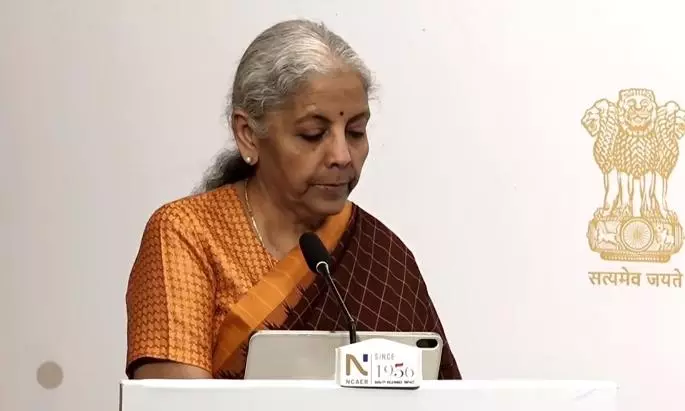
New Delhi: Union finance minister Nirmala Sitharaman on Thursday urged both the Centre and states to play a key role in a right direction for attracting investments, framing the right policies and ensuring that parts of this country which have remained underdeveloped for a long time are brought on board to catch up with the rest of the country. "So, there is a role for the Centre and that role cannot be played by one or two states - never. But unless the states, and I mean each one of them, are empowered, given the resources and also provided with the means to build capacity, the aspirations of India cannot be met," Sitharaman said while delivering the CD Deshmukh Memorial Lecture 2926 at the National Council of Applied Economic Research (NCAER) here.
Outlining the vision for a developed nation, she also described Viksit Bharat as a framework for zero poverty, universal quality education, comprehensive healthcare, skilled employment, full economic participation of women, and technological leadership. "Viksit Bharat is not an unprecedented ambition. In a way, it is a restoration. 2047 is no longer a distant aspiration. It is an immediate national horizon, and a good deal of it must be settled within the next few years," the finance minister said.
She further said that India's destiny is to become prosperous without becoming consumerist, wealthy without becoming materialistic, and globally successful without losing our civilisational character. "Our model is neither consumerist nor mercantilist, as wealth has meaning only when it strengthens society as a whole," she said, adding that 2047 is no longer a distant aspiration and it is an immediate national horizon, and a good deal of it must be settled within the next few years.
Focusing on the youth and GenZ on education and health care system of the country, Sitharaman also said that quality education and quality healthcare are entirely non-negotiable national priorities. Investment in public health and education is an expression of the Indian ethos. "Our ambition is not merely to improve upon our present. Our destiny is to stand among the foremost nations of the world," she said.
"India’s future must be built upon a partnership between generations. The older generation carries the wisdom and memory of this nation. That memory does not sustain itself. It fades when it is not transferred. The younger generation brings the energy, the innovation and the leadership to execute the next phase. They are also the people who will actually live in 2047 and beyond," she added.
Detailing India's developmental journey from post-Independence economic challenges to current progress, Sitharaman also stated that historical estimates show India accounted for roughly one-third of global GDP at the beginning of the Common Era. "The poverty was not the country's steady state, but was manufactured through centuries of invasions and colonialism, and prolonged for four decades after Independence," she noted.
