Why Jain Diwali Is a Celebration and a Farewell: The Story of Bhagwan Mahavir's Last Night

For Jains, Diwali began with a farewell.For them, the festival is as much about remembering as it is about celebrating
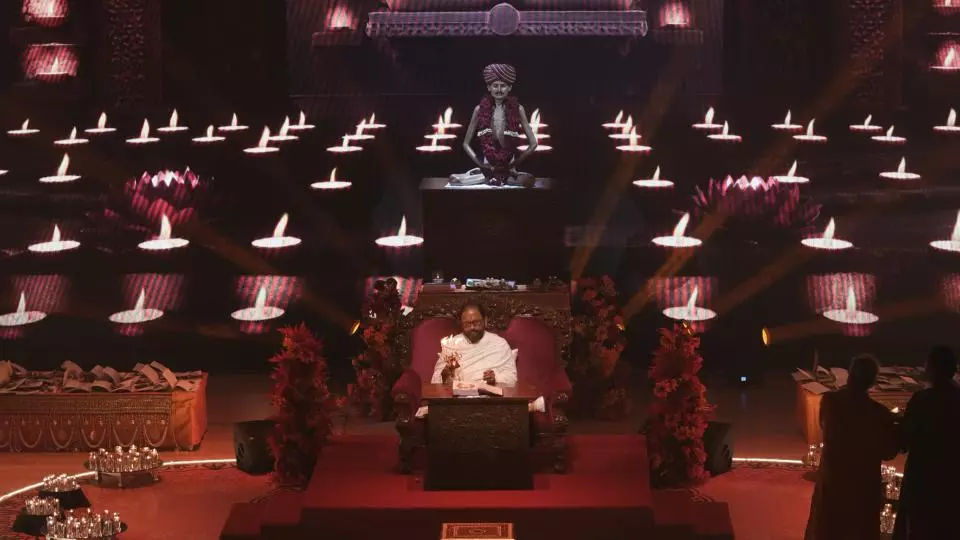
Most of us grew up with one version of the Diwali story. Jain families grow up with another, and it starts on a moonless night more than 2,500 years ago, in the alms hall of a king named Hastipal, in a town called Pavapuri (currently in Bihar)
Bhagwan Mahavir, the 24th Tirthankara, had been teaching for close to two days without a break. Jain tradition puts his final discourse at sixteen prahars, beginning on Dhanteras and ending on Diwali. When it was over, he emerged from the Samavasaran, the great assembly where Tirthankaras teach, and went to Hastipal's hall, where people kept coming for a last darshan.
He knew his time had come. He also knew that one person in particular would find it hard.
Gautam Swami was his chief discipleTheat love that Gautam had for Bhagwan Mahavirhad become the one thing still holding him back from Kevaljnan, the state of complete knowledge. So he sent him away. There was a Brahmin named Devsharma in a nearby village, he told Gautam, who would find spiritual awakening through him. Gautam went at once. "As You command, Lord," he said.
It was a kindness that would only make sense later.
That night, the new-moon night of the month of Aso, Bhagwan Mahavir slowly withdrew from the world. The traditional account is precise about it. First he stilled the outward workings of mind and speech, then the subtlest movements of the body, then the subtle workings of speech and mind. He entered the last stage of pure meditation, Shukla Dhyan, in which all activity ends. It lasted as long as it takes to say five short syllables. Then he was liberated, and ascended to Moksh, completely free from karmic bondage and the cycles of birth and death .
When the kings heard, they lit lamps. The light of their lives had gone out, the account says, and they wanted to mark it. People have lit diyas on that night ever since.
A festival with a lump in its throat.
This is why Jain Diwali feels a little different from the noise outside. It celebrates the highest thing a soul can reach. It also remembers the day his followers lost their teacher.
Pujya Gurudevshri Rakeshji, who founded Shrimad Rajchandra Mission Dharampur (SRMD) in 1994, often explains this with an image every Indian family will recognise. Think of a daughter's wedding, he says. There is joy all day. And then the car pulls away, and the same family is in tears. Nobody thinks that strange. Diwali, for a Jain seeker, is something like that.
What Gautam did
The story does not end with grief. When Gautam Swami came back from Devsharma's village and learnt what had happened, the attachment that had held him for so long finally gave way. Tradition says he moved from the sixth stage of spiritual development to the thirteenth and attained Kevaljnan himself.
Gurudevshri likes to point out what that tells us. Gautam commemorated this day by bringing about a spiritual transformation in himself and elevating his state. In the same way, we should atleast progress from the first stage to the fourth, where a person begins to see the Self clearly; thus beginning our journey of eventually becoming free from the cycle of birth and death.
Diwali at Dharampur
None of this means giving up the festival. Cholafali, ghughra and khajli still come out in Jain homes. Gurudevshri just asks people to make room for what the day is actually about, whether that is some time in chanting, japa, meditation or reading scripture.
At the Mission's international headquarters in Dharampur, in South Gujarat, that is what the Diwali Shibir is built around. There is Nirvan Kalyanak Bhakti in Bhagwan Mahavir's memory and collective mantra jaap on the night itself, at a campus where Shri Mahavir Prasaad, a tirth of 108 carved marble pillars, stands on the highest point of the hill.
Gurudevshri has spent decades on these texts, more than 16,000 hours of discourses across over 30 scriptures, including the Shri Uttaradhyayan Sutra, regarded as Bhagwan Mahavir's last sermon. His own spiritual guide, Shrimad Rajchandraji, the 19th-century philosopher Gandhi looked up to, once put the whole path in a single sentence: "To be devoid of mind's thoughts of volition and irresolution, that is the path of Mahavir."
The kings lit lamps because a light had gone out. It is worth remembering, as the diyas go up this year, what that light was.
