Look Up Tonight: Rare Aurora Display Could Reach Parts of India

The storm is expected to trigger stunning auroras (also called the northern and southern lights) that could be visible much further south than usual, potentially reaching parts of Northern India, Central Europe, the United States, and Southern Australia
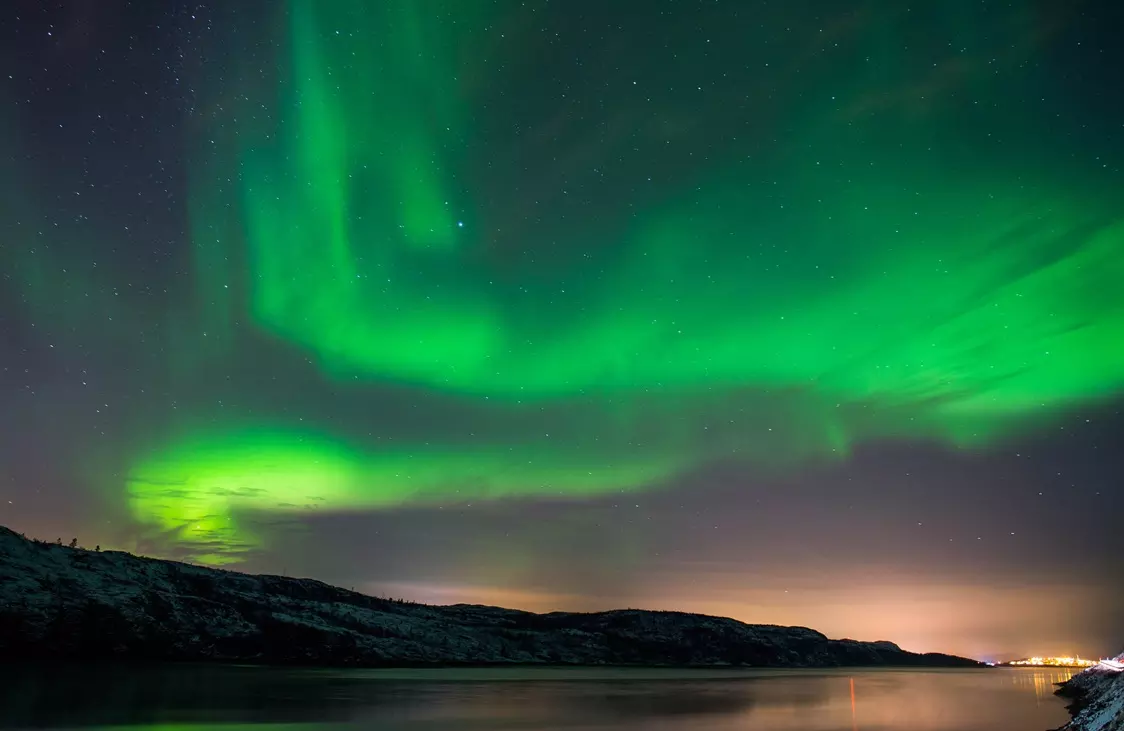
If you look up at the sky on Monday, June 8, 2026, you might just catch a glimpse of nature’s most spectacular light show. Following a turbulent week of solar activity, NASA and space weather agencies have issued an alert for a strong G3-class geomagnetic storm heading directly for Earth.
The storm is expected to trigger stunning auroras (also called the northern and southern lights) that could be visible much further south than usual, potentially reaching parts of Northern India, Central Europe, the United States, and Southern Australia.
What happened to the sun?
The celestial drama happened on June 6, when a restless patch on the Sun’s surface known as Active Region 4461 erupted. The region shot out a mid-tier, M1.8-class solar flare, a massive burst of X-ray radiation that immediately caused minor radio disruptions on Earth.
However, it wasn’t the radiation that caught the attention of space scientists; it was actually what the explosion left behind. The flare launched a coronal mass ejection (CME) consisting of a highly dense, magnetized “core filament”. Think of a solar filament as a massive bridge of superheated gas (plasma) held up by looping, invisible magnetic fields. When the magnetic structure became unstable, the “bridge” snapped like a giant rubber band, throwing a billion-ton cloud of magnetized plasma into the solar system.
This cloud is currently racing through space at an astonishing speed of 1,400 kilometers per second, and it is scheduled to collide with Earth’s magnetic shield today.
How severe will it be?
Space Weather Forecasters at the U.S. Space Weather Prediction Center (SWPC) have classified this as a G3 (strong) geomagnetic storm, with the possibility of brief escalations to G4 (severe). To put this into perspective, geomagnetic storms are rated on a scale from G1 (minor) to G5 (extreme). The historic solar storm of May 2024 was a G5 event that famously lit up the night skies with vibrant pinks and greens in places like Ladakh, India, where auroras are almost never seen. While tonight’s storm may not reach those extreme levels, a G3 or G4 storm is powerful enough to push the “aurora oval” significantly away from the polar regions and toward lower latitudes.
Understanding the Bz Vector
Whether or not we get a dazzling light show depends entirely on a single, unpredictable variable: the Bz orientation.
As we know, Earth is protected by a magnetic field called the magnetosphere. The incoming solar cloud also carries its own magnetic field.
If the solar cloud’s magnetic field points Northward, Earth’s shield will deflect it, and the storm will likely fizzle out.
If the field points Southward (negative Bz), it aligns perfectly opposite to Earth’s magnetic field. The fields will connect, the shield will open, and solar particles will pour into our upper atmosphere, colliding with gases to create curtains of green, red and purple light.
Scientists won’t know the direction of the Bz vector until the cloud passes monitoring satellites about 1.5 million kilometres away from Earth, giving a final warning window of just 15 to 60 minutes before impact.
Potential “Cannibal” Solar Activity
Adding to the suspense, the Sun has already released multiple smaller eruptions over the last few days. The space environment surrounding Earth is currently filled with turbulent, slower-moving solar winds from earlier events.
When a fast-moving CME (like today’s 1,400 km/s monster) overtakes slower CMEs ahead of it, it can absorb them. This phenomenon is known as Cannibal CME, and it can result in a single, much denser, and far more powerful magnetic strike when it hits Earth.
What to expect tonight?
For stargazers and aurora photographers, Monday night is the time to be on high alert. If conditions align favourably, a dark, clear sky away from city light pollution could offer a rare view of the auroras. While utility operators and satellite technicians are monitoring the storm to protect power grids and communication systems from fluctuating, the rest of the world is waiting to see if the Sun’s fury will transform into a breathtaking midnight display.
This article is written by Yashasvi M., from St. Francis College for Women, interning at Deccan Chronicle.
