Jameela Nishat’s Flying Embers, a Book of Urdu Poems

22 Feb 2026 8:53 AM IST22 Feb 2026 8:53 AM IST
Jameela Nishat gives us a profound gift – a set of poems that are evocative, poignant, provocative and insightful.
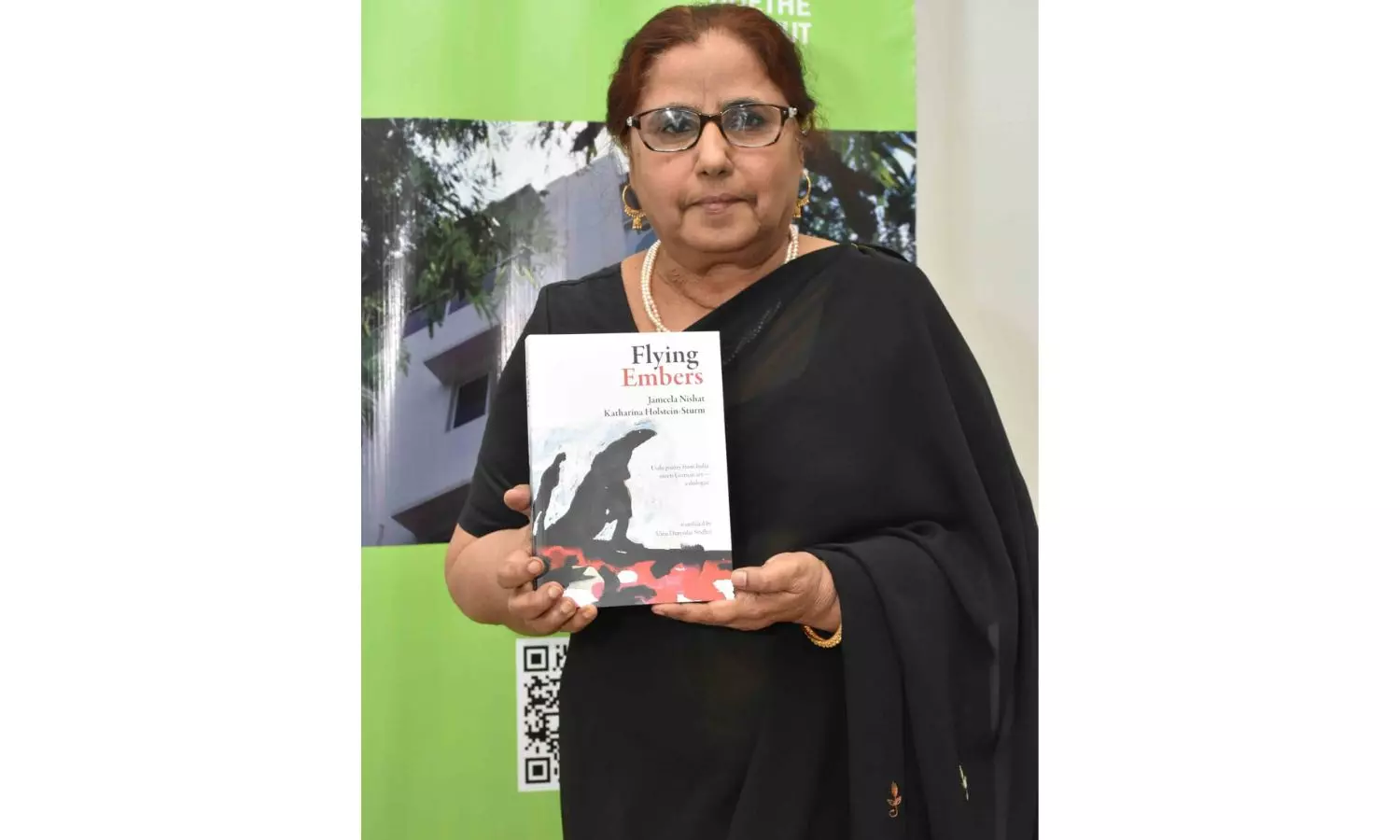
Jameela Nishat (Photo: By Arrangement)
Jameela Nishat gives us a profound gift – a set of poems that are evocative, poignant, provocative and insightful. The presentation itself is breathtaking, bringing to life Chughtai’s labour of love that came a 100 years ago.
The Muraqqa, that Chughtai so lyrically created, gave Ghalib’s ethereal poetry an artistic vision, embedded in South Asian ethos and imagery, and giving the reader a view into what great poetry and art mean, especially when they come together. Sadequain must have done the same when he paid homage to Ghalib through his paintings in the 60s.
Jameela’s book gets a similar uplift with Katharina Holstein – Sturm’s brush, that takes the lines in Urdu, translated with such care and affection by Uma Damodar Sridhar, and make Chughtai come alive again. Each poem, one is a purely feminist view of life, another a plea to break barriers and borders, yet another a sophisticated reminder of mortality……all get translated twice, once into English and then into artistic images, each adding value to the other.
This must have been such an ambitious project when it started and when it turned into a seminal work of art, culture, painting and translation. The journey couldn’t have been easy, as it involved three different talented people coming together to uplift each one’s craft and creativity, and yet maintain a uniformity of thought that makes the book a collective effort and a cogent read. The poems themselves could not have been easy to write, as this was presumably the first step taken by the trio.
Dread, fear, night, darkness, despair followed by hope and achievement. A mother’s love and a daughter’s belief come together to give us lessons on what life is and what it could be. Death and nostalgia come through often, bringing with them a poetic understating of life and mortality, of longing and love. The terrain is familiar; the poet walks with Maqdoom and Kannabiran. Soghra Mirza and Balagopal, each one a legend, giving to society the best they could, asking for their rights, protesting against power and leave behind memories that inspire and kindle hope.
The Murraqqa, that was produced a hundred years ago, had a foreword written by Sir Mohammad Iqbal. In that famous work he says, “Both God and man live by perpetual creation……….The artist who is a blessing to mankind defies life. He is an associate of God and feels the contact of Time and Eternity in his soul….The modern age seeks inspiration from nature. But Nature simply “is” and her function is mainly to obstruct our search for “Ought” which the artist must discover within the deeps of his own being.” What Iqbal wrote then for that masterpiece by Chughtai and Ghalib could so easily have been written for the Flying Embers, by Jameela, Uma and Katharina.
( Source : Deccan Chronicle )

Next Story