Gujarat : Great Indian Bustard Chick Born In Wild After Decade Goes Missing

Forest authorities expressing fear that it may have fallen prey to wild predators.
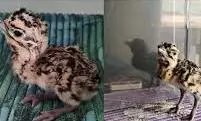
Ahmedabad : A month-old chick of the critically-endangered Great Indian Bustard (GIB) born in the wild in Gujarat after a decade through a novel conservation method has gone missing, with forest authorities expressing fear that it may have fallen prey to wild predators. The chick, born in the Naliya grassland in Kutch on March 26, could not be located for the last three to four days.
Teams of the state forest department and Wildlife Institute of India (WII) have not been able to locate the chick.
Talking to PTI, in-charge Principal Chief Conservator of Forests Jaipal Singh said that while the hatching of a GIB chick in the wild in Gujarat through the 'jumpstart technique' was a major milestone towards its conservation, there is a concern that the chick may have fallen prey to smaller predator.
This happened despite efforts being made to keep a close watch on it, the Kuch forest department said in a statement.
Singh said that while this is disappointing, the breeding programme initiated by the state forest department will continue.
An official release issued earlier had stated that Gujarat witnessed the birth of a GIB chick after a decade, in Kutch, through a novel conservation measure known as the jumpstart approach.
The jumpstart approach is a captive-to-wild transfer technique designed to boost the population of the critically endangered bird. It involves taking a fertile egg from a captive breeding centre, transporting it and placing it into the nest of a wild female bird that is currently sitting on an infertile (non-hatching) egg.
Singh said, "Our efforts will persist. On the one hand, the programme for breeding new chicks will continue, on the other, the initiative to bring additional chicks and release them into this region will also carry on."
Gujarat had not witnessed the hatching of a GIB chick in this region for a long period. To address this, a programme was conducted in collaboration with the central government and the WII, where a new milestone was achieved by successfully transporting eggs from Rajasthan and hatching them here.
"The chick survived until it reached the stage of taking its first flight. However, it moved beyond the scope of our monitoring subsequently," Singh said.
"Even if this has indeed occurred (being hunted by smaller predators), the breeding programme we have initiated will continue. As part of this initiative, we have tagged two GIBs. Whenever they lay eggs, we will procure them from Rajasthan and sustain our programme for breeding new chicks," he said.
The programme for breeding new chicks will continue along with the initiative to bring additional chicks and release them into this region, Singh said
In its statement, the Kutch forest department said the chick has not been located over the past few days by its staff, watchers and WII team members, who were continuously monitoring it closely.
"In the last 3-4 days, the teams have not been able to locate the chick despite efforts taken to keep a close watch on it. Since the area is a natural habitat for various wildlife, it is possible that it may have been hunted by them," it said.
It said that the conservation and restoration of any species requires a significant amount of time, as well as scientific and sustained effort.
"Since the GIB is a ground-nesting species, its mortality rate is particularly high during the initial stages of life. Of the chicks that hatch from the eggs, which themselves account for only 40 per cent of the total eggs laid, 60 per cent do not survive beyond their first two months," it said.
Subsequently, however, their chances of survival increase significantly, it added.
The forest department further said that during these critical initial months - when the chick is not yet capable of flight - the female bird strives to protect it from predators such as jackals, foxes, feral cats, mongooses, birds of prey, and monitor lizards.
The jumpstart technique serves to enhance the GIB's chances of survival, with the specific objective of this technique being to ensure that the hatched chick continues to receive care and nurturing from a surrogate female GIB, it said.
"While this method proves effective in reducing egg predation, it does not necessarily increase the likelihood of the chick's survival after hatching. Efforts undertaken in Rajasthan indicate that even under optimal conservation conditions, only approximately half of the chicks manage to survive for two months," it said.
"In Gujarat, the team implementing the jump start technique successfully executed several critical tasks: the safe transportation of eggs, their subsequent placement and remote monitoring, habitat management (including the control of water sources and invasive species), and measures to mitigate the impact of predators.
Nevertheless, despite these efforts, the risks of mortality resulting from predation and natural causes cannot be entirely eliminated that may ultimately lead to the death of the chick. Through this methodology, efforts to restore the GIB population in Kutch will continue, it said.
"To this end, two female GIBs have been tagged to facilitate the collection of data regarding their nests and eggs, thereby enabling the sustained application of this methodology in the future," it said.
Concurrently, the forest department is undertaking measures to improve the habitat - such as removing harmful vegetation, reinforcing fencing, relocating predators, and implementing water management systems - to ensure greater success in future conservation endeavors, it said.
