FICCI Charts Future of AI-Driven Healthcare in India

Book on AI's role and limits in healthcare launched, industry leaders call for a prevention-first, patient-centric digital health ecosystem
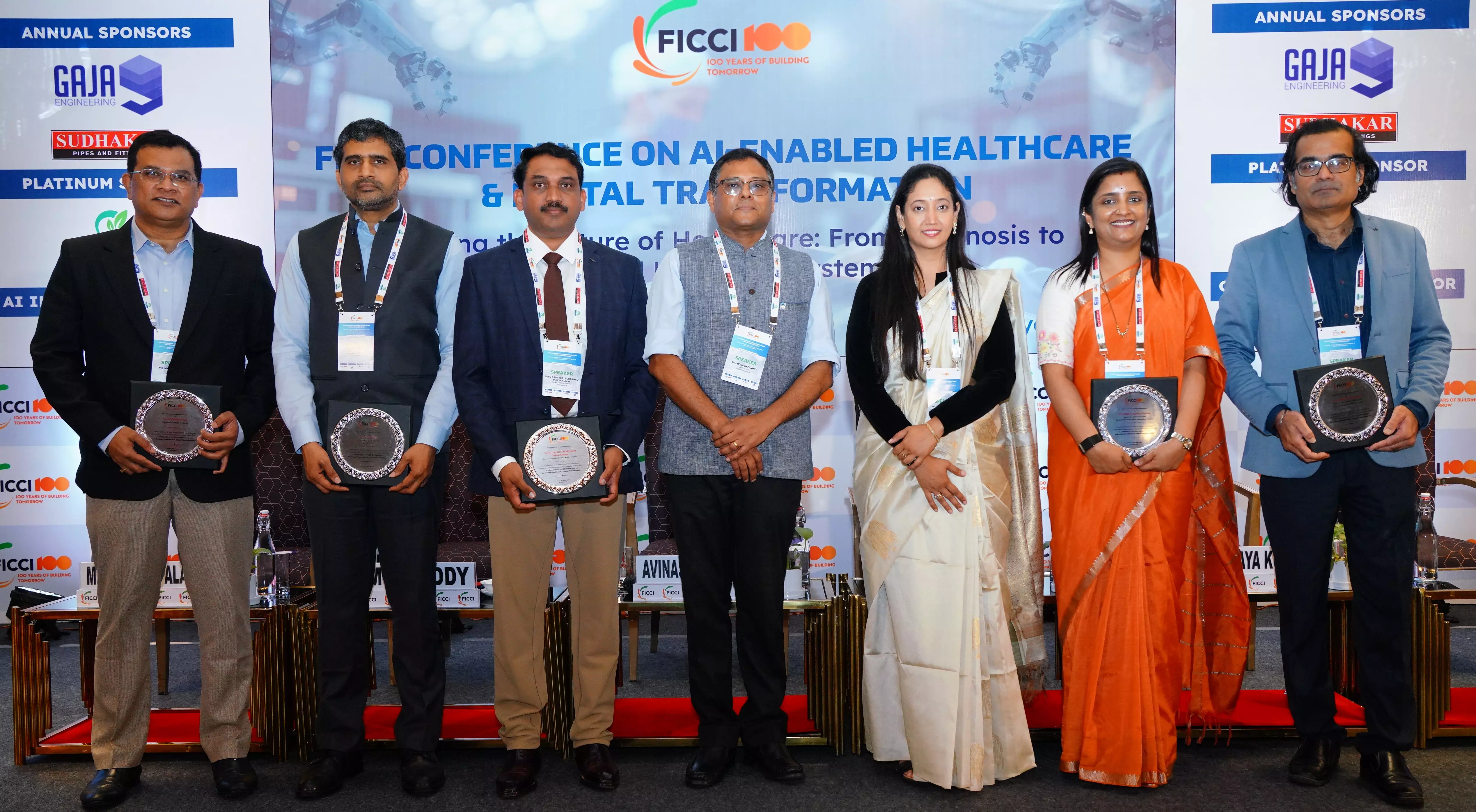
Hyderabad: The Federation of Indian Chambers of Commerce and Industry (FICCI), Telangana State Council, launched its first Healthcare Panel and organised a conference on “AI-Enabled Healthcare & Digital Transformation” on Saturday at Vivanta by Taj, Hyderabad, themed “Building the Future of Healthcare: From Diagnosis to Digital Health Ecosystems.” The inaugural session also featured the release of “Health Data and Power: What AI Can Do and Cannot Do,” examining the capabilities and limits of artificial intelligence in healthcare.
The conference brought together healthcare leaders, clinicians, researchers and policy experts to deliberate on AI-enabled care, preventive and outcomes-based healthcare, medical tourism, healthcare accessibility, and skilling for the healthcare workforce. The newly launched panel is expected to advise the Telangana government on healthcare policy.
Announcing the launch of the Telangana Healthcare panel, Ms. Deepti Sai Prasad, Chair, FICCI Telangana Healthcare Panel and Managing Director, Ozone Hospitals, outlined its early priorities: AI-enabled care, preventive and outcomes-based healthcare, medical tourism, healthcare accessibility, education and skilling for the healthcare workforce. She noted that the panel would work to shape policy recommendations for the state government in these areas.
Dr. Chinna Babu, Co-Chair, FICCI Telangana Healthcare Panel and Clinical Director of Surgical Oncology, Yashoda Hospitals, spoke about extending preventive healthcare and accessible services beyond Hyderabad into tier-2 and tier-3 cities. He said weak healthcare infrastructure in smaller towns was pushing up out-of-pocket expenditure for patients who lack local access to care.
In his special address, Mr. Satya Sai Prasad B V, Chairman, Ozone Hospitals, pointed to India’s historical leadership in medicine and surgery and cautioned against private equity dictating terms to doctors, arguing that hospital management should remain patient- and doctor-centric. “Health is wealth. A healthy person contributes to their family, society and the nation, while sickness becomes a burden on all of them,” he said, calling on government to treat healthcare spending as an investment in growth rather than an expenditure.
Dr. Arun Kumar Tiwari, the Indian missile scientist and author who worked closely with Dr. APJ Abdul Kalam, outlined four transformations that AI would bring to healthcare. “ A shift from late diagnosis to early prediction, from one-size-fits-all treatment to personalised care, from concentrated medical expertise to wider public access to health information, and from fragmented records to a connected system such as the Ayushman Bharat Health Account (ABHA).”
Dr. Mona Duggal, Director, ICMR-National Institute for Research in Digital Health, called for a shift from health records to wellness records, arguing that a proactive, wellness-first approach should feed into clinical health records rather than the other way round. She pointed to three life stages - early childhood habits, the college years, and the workplace, as points where India’s healthcare system currently under-invests. She noted that most public health research still focuses on rural and elderly populations rather than the working-age majority. On writing the preface to Ms. Deepti Sai Prasad’s newly launched book, she described it as a work that balances innovation with caution, ambition with ethics, and technological capability with human compassion.
Speaking on the panel on Building Digital Health Ecosystems, Dr. Avinash Pandey, Group Leader, NABH Digital Health said, “India’s healthcare organisations had invested heavily in digital systems over the past decade, but technology adoption alone had not translated into transformation. Hospitals with sophisticated systems still saw clinicians relying on paper records, and dashboards built for leadership that often went unused. Digital health in the country remained organised around institutions rather than patients, creating digital islands of fragmented information. The design principle is to follow the patient,” he said, arguing that interoperability was fundamentally a clinical problem rather than a technical one. He cited NABH data showing hospitals accredited to its digital health standards had recorded an average 30 per cent reduction in patient waiting times.
The inaugural session concluded with a vote of thanks from Ms. Isha Sinha, Chief Legal & Compliance Officer, Medicover Hospitals. The day continued with discussions on ‘Healthcare workforce skills in digital health tech & AI era” where panelists explored evolving skill requirements for healthcare professionals in the era of Digital health, AI and emerging technologies. The session on AI in clinical care and diagnostics explored how AI is transforming clinical care through applications in radiology, pathology and predictive analysis. It took real-world use cases and addressed challenges in adoption, accuracy and integration within existing healthcare systems.
A workshop was also conducted on “AI & HealthTech Innovation - Opportunities for Startups and providers” focusing on practical aspects of implementing AI solutions in healthcare.
The conference reaffirmed FICCI’s commitment to facilitating industry dialogue, knowledge sharing and collaboration to accelerate the adoption of digital health technologies and support the growth of India’s healthcare sector.
