When a Vacuum Learns to Read the Floor

From anti-tangle brush bars to sensors that read changing floor surfaces, the latest generation of cordless vacuums is being engineered around the frustrations people encounter every day.
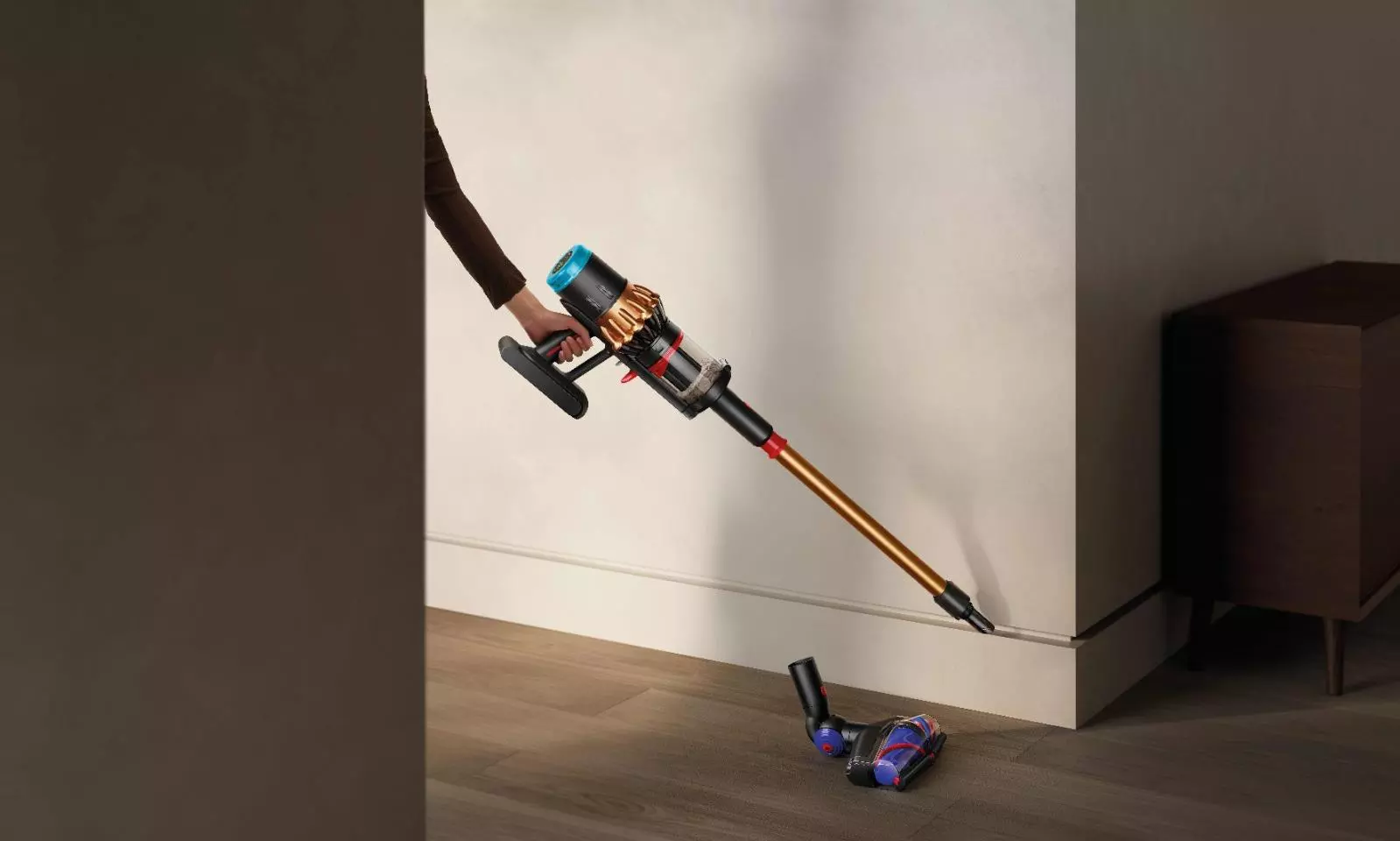
A vacuum cleaner is usually judged by a simple question: how much can it pick up? But designing one for the realities of a modern home involves a more complicated set of problems. Hair that wraps around a brush bar, the shift from a hard floor to a carpet, dust that cannot be seen and the mess left inside the bin all require different engineering solutions.
For Tim Hare, Design and Development Engineer, Floor Care, the starting point is not a specification sheet but the frustrations people encounter while cleaning.
“Our engineering ethos at Dyson, which is ingrained into every engineer, is that we want to solve real-day frustrations,” he says. For the V16, that meant rethinking three parts of the cleaning experience: dealing with hair, moving between different floor types and emptying the bin.
The first of those problems sounds simple until the engineering becomes visible. Hair does not merely sit on a brush bar. It wraps around it, builds up and eventually has to be pulled or cut away. The response was a new cleaner head built around two cone-shaped brush bars.
Dyson recently launched the V16 Piston AnimalTM cordless vacuum, Dyson’s most powerful anti-tangle cordless vacuum, designed to deliver uncompromising power, intelligent performance and effortless maintenance.
“The key engineering brief for the V16 was to rethink how we deal with hair, which led to the development of new anti-tangle technology,” Hare says.
Getting that principle to work reliably was considerably harder. “Getting those cone-shaped brush bars to reliably anti-tangle hair up to 25 inches long, with nothing left on the brush bar, was an immense engineering challenge that required a lot of fine-tuning,” he says.
Tim Hare, Design and Development Engineer.
The shape of the brush bars is central to the solution. As hair is picked up, the conical design encourages it to move towards the narrower outer ends, where it can be drawn directly into the bin rather than continuing to wind around the brush bar. The cleaner head is also designed to sense the surface beneath it and alter its operation accordingly.
That sensing is another departure from the traditional idea of a vacuum as a machine that simply applies the same cleaning action everywhere.
“We designed a new cleaner head called the All-Floors Sensing Cleaner Head. It measures pressure, current and the dust coming through the machine, and then adapts to best suit the needs of the individual surface,” Hare explains.
A hard floor, for instance, does not necessarily require the same treatment as a carpet. Hare says the machine reduces brush-bar speed and suction on hard floors, partly for acoustic reasons. When it detects a carpet, it increases both to provide deeper cleaning into the pile. The important part, he says, is that the adjustment happens automatically.
“The customer never has to change the cleaner head or manually adjust the settings. The machine simply knows what to do.”
This becomes particularly relevant in homes where different surfaces exist within the same cleaning session. Research conducted across markets identified hard floors as a predominant feature of Indian homes, alongside frequent transitions between rugs and areas that require cleaning both high and low.
“We therefore focused on making all of that functionality as seamless as possible,” Hare says. On moving from a hard floor to a rug, the user does not have to stop and change the cleaner head. The wand also incorporates a way to access a built-in crevice tool for cleaning higher areas and narrow spaces.
But the engineering problem does not end once dust has been picked up. What happens to it afterwards matters too.
“One of my favourite features is the Piston, which is where the name comes from,” Hare says. The mechanism inside the bin performs several functions. It compresses dust, allowing the bin to hold three times the volume of dust, while a wiper cleans the inside of the bin and the area around the sensor. During emptying, the piston pushes the waste out, reducing the need to reach into the bin to remove debris.
The idea reflects a broader shift in how cleaning appliances are being designed. Instead of focusing only on the moment when dirt is picked up, the engineering considers what happens before, during and after that process.
That is also why suction, on its own, is not the complete measure of cleaning performance. Hare points to the amount of material in a home that cannot be seen by the naked eye, including skin cells, dust mites and pollen.
“Raw suction power alone isn’t enough,” he says. Effective cleaning, he explains, involves the interaction between the cleaner head, cyclone technology, sealing and filtration. The objective is not simply to capture dust and debris but to prevent it from being redistributed into the surrounding environment.
That approach brings the engineering back to where Hare says it began: the everyday frustrations of cleaning. A tangled brush bar, an abrupt change in flooring, a difficult corner or a bin that is unpleasant to empty may seem like small inconveniences individually. Designing a machine that addresses all of them without requiring the user to constantly intervene is a considerably larger engineering exercise.
For Hare, that is ultimately what makes the V16 different from simply adding more power to a vacuum. The challenge, he says, was to make the machine respond to the home around it, rather than asking the person cleaning to continually respond to the machine.
