Tamil Nadu gets its ducks in a row Anti-Chironomus: Mission Possible

DC had on Thursday reported with pictures how Chironomus invaded Korattur and how it is giving sleepless nights to residents of the area.
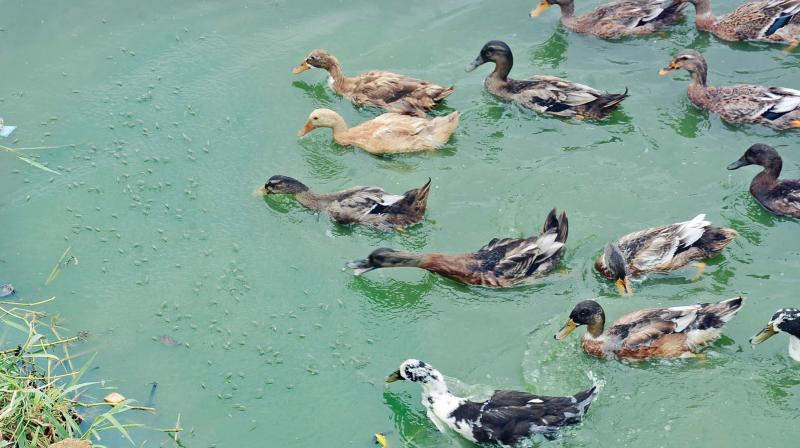
Chennai: A large percentage of insects, especially Chironomus that wrecked havoc in the area for the last few years, have been eliminated and efforts are on to ensure that they are completely eradicated, a day after 300 ducks were let into the water body based on a suggestion from Chief Minister J Jayalalithaa.
Korattur lake became the hotspot for senior officials of the health ministry and Chennai corporation for the second day on Monday the Deccan Chronicle report highlighting the problems caused by the invasion of Chironomus in the area created ripples.
Health minister C. Vijaya Bhaskar and health secretary J. Radhakrishnan inspected the area on Monday morning and directed officials and sanitary workers to ensure that insects don’t breed in the lake again.
“The situation came under control last night itself. Not only did the Greater Chennai corporation let ducks into the Lake, but they are also removing all the water hyacinth plants and ensuring that the overall hygiene of the area is improved,” Dr. Kolandaisamy, Director of Public Health, told Deccan Chronicle.
“Once the work was initiated, people were satisfied as they were able to move around freely,” added Dr. Kolandaisamy.
DC had on Thursday reported with pictures how Chironomus invaded Korattur and how it is giving sleepless nights to residents of the area. Though the insect does not cause any illness as such, it leads to lot of irritation if it comes near anyone.
Stating that the ducks will be in the lake permanently, deputy commissioner of health Mr Kannan said that it would take a day or two to usher in a complete change. With the insects known to breed during monsoons, the areas around the lake have been known to see the insects each year.
“Every year during this time we take precautionary measures. However, this year, the population of insects was alarming. The insects have now reduced drastically and we stayed on till beyond 8 on Sunday night to see to it that the nuisance had reduced,” said Mr Kannan.
The health secretary said he was doubtful as to what kind of a response they would see. “We saw that a majority of the insects had died. The adult mosquitoes are dying mainly due to the spraying. Work is also being done to remove organic materials, especially the water hyacinth,” he said.
The team has identified around 30 locations adjacent to the lake and expanded their activities. Though the PWD had earlier built a path near the lake for walkers, it was not being used, as it was not clean. However, officials said, with work being done to clean up the surroundings, in addition to the introduction of ducks into the lake, the path could soon attract residents and walkers.
“The only challenge for us is to ensure that the ducks are not stolen. The presence of these ducks is effective and therefore, in future also, there won’t be a threat. Efforts are also being made to ensure that the water is protected,” said Dr. Kolandaisamy.
The ducks, donated by the Tamil Nadu Veterinary and Animal Sciences University (Tanuvas) and other departments, were shifted immediately as an emergency. “We donated 104 ducks from our farm. They are now going to be under the control of Corporation. When we visited the lake on Monday morning, we found that the ducks had already adapted to the lake,” said Tanuvas vice chancellor Dr S. Thilagar.
TNAU experts coming to study lake
A team from the Tamil Nadu Agricultural University in Coimbatore will be here on Tuesday to conduct a detailed study about invasion of insects in the Korattur lake.
“Chironomus is a bug, which breeds in compost and waste material right after the rains. Each adult lays 3,000 eggs in the water and the adults come up after 7 pm, which is their mating time. Hence, the government has put up temporary lights,” said Dr Devanathan, professor and head, Plant Pathology Department, Information and Training Centre, Anna Nagar, Chennai.
Sumathy, an agricultural entomologist, from Tamil Nadu Agricultural University, will also be present for the study. Expert from the university, David Manohar, will be arriving on Tuesday morning.
A check has to be kept on the surrounding areas as the insects can be carried to other places based on the wind direction. “All the bushes are being removed from the surrounding areas. We have advised the corporation workers to spray the insecticide on the land area and not in the water. Also, sometimes, the Corporation workers tend to use an overdose of insecticides and therefore we have advised them to limit the usage to the recommended dose,” added Dr Devanathan.
