Critics attribute this change to the broader socio-political transformations following the abrogation of Article 370 on August 5, 2019-when J&K was also split up into two Union territories- J&K and Ladakh- and opened doors to linguistic pluralism.
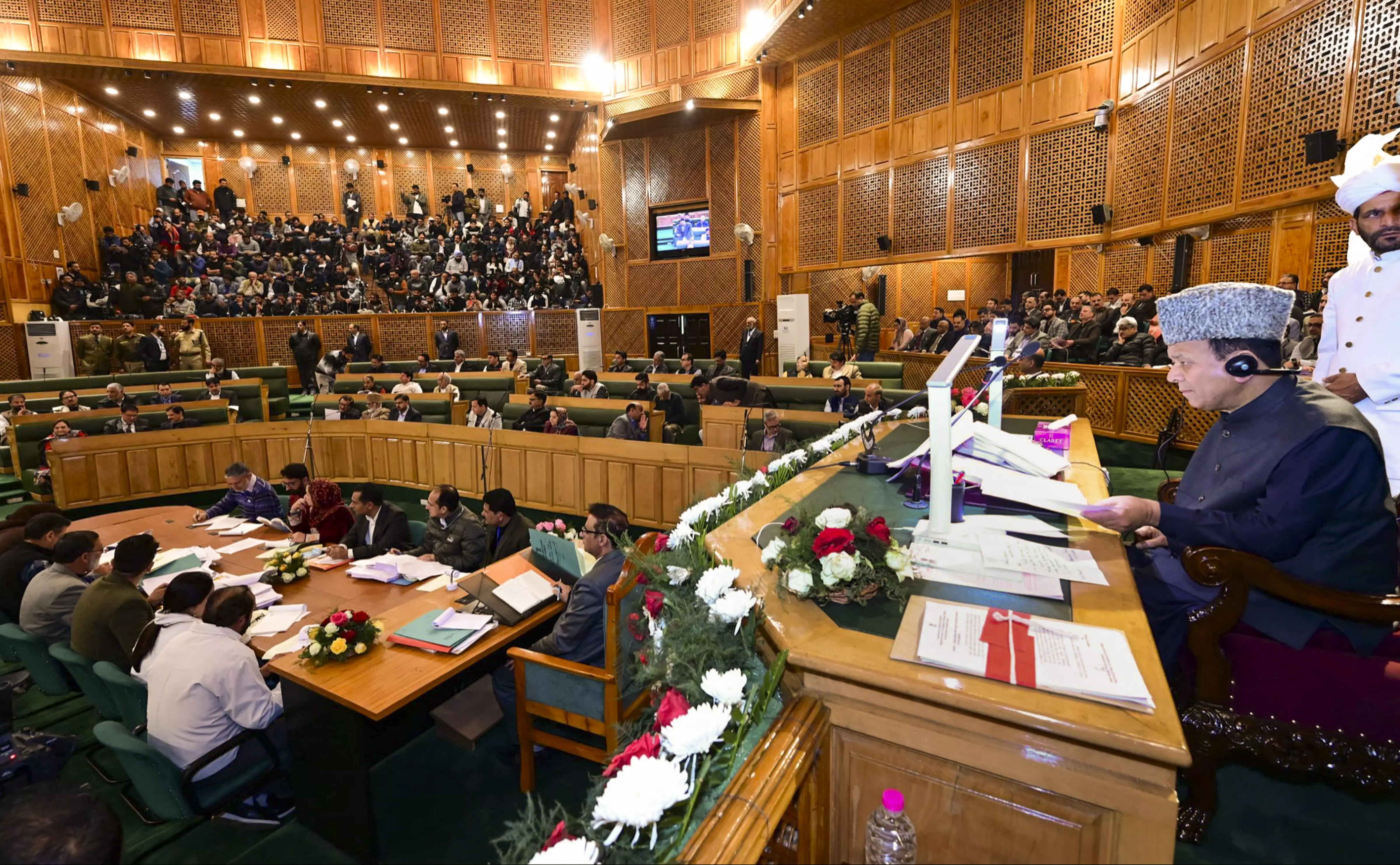
Srinagar: The autumn session of the Jammu and Kashmir Legislative Assembly which concluded on Friday highlighted a subtle but significant shift: the increasing use of Hindi into everyday proceedings. This evolution, observed even among non-Bharatiya Janata Party (BJP) members from the region's majority Muslim community, marks a departure from the historical dominance of Urdu, the primary language of the proceedings.
Critics attribute this change to the broader socio-political transformations following the abrogation of Article 370 on August 5, 2019-when J&K was also split up into two Union territories- J&K and Ladakh- and opened doors to linguistic pluralism. Analysts highlight a pivotal factor behind the growing adoption of Hindi—not only in the J&K Assembly but also among the general populace: the widespread influence of Hindi-language television channels and digital news portals.
During the weeklong session, lawmakers frequently peppered their speeches with Hindi words and phrases, articulating grievances, demands, and viewpoints on pressing issues. Terms like “maadhyam” (medium), “aavashyakata” (need), “aasha” (hope), “shraddhaalu” (devotee), “aapatti” (objection), “ashirwad” (blessing), “anurodh” (request), “kripya” (please), “Parivaar” (family), “Desh” (country), “Samay” (time), “paryaavaran” (environment), “durghaṭnā” (accident), “paksh mein” and “hith mein” (in favour), and “khed” (regret) became commonplace. This linguistic blend contrasted sharply with the past, when Urdu—J&K's sole official language until a few years ago—reigned supreme in such forums.
Speaker Abdur Rahim Rather stood out as a bastion of tradition, conducting proceedings and delivering statements primarily in chaste Urdu. However, not all members navigated the multilingual terrain smoothly. Instances of mangled pronunciations and inaccurate terminology arose when speakers toggled between Urdu, English, or a hybrid Hindustani (Urdu-Hindi mix), underscoring the challenges of this transitional phase.
A poignant irony emerged when the Speaker disallowed senior National Conference leader and former Speaker Mubarak Gul from addressing the House in Kashmiri—his mother tongue and one of India's 22 constitutionally recognised languages under the Eighth Schedule. The rationale? The absence of translation facilities into English, Hindi, or Urdu, which could leave many members, particularly from the Jammu region, unable to comprehend. Gul complied without protest, swiftly switching to Urdu, highlighting the practical barriers to full linguistic inclusivity.
The session also addressed misconceptions about Urdu's status. Responding to MLA Sheikh Khursheed Ahmad's query, the Minister in-charge of the Estates Department clarified in writing that Urdu signboards had not been removed from Civil Secretariat chambers in Jammu and Srinagar. Instead, trilingual boards featuring Urdu, English, and Hindi have been installed to promote uniformity and represent all official languages.
The minister emphasised that Urdu's continued presence eliminates any need for reinstallation. Simultaneously, the government outlined proactive steps to elevate Hindi. In a reply to BJP MLA Ranbir Singh Pathania, details emerged on implementing the J&K Official Languages Act, 2020. This landmark legislation expanded official languages from just Urdu (and English in practice) to include Kashmiri, Dogri, Hindi, and English.
The government said that key measures include trilingual digital initiatives with official websites and portals of various departments being revamped to support Urdu, English, and Hindi, enhancing accessibility and inclusivity. It said that all Hindi-received communications are responded to in Hindi-English format.
As per the reply, a 2022 committee's report on notifying specific areas for using these languages is under review, pending Finance Department clarifications. The government further stated that efforts are underway to encourage Hindi usage in government operations.
Assembly business can now be conducted in any of the five official languages, fostering a more inclusive environment. However, debates persist, particularly around job requirements. For instance, the mandatory Urdu proficiency for roles like Naib Tehsildar has faced legal scrutiny. A recent Central Administrative Tribunal (CAT) ruling affirmed that proficiency in any of the five languages suffices, aligning with the 2020 Act and challenging Urdu's exclusivity in certain domains.
Urdu's roots in J&K trace back to 1888, when Dogra ruler Pratap Singh replaced Persian—the lingua franca for centuries—with Urdu, influenced by Punjabi Hindu officials. This shift disrupted Kashmiri Pandits, proficient in Persian, but had minimal impact on Muslims due to shared Arabic script and their limited state service roles. Post-1947, under Sheikh Muhammad Abdullah's government, Urdu retained its status, enshrined in the J&K Constitution's Section 145 and echoed in the National Conference's 1944 Naya Kashmir manifesto, which positioned Urdu as a unifying link across regions and communities.
Over decades, English encroached on official work, diminishing Urdu's prominence. Recent demands, primarily from Kashmiri Pandits, to adopt the Devnagari script for Urdu have gained traction, with government sources indicating serious consideration.
The 2020 Act itself sparked controversy. Approved by the Union Cabinet over a year after J&K's reorganisation, it fulfilled “public demand,” according to then-Minister Prakash Javadekar. Yet, it drew criticism as an “anti-Urdu bias” driven by political motives, with legal experts arguing it violated Section 47 of the J&K Reorganisation Act, 2019, which reserves such decisions for the UT's Legislative Assembly.
While Urdu remains a cornerstone—fully recognised and widely used in J&K's government and assembly—the 2020 Act symbolises a move toward multilingualism, reflecting India's diverse linguistic heritage. Proponents hail it for inclusivity, bridging Jammu's Hindi-Dogri speakers with the Valley's Urdu-Kashmiri users. Detractors, however, view it as eroding cultural identities in the Valley.
In a related development, Ladakh—carved out as a separate UT in 2019—saw its own linguistic update in June this year. The President promulgated the Ladakh Official Languages Regulation, 2025, declaring English, Hindi, Urdu, Bhoti, and Purgi as official languages. English continues as the default for official purposes, ensuring continuity while embracing regional tongues like Bhoti and Purgi.
As J&K navigates this linguistic evolution, the balance between tradition and progress will shape its future discourse. The Assembly autumn session's Hindi infusions may signal a new era of hybridity, where languages coexist not just on signboards but in the hearts and voices of its people.

