Gadkari Marks Zojila Tunnel Breakthrough, Bringing All-Weather Access to Ladakh Closer

Zojila Tunnel Breakthrough Nears All-Weather Kashmir-Ladakh Link
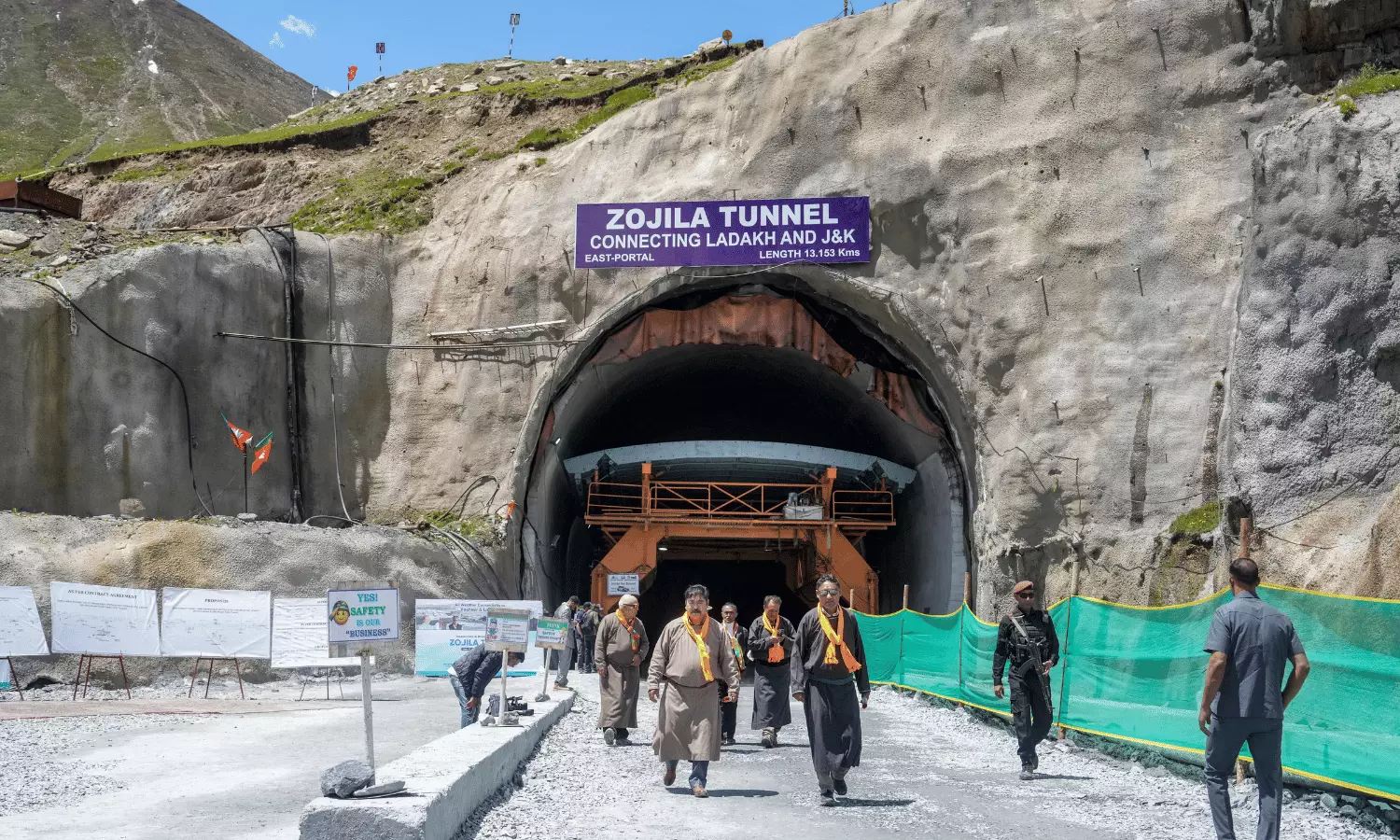
Srinagar: Union Minister for Road Transport and Highways Nitin Gadkari on Tuesday marked a major milestone in the Zoji(la) Tunnel project by triggering the final breakthrough blast, an achievement that brings all-weather road connectivity between the Kashmir Valley and Ladakh significantly closer to reality. The ceremony, held near the tunnel’s eastern portal at Minimarg in Ladakh, was attended by Jammu and Kashmir Lieutenant Governor Manoj Sinha and Chief Minister Omar Abdullah.
The breakthrough came after a controlled blast pierced the final 2.5 metres of rock, connecting the two ends of the main tunnel after years of excavation through one of the Himalayas’ most challenging stretches. Officials said the milestone was achieved six months ahead of schedule, underscoring the scale of progress in a project regarded as one of India’s most ambitious strategic infrastructure ventures.
Built at an altitude of around 11,578 feet, the horseshoe-shaped, single-tube, two-lane tunnel measures 13.153 kilometres in length, 9.5 metres in width and 7.57 metres in height. Executed by Hyderabad-based Megha Engineering and Infrastructure Ltd (MEIL) for the National Highways & Infrastructure Development Corporation Ltd, the project forms the core of a wider corridor linking Baltal in Kashmir Valley with Minimarg in Ladakh through approach roads and supporting structures.
Once operational, the tunnel will bypass the avalanche-prone Zojil(a) Pass located at an altitude of approximately 3,528 meters (11,575 feet) above sea level, which remains cut off by heavy snowfall for several months each winter, and is expected to reduce travel time across the stretch from about 1 to 1.5 hours to nearly 15 minutes. The project is therefore expected to transform civilian movement, strengthen supply chains, improve access to healthcare and education, and significantly enhance military logistics in a strategically sensitive border region.
Gadkari described the achievement as a defining chapter in India’s infrastructure journey and said the tunnel would serve as a lifeline for J&K and Ladakh by ensuring seamless connectivity through the year. He said the project, built to global safety standards despite difficult geology, severe cold and frequent weather disruptions, reflected the determination of engineers, workers and executing agencies who sustained work in extreme high-altitude conditions.
He also highlighted the project’s regional impact, saying it would boost tourism, facilitate trade and generate wider economic activity across the Himalayan belt. According to project officials, nearly 80 per cent of the workforce has been drawn from local areas, giving the project an important employment and community participation dimension alongside its engineering and strategic value.
Officials said about 85 per cent of the overall work has been completed. With excavation now concluded, the project will move into the next phase of civil finishing and systems installation, including concrete lining, ventilation, lighting, drainage and safety infrastructure. The tunnel is expected to be opened to the public in February 2028 after the remaining civil and electrical works are completed.
Engineers have used the New Austrian Tunnelling Method, which is considered particularly suitable for fragile Himalayan geology because it allows excavation and support systems to adapt to changing ground conditions. Despite the risks posed by unstable rock, water ingress and avalanches, the project has maintained a strong safety record and stands out as a major feat of endurance and technical execution.
Speaking at the event, Lieutenant Governor Sinha said the breakthrough would help secure seamless, all-weather connectivity between J&K and Ladakh, while Chief Minister Abdullah said the tunnel would ease long-standing hardships caused by the seasonal closure of the Zoji(la) axis and bring tangible benefits to students, patients, traders and travellers across the region.
Gadkari also announced a fresh set of road initiatives for Ladakh, including the Leh South Bypass, the Leh North Bypass, the proposed Fatu La twin-tube tunnel and progress on the Tela Pass Tunnel project, while reiterating the Centre’s broader push to improve year-round access to remote and strategically important border areas.
With the excavation phase now complete, the Zoji(la) Tunnel has moved from aspiration to near reality. More than just an engineering achievement, the breakthrough marks a decisive step towards ending Ladakh’s winter isolation and strengthening connectivity, resilience and opportunity across the wider region.
