From Farmer To Agri-Entrepreneur: How Odisha’s Santosh Mishra Is Transforming Sugarcane Farming In Koraput

What started as conventional farming on a modest landholding has grown into a 68-acre sugarcane operation with an annual turnover of nearly Rs 7 crore: Reports
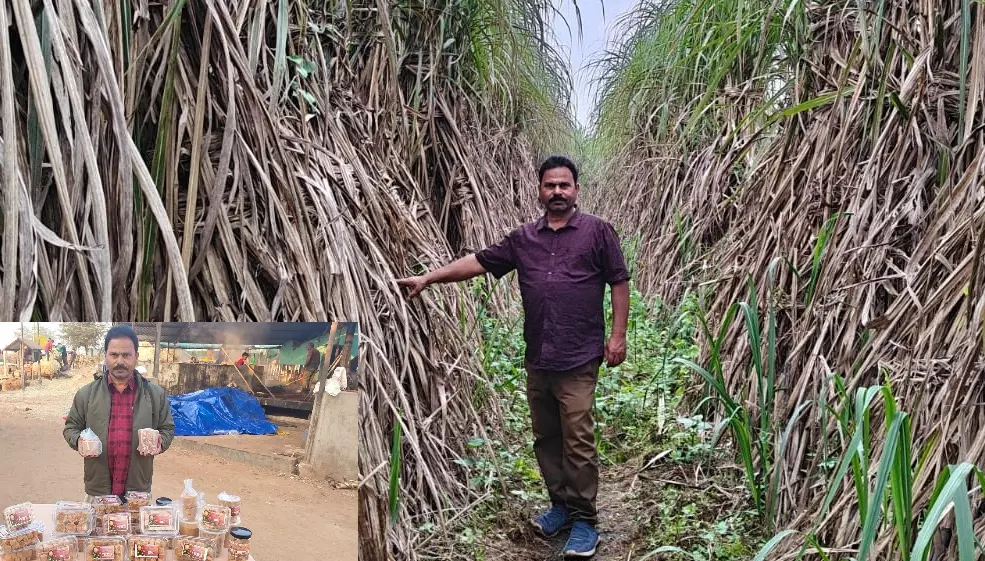
KOTPAD: In the agricultural heartland of Odisha's Koraput district, Santosh Mishra of Asana village under Kotpada block has emerged as a remarkable example of how innovation, scientific farming and entrepreneurship can transform traditional agriculture into a thriving business enterprise.
What started as conventional farming on a modest landholding has grown into a 68-acre sugarcane operation with an annual turnover of nearly Rs 7 crore. His success is inspiring hundreds of farmers across the region to view agriculture not merely as a means of livelihood but as a profitable enterprise.
The turning point in Santosh's journey came when two borewells installed by Odisha Lift Irrigation Corporation (OLIC) Ltd provided assured irrigation. With reliable water access, he expanded cultivation to 23 acres of owned land and 45 acres taken on lease. He adopted scientific farming techniques, including drip irrigation and fertigation systems powered by 5 HP submersible pumps, ensuring efficient use of water and nutrients.
Committed to sustainable agriculture, Santosh recycles decomposed sugarcane trash and compost to reduce dependence on chemical fertilizers. He has also introduced drone technology for selected farm operations, demonstrating the potential of modern tools in traditional farming.
Recognising the growing demand for quality planting materials, Santosh diversified beyond crop production. Over the years, he developed a collection of 17 to 18 elite sugarcane germplasm varieties sourced from leading research institutions in Tamil Nadu, Maharashtra and Andhra Pradesh. Today, he is among Odisha's largest suppliers of sugarcane planting materials for both government programmes and private farmers.
He has distributed more than 40 lakh sugarcane plantlets across the state and consistently achieves yields of around 80 tonnes per acre, well above the state average. His crop also records a sucrose content of 14–15 percent, making it ideal for value-added processing. During the current season alone, he reportedly sold sugarcane plantlets worth Rs 2.75 crore.
Understanding that greater profits lie in value addition, Santosh established the Maa Bhagabati Sugarcane Crusher unit with government support. The unit produces around 8,500 quintals of organic jaggery and related products annually, including traditional jaggery, organic ginger jaggery and premium jaggery cubes. These products are marketed within Odisha and in several other states.
The impact of Santosh's success extends far beyond his own farm. Through contract farming arrangements, he now oversees nearly 300 acres of sugarcane cultivation involving numerous farmers. By providing quality planting materials, technical guidance and market linkages, he has helped create a network of growers adopting improved varieties and scientific cultivation practices.
According to estimates, his cultivation cost is around Rs 80,000 per acre while generating a net profit of nearly Rs 2 lakh per acre annually.
Dr. Sarba Narayan Mishra, Professor and Head of Agricultural Economics at OUAT, Bhubaneswar, believes Santosh's model demonstrates how irrigation, technology and value addition can make farming highly profitable. More importantly, he says, the model creates opportunities for hundreds of other farmers through technology transfer and market integration.
"Santosh Mishra has shown that agriculture can become a highly profitable enterprise when scientific crop management, quality planting materials and market-oriented value addition are integrated into a single business model. His achievements challenge the traditional perception that farming is a low-income occupation," Dr. Mishra observed.
As Odisha seeks to promote agribusiness and increase farm incomes, Santosh Mishra's journey from a village farmer to a multi-crore agri-entrepreneur stands as a powerful blueprint for the future of agriculture in the state.
