Four Hours of Chess a Week Sharpens Young Minds, Says Viswanathan Anand
Chess Mahakumbh’ at KIIT University draws global participation, marks a first for India
Bhubaneswar: Playing chess for as little as four hours a week can significantly help students structure their thoughts and improve academic performance, India’s chess icon Viswanathan Anand said here on Wednesday, underlining the growing relevance of the cerebral sport in education.
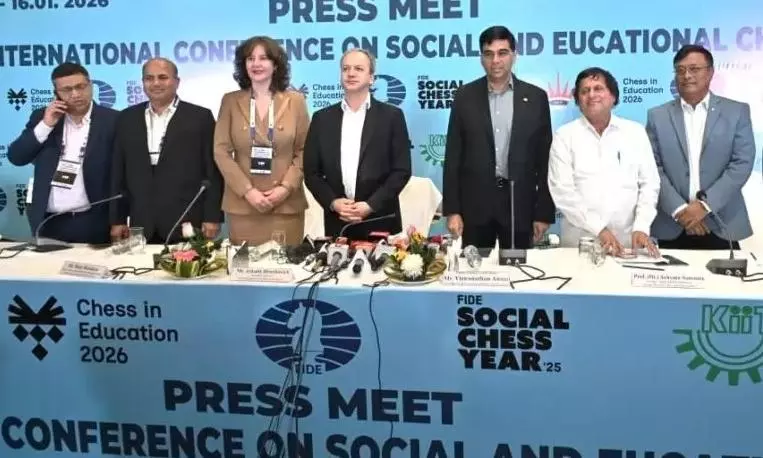
Inaugurating the International Conference on Social and Educational Chess, titled ‘Chess Mahakumbh’, at KIIT University, the five-time world champion described chess as a versatile learning tool capable of benefiting diverse sections of society.
“Chess promotes structured thinking,” Anand told mediapersons, dismissing the long-held perception of chess as a “royal game” and noting that it has increasingly become a game of the masses.
Emphasising its educational value, Anand observed that students who regularly play chess often demonstrate better academic outcomes. While acknowledging that chess remains largely urban-centric, he stressed that technology—particularly mobile phones—has enabled the game to reach rural and remote areas.
“Statewide tournaments and organised initiatives can help popularise chess at the grassroots,” he said, also citing innovative programmes that use chess in social development, including within prisons.
International Chess Federation (FIDE) President Arkady Dvorkovich said chess cultivates critical life skills and cognitive abilities that are difficult to acquire through other disciplines. “It is a powerful instrument for knowledge-building and personal growth,” he remarked.
FIDE Deputy Chair Dana Reizniece echoed the sentiment, stating that the objective was not to create the next Viswanathan Anand, but to help children become “champions of their own lives”.
She noted that chess supports learning in logic, mathematics and languages, particularly at the early education stage. Citing a 2021 global survey, she said over 25 million children worldwide were engaged in chess-based education and called for doubling that number, with KIIT University playing a proactive role. She also proposed developing a university-level academic programme centred on chess.
KIIT and KISS founder Dr Achyuta Samanta termed the event historic, noting that it was the first time such a prestigious global chess conference was being hosted in Odisha. He highlighted chess’s unique ability to break social barriers, adding that thousands of tribal students at KISS actively play the game.
Being held from January 14 to 16 with the support of FIDE and the All India Chess Federation (AICF), the conclave has drawn eminent chess personalities from over 40 countries, along with more than 5,200 participants. The inaugural day also saw the launch of the International Chess Hall and the Viswanathan Anand Chess Academy at KIIT, reinforcing the university’s commitment to promoting chess at both grassroots and global levels.
