Interacting with reporters in Amritsar, Chouhan said Punjabis have always been at the forefront when it comes to serving the country and humanity.
New Delhi: Flood situation in North India continues to remain grim as severe cities, villages and farm areas continued to remain submerged in water on Thursday as well. Situation was particularly bad in Punjab that has suffered the maximum wrath of the rain and flood, particularly due to water discharge from Bhakra and Pong dams
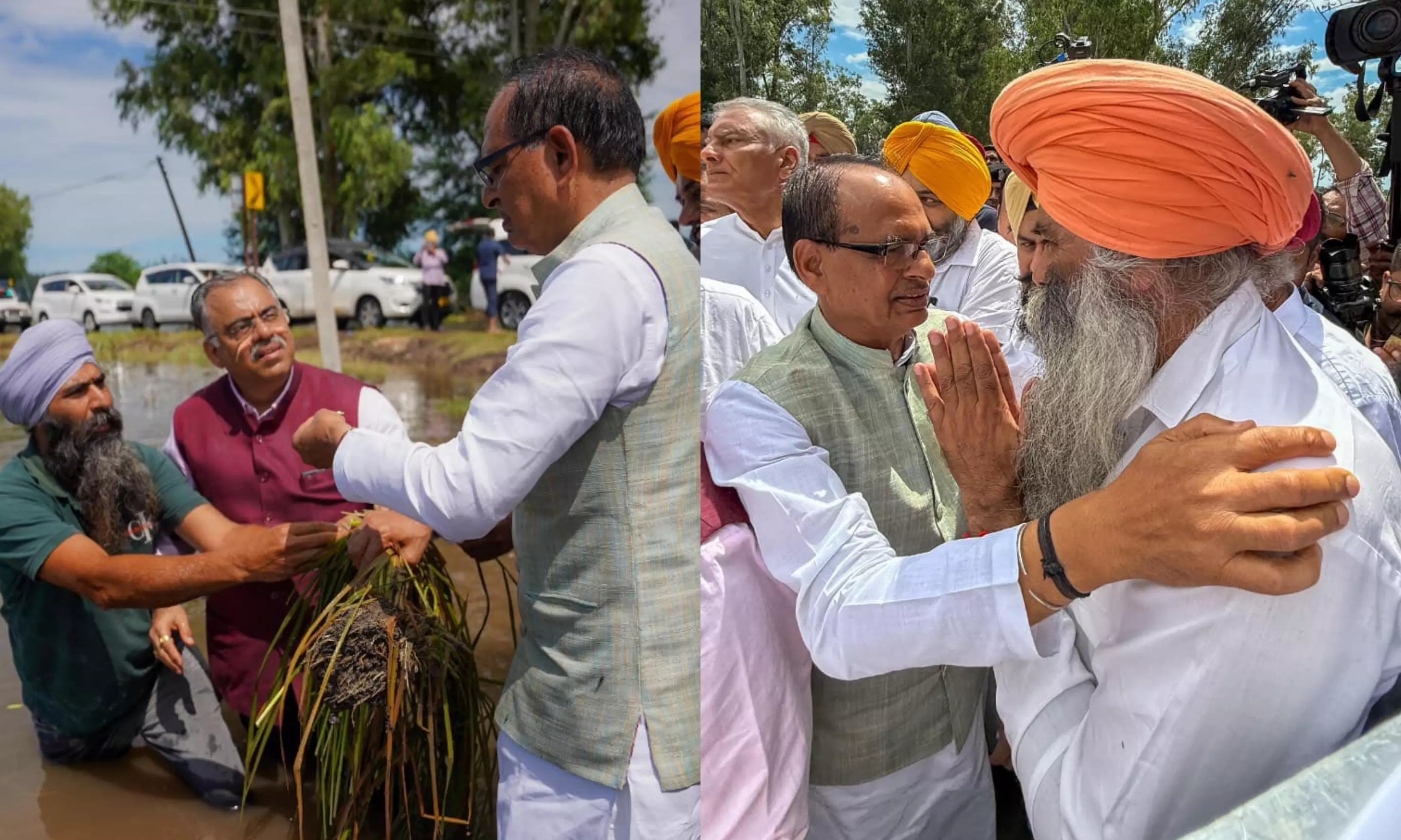
As people of the state stand together to brace the natural calamity, Union Agriculture and Farmers Welfare Minister Shivraj Singh Chouhan on Thursday visited flood-hit areas in Punjab's Amritsar and Gurdaspur districts, where he interacted with people, including farmers, affected by the deluge. Riding a tractor, Chouhan entered an inundated field in Gurdaspur and got a first hand experience of the calamity as he checked the paddy crops damaged by the floodwater.
Interacting with reporters in Amritsar, Chouhan said Punjabis have always been at the forefront when it comes to serving the country and humanity. "But today, Punjab is facing a difficult time due to floods and several villages are impacted, disrupting normal life. Loss is visible. The crop is completely damaged. Fields are inundated. The Centre fully stands with the people of Punjab in this difficult hour. I have been sent to Punjab by the Prime Minister. We will take stock of the situation, talk to the people," he said.
He further said the silt that the Ravi River brought has been deposited in fields, and there will be a crisis for the next crop. However, he said the government would do everything for farmers and people. Earlier, Governor Kataria submitted the report on the flood situation in Amritsar, Pathankot, Gurdaspur, Tarn Taran, and Ferozepur districts, officials said.
Officials from various departments are part of these central teams, including agriculture, rural development, roads, energy, finance and Jal Shakti are also touring the state. They will assess the situation and give a detailed report to the Centre amid demand from Opposition for special relief package for flood hit states. Punjab Agriculture minister Gurmeet Singh Khuddian and MLA Kuldeep Singh Dhaliwal met Chouhan and submitted a memorandum to him, seeking Rs 2,000 crore as financial assistance in the first phase for the losses caused by floods in the Ajnala assembly constituency. They also demanded the release of the state's "pending" Rs 60,000 crore from the Centre.
With the Bhakra dam around one foot short of its maximum capacity of 1,680 feet, the Rupnagar administration of Punjab on Thursday issued an alert, urging people near the Sutlej river to move to safer places. The water level in the Pong dam, on the Beas river, touched 1,394.51 feet, four feet above its upper limit capacity of 1,390 feet. Even as people in the state struggled to stitch up their own lives, visuals of people saving drowning animals, both domestic and wild, filled social media.
Punjab is currently facing one of its worst flood disasters in decades. The floods are a result of swollen rivers, the Sutlej, Beas, and Ravi, along with seasonal rivulets caused by heavy rainfall in their catchment areas in Himachal Pradesh and Jammu & Kashmir. Additional heavy rains in Punjab have intensified the flooding situation, aggravating the challenges faced by residents. The deluge has claimed 37 lives so far and impacted over 3.55 lakh people, and crops over 1.75 lakh hectares of land have perished in the floods,.
Centre has also deputed an inter-ministerial team to assess the scale of damage in Jammu Kashmir as administration intensified restoration work and debris clearance in low-lying areas of Jammu city following flooding in the Tawi river, and has considerably restored water and power supply in the affected areas. The focus at present remains to repair damaged roads, power infrastructure, and restore water supply. Disaster relief teams were working to rescue people from Anantnag and Budgam areas where flooding took place after breach of Jhelum bund affecting several villages. Nearly 200 families have been evacuated from these areas.
Water also entered houses of Haryana where close to 2000 villages are reeling under flood. In Delhi floodwaters reached near Delhi Secretariat, which houses the offices of the chief minister, cabinet ministers and key bureaucrats. Areas near Vasudev Ghat were also flooded. In low-lying areas like Mayur Vihar Phase I, even some relief camps were inundated.
Meanwhile, taking note of the unprecedented landslides and floods in states such as Himachal Pradesh and Uttarakhand, the Supreme Court on Thursday sought responses from the Centre, National Disaster Management Authority (NDMA) and others while observing illegal felling of trees led to the disasters.
Observing that a balance ought to be struck between “development and environment”, a two-judge bench of Chief Justice of India B R Gavai and Justice K Vinod Chandran also issued notices to the Union Ministry of Environment, Forest and Climate Change, the National Highway Authorities of India as well as the governments of Himachal Pradesh, Uttarakhand, Jammu and Kashmir and Punjab.
“We have seen unprecedented landslides and floods in Uttarakhand, Himachal Pradesh and Punjab. From the media reports it is noticed that in the flood a huge number of wood was flowing along. Prima facie it appears that there has been illegal felling of trees. Thus issue notice to respondents,” the CJI said.
The CJI told Solicitor General Tushar Mehta: “Please take note of this. It appears to be a serious issue. A large number of wooden logs are seen to be falling around… it shows illegal felling of trees. We have seen pictures of Punjab. Entire fields and crops are inundated…Development has to be balanced with mitigating measures.”
Mr Mehtra responded saying, “We have interfered with nature so much...That nature is giving back now. I will speak to the secretary of the environment ministry today itself and he will speak to the chief secretaries (of the states).”

