Farooq, Mehbooba Clash Sparks Fresh Debate Over Ladakh and J&K’s Future

Abdullah responded to PDP's Mehbooba Mufti by referencing the Dixon Plan's history, claiming that calls for new administrative divisions are politically driven and harm regional unity.
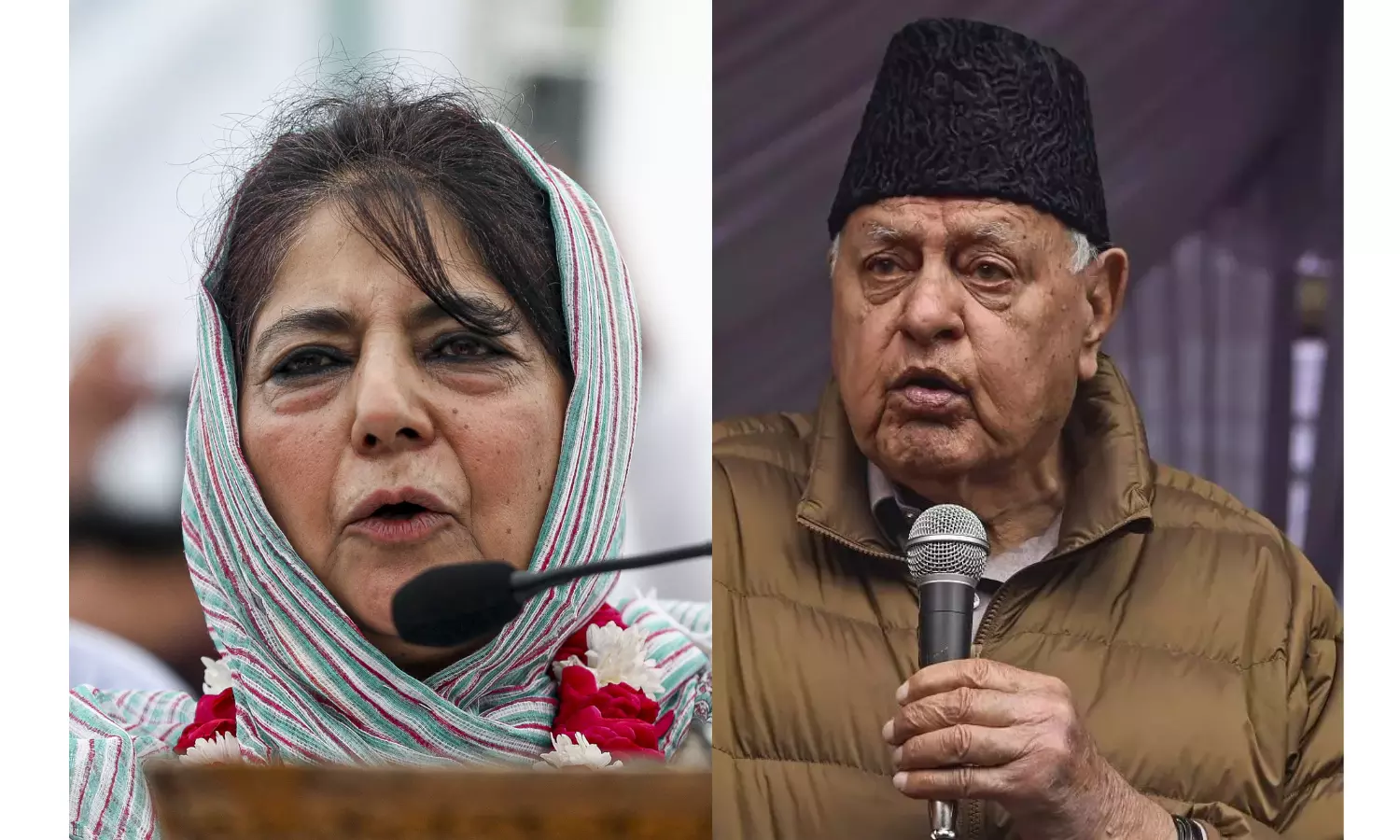
Srinagar: Former Chief Minister and National Conference (NC) president Farooq Abdullah on Tuesday reiterated that Ladakh would eventually seek reunification with Jammu and Kashmir, arguing that public dissatisfaction in the Union Territory has grown since its separation in 2019.
Speaking to reporters in Jammu, he said people in Ladakh increasingly regret the decision and are voicing their desire to rejoin the erstwhile state. Abdullah dismissed demands for separate statehood for Jammu as misguided and warned that fragmenting regions for political convenience would weaken J&K’s unity. He also rejected PDP chief Mehbooba Mufti’s call for new districts in Pir Panjal and Chenab Valley, alleging that such proposals echo attempts to revive the Dixon Plan—an idea he said will never be acceptable.
The Dixon Plan- also known as the Dixon Proposal- was a mediation effort in 1950 by Sir Owen Dixon, an Australian jurist and former Chief Justice, appointed as the United Nations Representative for India and Pakistan to resolve the Kashmir dispute.
The Dixon Plan offered a targeted alternative to a full statewide plebiscite by acknowledging that Jammu and Kashmir was a diverse and non‑uniform region. It proposed that areas with clear preferences—such as the Hindu‑majority plains of Jammu and the Buddhist‑majority regions of Ladakh—be assigned to India without a vote, while territories evidently aligned with Pakistan, including Azad Kashmir (PoK) and the Northern Areas (now Gilgit‑Baltistan), be allocated to Pakistan outright. The remaining mixed belt of Jammu would be divided along demographic lines, with the Chenab River often cited as a natural boundary: Muslim‑majority areas to the west potentially going to Pakistan, and Hindu‑majority areas staying with India.
As per this plan, the central zone of uncertainty—the Kashmir Valley and possibly adjoining areas near Muzaffarabad—would then face a UN‑supervised plebiscite to choose between India and Pakistan, with no provision for independence. This vote would follow complete demilitarisation of the plebiscite area to ensure neutrality. The proposal sought to break the deadlock but was ultimately rejected by both India and Pakistan.
Mufti, meanwhile, pressed the NC to clarify its stand on granting divisional status to Pir Panjal and Chenab Valley, insisting the demand stems from administrative necessity rather than political motives. She argued that both regions suffer from difficult terrain, environmental vulnerability, and chronic neglect, making decentralised governance essential. Former chief minister accused both the NC and BJP of criticising the PDP for raising legitimate concerns, calling it ironic given their own history of political divisions.
Drawing a historical parallel, she reminded Abdullah his father Sheikh Muhammad Abdullah’s alleged support for the Dixon Plan had once led to his arrest, adding that genuine demands are again being unfairly labelled as divisive. She further accused the BJP of weakening Pir Panjal and Chenab Valley through delimitation driven by electoral interests rather than public welfare.
Abdullah, responding to various criticisms, questioned Mufti’s record on unemployment during her tenure and reiterated that the NC has always stood firmly with India, even at great personal cost. He rejected allegations that his party fuels unrest and said those making such claims should examine their own actions. He also ruled out any need for new districts or administrative divisions, maintaining that Jammu, Kashmir, and Ladakh form a natural whole.
On foreign policy, Abdullah said India’s relationship with US President Donald Trump remains strong and expressed hope that global tensions would ease. He added that dialogue with Pakistan cannot be dismissed, recalling Atal Bihari Vajpayee’s reminder that neighbours cannot be changed. Abdullah also criticised sections of the media for what he described as “Pakistan phobia,” arguing that no single country holds a monopoly on reckless behaviour.
As political exchanges intensified, BJP leader Bali Bhagat accused Abdullah of selective outrage and political hypocrisy, arguing that his recent remarks that it (BJP) was fostering a Hindu‑Muslim divide were an attempt to deflect from his own legacy.
Responding to Abdullah’s claim that a “fire of hatred” was being spread for electoral gain, Bhagat, a former minister, said Abdullah lacked the moral authority to speak on communal harmony, arguing that some of the worst communal ruptures in J&K occurred during his tenure.
Bhagat alleged that Abdullah was targeting the BJP to deflect attention from the NC’s role in the marginalisation and forced exodus of Kashmiri Pandits, which he said shattered centuries of coexistence in the Valley. He claimed that threats, selective killings, and fear‑driven migration took place under NC rule, calling it the real blow to unity rather than the narrative Abdullah now presents.
Criticising Abdullah’s frequent references to Pakistan, Bhagat said invoking Islamabad had become his standard response whenever questioned on governance or past failures. He argued that Abdullah’s shifting positions on dialogue and tensions with Pakistan reflected inconsistency, while the BJP maintained a firm stance on national security and terrorism. Bhagat added that Pakistan’s involvement in militancy was an undeniable reality and accused Abdullah of making statements that diluted external accountability.
Calling Abdullah’s remarks on Hindu‑Muslim unity a calculated political move, Bhagat said the NC leader was attempting to revive his shrinking political base. He asserted that the BJP stands for inclusive development and equal rights for all communities, and that communal harmony is built through justice and accountability, not rhetoric. Bhagat concluded that efforts to deflect blame by labelling the BJP as communal would not succeed, insisting that the NC’s role in some of Jammu and Kashmir’s most difficult periods cannot be obscured.
Despite the criticism, Abdullah maintained that the NC remains committed to safeguarding J&K’s unity and identity.
Responding to accusations the NC and PDP thrive on instability, Abdullah said such claims were absurd. He asserted that those pointing fingers should “look at themselves,” reiterating that the NC had “faced bullets to remain with India.”
