Explainer: Why New Mining Law Has Sparked Centre-State Showdown

26 Nov 2026 11:11 PM IST26 Nov 2026 11:11 PM IST
States argue that while Parliament has authority over the regulation of mines and mineral development, that authority cannot automatically extend to overriding their constitutional powers over land and taxation.
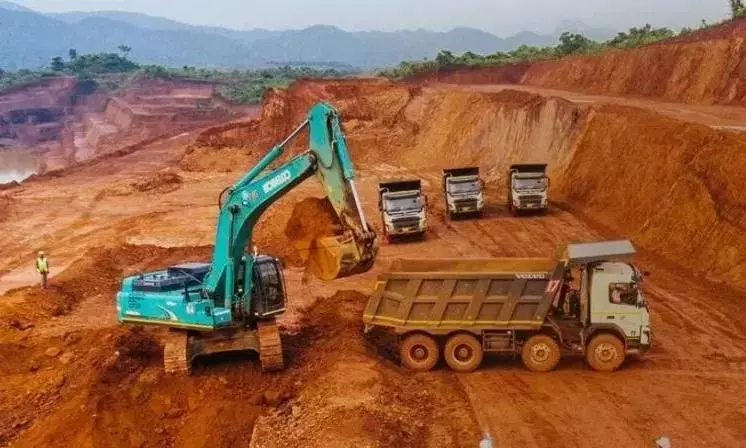
Representational Image
New Delhi: A fresh confrontation has erupted between the Centre and mineral-rich states over changes to mining law, with Jharkhand becoming the latest state to demand its withdrawal, warning that the legislation could strip it of a significant source of revenue and undermine its fiscal autonomy.
Chief Minister Hemant Soren on Thursday moved a resolution in the Jharkhand Assembly seeking the withdrawal of the amended Mines and Minerals (Development and Regulation) Act, 2026, estimating that the state could lose nearly Rs 13,000 crore annually. He argued that the changes would weaken its ability to finance welfare and development programmes, particularly in mining-affected areas.
The dispute goes beyond the immediate question of revenue. It has reopened a constitutional debate over the division of powers between the Centre and states, coming just two years after the Supreme Court recognised the states' authority to tax mineral rights and mineral-bearing land.
What Has The Centre Changed?
Parliament passed the Mines and Minerals (Development and Regulation) Amendment Bill, 2026, on August 13, amending the Mines and Minerals (Development and Regulation) Act, 1957, which governs the country's mining sector.
The legislation seeks to establish a more uniform fiscal framework for major minerals by restricting the ability of states to impose taxes, cesses and other levies on mineral rights and mineral-bearing land, except under conditions prescribed by the Centre.
It also expands the Centre's regulatory remit to cover mineral-bearing land, defined according to mineral-content parameters prescribed under the law.
A key provision, Section 9D, bars states from independently imposing such levies, whether calculated on the basis of mineral quantity, value, royalty or other criteria, unless permitted under conditions set by the Union government.
Unpaid or uncollected dues from certain earlier state levies are also rendered invalid, although amounts already deposited or recovered are not subject to refund.
States have historically used their powers over land and mineral rights to raise additional revenue from mining operations, over and above royalties and other statutory payments.
Why Are States Objecting?
The immediate flashpoint is the Supreme Court's July 2024 ruling in the Mineral Area Development Authority versus Steel Authority of India case.
In a landmark decision by a nine-judge Constitution Bench, the court held by an 8-1 majority that royalty paid under the MMDR Act was not a tax and that states had the constitutional authority to levy taxes on mineral rights and mineral-bearing land.
The ruling recognised the states' powers under Entries 49 and 50 of the State List of the Constitution's Seventh Schedule. It also held that the existing MMDR Act did not restrict those powers.
The judgment potentially opened up a substantial new revenue stream for mineral-rich states, including through levies on the value or quantity of minerals extracted. It also allowed states to pursue certain past dues, subject to the court's directions on the period and manner of recovery.
The 2026 amendment has effectively sought to place new statutory restrictions on the exercise of those powers.
States argue that while Parliament has authority over the regulation of mines and mineral development, that authority cannot automatically extend to overriding their constitutional powers over land and taxation.
The legal distinction is important. The Supreme Court recognised Parliament's ability to limit state taxation of mineral rights under Entry 50, but separately held that the power did not extend to state taxation of land under Entry 49. The amendment's treatment of mineral-bearing land therefore, raises particularly significant constitutional questions.
Which States Are Opposing?
Jharkhand's opposition is among the most consequential because of its dependence on mining revenues.
Jharkhand: Soren says the state currently collects around Rs 13,000 crore annually through cesses on mineral rights and mineral-bearing land. He argues that the amendment would prevent it from imposing such levies, putting welfare spending, social security, healthcare, education and rural development programmes at risk. The Assembly's resolution seeks the law's withdrawal.
Kerala: Chief Minister V.D. Satheesan has criticised the legislation as an encroachment on states' constitutional rights over land. He has argued that bringing mineral-bearing land under greater central control threatens the federal division of powers, particularly given Kerala's mineral resources, including coastal and rare-earth deposits. The state has indicated it will communicate its objections to the Centre.
Karnataka: Deputy Chief Minister G. Parameshwara wrote to Prime Minister Narendra Modi and Union Mines Minister G. Kishan Reddy on August 18, urging the Centre to withdraw or reconsider the legislation. He argued that the amendment restricts the states' constitutional fiscal powers and called for structured consultations with mineral-producing states.
Odisha: The legislation has also triggered a political confrontation in the mineral-rich state. BJD president and former chief minister Naveen Patnaik has accused the Centre of taking away Odisha's constitutional rights over mineral-bearing land and its authority to levy cess on mining. Former Union minister Dharmendra Pradhan has rejected the criticism, accusing the previous BJD government of favouring private mining interests. The exchange has turned the issue into a political contest between the BJP and BJD.
What Is The Centre's Defence?
The Union government says the amendment is intended to prevent unpredictable and overlapping state-level levies from making mining commercially unviable.
Mines Minister Reddy has maintained that the legislation applies to major minerals and does not dilute states' existing powers over minor minerals. He has also said the Centre has no intention to take away states' rights over land or minerals.
The government's argument is that mining requires large upfront investments and long project timelines. Unanticipated taxes, multiple levies and differences in state-level taxation can raise extraction costs, discourage investment and make domestic minerals less competitive than imports.
The Centre says a predictable fiscal regime would encourage investment, increase domestic production and ultimately expand revenues for states.
It has also argued that states will continue to receive the bulk of mining-sector revenues through royalties, auction premiums, District Mineral Foundation contributions and their share of Goods and Services Tax.
According to government figures, states now receive around 90 per cent of mining-sector revenue, with their share of total mineral revenue, including coal and non-coal minerals, reaching approximately Rs 1.14 lakh crore in 2025-26. The Centre says this broad revenue-sharing arrangement will remain unchanged.
The government has cited a rise of more than 350% in state mineral revenues over the past decade and said states have collectively received more than Rs 7 lakh crore from the sector since the auction regime began in 2015.
What Is At Stake?
The controversy has three major dimensions.
First is the fiscal impact. For states such as Jharkhand and Odisha, mineral revenues are an important source of funds for infrastructure, public services and welfare programmes. Their concern is not simply that an existing revenue stream could shrink, but that they may lose the ability to create additional levies when mineral production and prices rise.
The Centre, however, disputes the premise that the amendment will reduce overall state revenues, arguing that royalties, auction premiums and other statutory receipts will remain intact and that greater investment will expand the revenue base.
The competing estimates also need to be viewed carefully: Jharkhand's Rs 13,000 crore figure represents the state's assessment of the revenue at risk from the restrictions, not an independently established estimate of the amendment's net impact on its overall finances.
Second is the question of federalism. The legislation tests the boundaries between Parliament's authority to regulate mines and mineral development and the states' constitutional powers over land and taxation. If the Centre can prescribe conditions for state levies on mineral-bearing land, states fear that the precedent could extend beyond mining and weaken their fiscal autonomy in other areas.
The legal challenge is particularly significant because the Supreme Court's 2024 judgment had explicitly distinguished between the states' power to tax mineral rights and their power to tax land. Whether the new law can validly restrict both will be central to any constitutional challenge.
Third is the future of India's mining industry. The Centre wants to reduce import dependence, attract investment and secure domestic supplies of minerals critical to manufacturing, defence, infrastructure and the energy transition. A more predictable tax structure could help achieve those goals. But states argue that investment certainty cannot come at the expense of the constitutional rights of the regions where the resources are located.
For mineral-producing states, the issue also has a wider political and economic dimension: they bear much of the environmental and social cost of extraction, including displacement, land degradation and pressure on local infrastructure, while the benefits of mineral production extend across the national economy.
The confrontation, therefore, goes beyond who gets to collect a cess from mining companies. It is about who controls the economic value of India's mineral wealth, how that wealth is distributed and whether the Centre can reshape the fiscal powers of states in the name of national economic priorities.
( Source : PTI )

Next Story