Vande Bharat to Link Jammu and Srinagar on March 1

Northern Railway officials on Tuesday said that a Vande Bharat service will run with halts at seven stations along the Srinagar–Jammu route
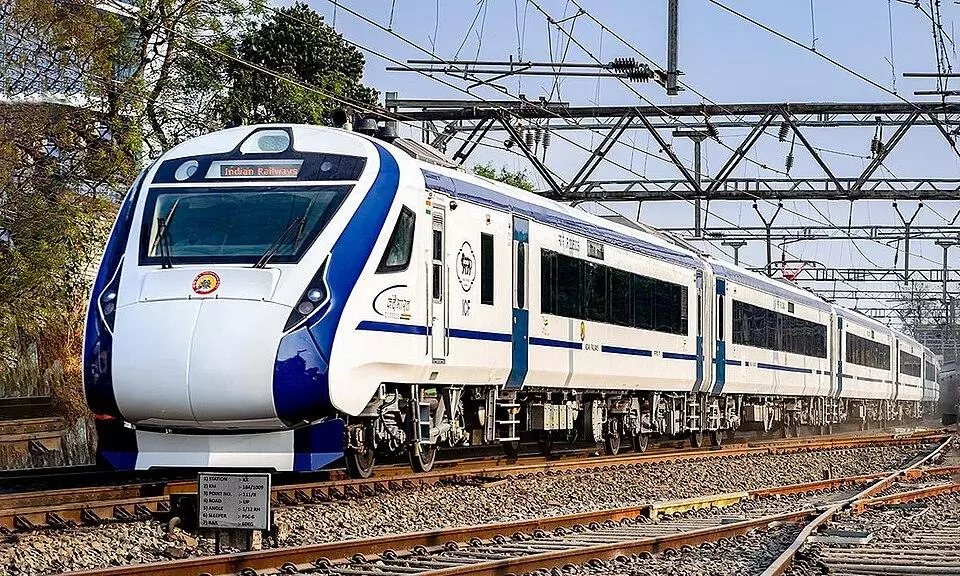
Srinagar: In a major boost to rail connectivity in Jammu and Kashmir, direct train services between Jammu and Srinagar are scheduled to commence from March 1, a development expected to ease passenger travel and significantly strengthen transport links between the Union Territory’s twin capitals.
Northern Railway officials on Tuesday said that a Vande Bharat service will run with halts at seven stations along the Srinagar–Jammu route, and that the rake composition has been revised to 20 coaches from an earlier plan of eight to meet higher passenger demand. Senior Divisional Commercial Manager Uchit Singhal confirmed that preparations and station upgrades at Jammu Tawi are being completed ahead of the launch. He said the new service will markedly improve year‑round connectivity between the Kashmir Valley and the rest of the country.
J&K officials noted that the rail link will reduce dependence on the landslide‑prone Jammu–Srinagar National Highway (NH44), shorten travel times, and make movement of people and goods faster and more predictable. “By providing all‑weather access, the service is expected to spur tourism and trade, ease pilgrimage travel to Katra, generate local employment through expanded services and infrastructure, and strengthen logistical mobility for essential supplies and defence deployments,” one of them asserted. Local businesses and tourism stakeholders anticipate easier access to markets and visitors, while residents look forward to more reliable travel options across seasons.
The direct Jammu–Srinagar trains are the culmination of decades of planning and phased construction under the Udhampur–Srinagar–Baramulla Rail Link (USBRL), a project conceived to integrate the Valley with the national rail network and provide dependable, year‑round connectivity. Sanctioned in the late 1990s and executed in stages over many years, the USBRL’s phased openings—linking Baramulla, Srinagar, Qazigund, Banihal, Katra and the Sangaldan–Katra stretch—have progressively closed the gap between the Valley and the rest of India, with the final phase inaugurated in June 2025. The objectives of the ₹43,780 crore USBRL project which is a part of a 338-km railway line from Jammu to Baramulla have been to reduce travel time, boost tourism and trade, and offer a resilient alternative to the highway.
Beyond passenger convenience, the rail link carries profound strategic and economic significance. Reliable rail connectivity shortens transit times for people and goods, lowers transportation costs for construction materials and agricultural produce, and expands markets for Kashmiri horticulture and handicrafts. The line also creates predictable logistics that can underpin local industry, stimulate employment through station upgrades and ancillary works, and open new opportunities for pilgrimage and leisure travel—factors that together help integrate the Valley more closely with the national economy.
The USBRL also strengthens defence logistics and operational readiness. In a validation exercise on December 16 last year, the Indian Army used a Military Special Train to move tanks, artillery and engineering equipment from the Jammu region to Anantnag, demonstrating improved mobility and rapid‑deployment capability in difficult terrain. Executed in close coordination with the Ministry of Railways and leveraging the USBRL, the operation highlighted how rail connectivity can shorten deployment timelines, enhance logistical resilience in adverse weather, and provide greater flexibility for sustaining operations in high‑altitude and strategically sensitive areas.
At the heart of the USBRL’s engineering achievements are landmark structures such as the Chenab Rail Bridge, the world’s highest railway arch bridge, and the Anji Khad cable‑stayed bridge, India’s first for rail. Rising hundreds of metres above riverbeds and spanning long distances, these bridges—together with long tunnels like the Pir Panjal tunnel and hundreds of smaller viaducts—overcame extreme Himalayan terrain and seismic challenges to turn a century‑old aspiration into operational reality. The inauguration of these works and the start of direct Jammu–Srinagar services mark a transformational shift in how the Kashmir Valley connects with the rest of India, blending engineering ambition, strategic planning and economic intent to deliver resilient, year‑round rail access.
