Delhi Police Defends Force At ‘Chalo Sansad’ Protest, Cites 240 Injured Personnel

18 Aug 2026 1:34 PM IST18 Aug 2026 1:34 PM IST
Affidavit tells Supreme Court protest was hijacked by anti-social elements and history-sheeters
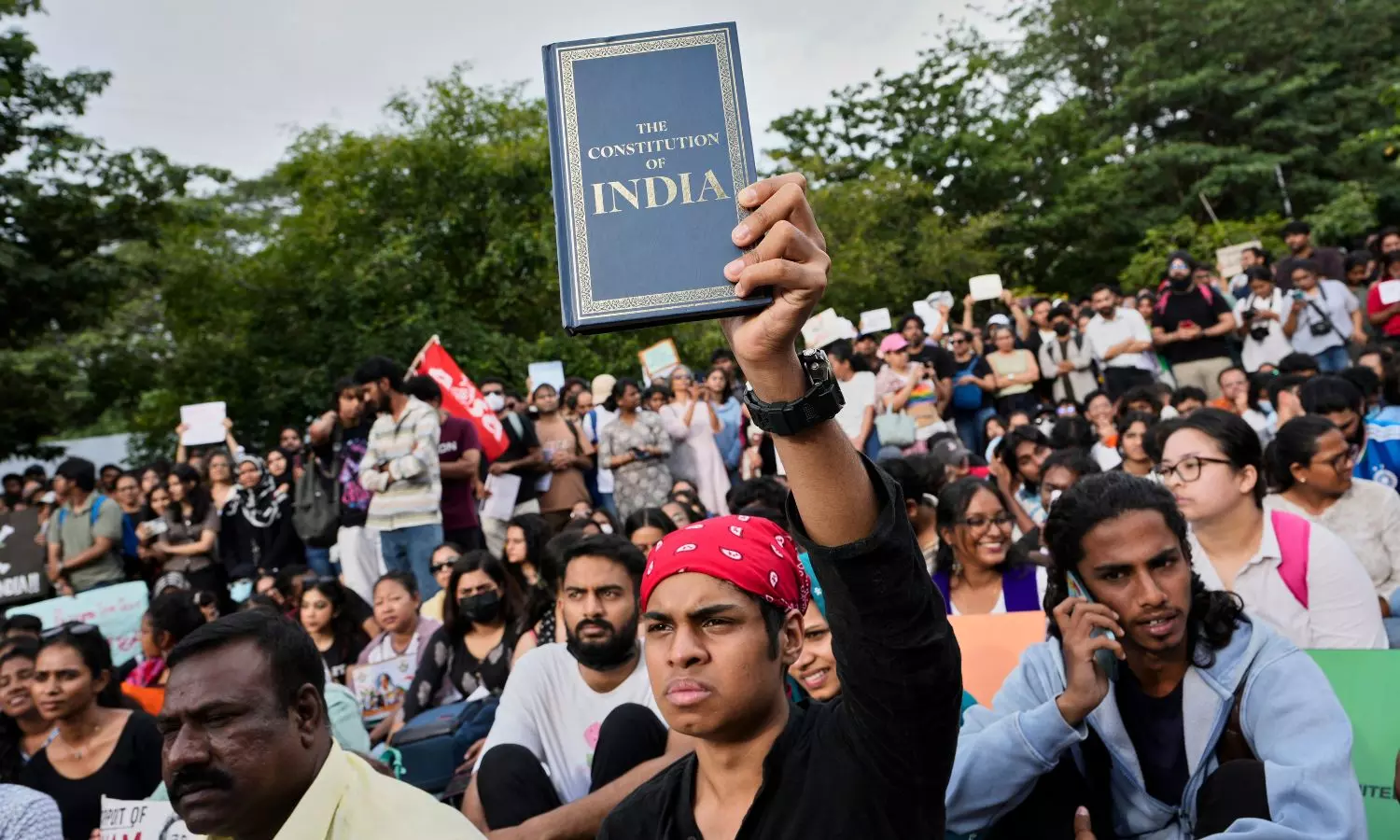
The Delhi Police has defended its use of force during the July 20 ‘Chalo Sansad’ protest, saying violence erupted after protesters breached barricades and ignored repeated warnings.
The Delhi Police has strongly defended the use of force during the "Chalo Sansad" protest here on July 20, telling the Supreme Court that the agitation was hijacked by "anti-social elements" and "history-sheeters", resulting in a breakdown of law and order that left more than 240 police personnel injured.The Delhi Police affidavit, filed by Deputy Commissioner of Police Sachin Sharma of the New Delhi district in response to a batch of petitions alleging excessive use of force against protesters, said the force was willing to have its actions examined by a court-appointed panel.
"The use of force by police can be gone into by a Committee appointed by this Hon'ble Court and the Delhi police will fully cooperate with such Committee and provide all details necessary.
"At the cost of repetition, it is submitted that since a Committee may be appointed by this Hon'ble Court which will examine all the issues related to use of force by the police officials," it said.
On August 3, a bench headed by Chief Justice Surya Kant, while hearing petitions on the issue, had clarified that the expression "criminal antecedents" in its order on releasing student protesters referred only to those involved in grave and heinous offences. It had also said states could close or withdraw FIRs against the remaining students in accordance with law.
The affidavit said more than 30,000 people, including alleged miscreants and anti-social elements, had gathered in and around Jantar Mantar on July 20 during the protests, which later turned violent.
Police resorted to force only after repeated warnings and attempts to prevent protesters from advancing towards Parliament were not heeded.
According to the affidavit, 2,873 people who attended the protest had particulars matched existing crime records in official police databases.
It said 92 of the people present at the site were involved in more than 10 criminal cases, of whom 47 were "history-sheeters".
"The right to protest peacefully is a fundamental right of every citizen, including young students/young individuals. This right is sacrosanct and must be preserved at any cost. The difficulty arises when an initial peaceful protest turns violent, resulting in bodily harm either to the other citizen as well as the police personnel along with destruction of public property," the affidavit said.
"Anti-social elements merging with the crowd, with criminal background infiltrating such protests either to give bad name to the protestors or to the police, is always a matter of concern and worry, not only in India but everywhere," it added.
Police said if the violence did not stop or appeared to be spreading rapidly, a graded response was adopted, beginning with minimal use of force, with decisions taken according to the situation on the ground, the affidavit said.
"More than 240 police officers have suffered injuries; the investigation will take into consideration the grievances of the protestors as well as the grievances of those police officers who were deployed on duty and have suffered injuries.
"Both will have to be and should be investigated impartially. The facts narrated herein are the facts as appear and available as on date which would need an investigation," it said.
The affidavit said the permission granted for the protest had lapsed on July 20 itself, but the protesters did not vacate the venue or disperse after holding the dharna.
"The agitation thereafter witnessed the participation of a large number of students, political workers, political leaders, activists and others addressing the gatherings on different dates, thereby repeatedly appealing for continuation and expansion of the agitation, permission of which had already lapsed," it said.
"It is a matter of fact that during the course of events as they unfolded on July 20, the protest did not remain peaceful and instead pervasive lawlessness had crept in," it said.
Despite repeated requests and warnings by police, protestors breached multiple layers of barricades and refused to comply with lawful directions in their bid to reach and gather near Parliament, it said.
"The protest took an unprecedented turn when a call was given for a march towards Parliament on July 20, the opening day of the Monsoon Session of Parliament.
"It was this call and at this moment which saw rapidly increasing mobilisation and the crowd strength started increasing thereby necessitating heightened security and measures for maintaining law and order," it said.
Justifying the action, the affidavit said the police were duty-bound to maintain law and order, protect life and property from untoward incidents and restrict protesters to the designated protest site.
The affidavit said it was also their duty to prevent the protesters from causing any damage to vital installations, including Parliament, Rashtrapati Bhavan, Seva Teerth, Kartavya Bhavan, other central government offices, and residences of Union ministers.
"The officers were constrained to use force only and only after the protestors breached the multiple layers of the barricade and started resorting to violence.
"There is a digital record available that shows disturbing visuals of big groups of protestors targeting lone police officials with stones, sticks, beating them up without any provocation almost in a mob lynching fashion," it said.
( Source : PTI )

Next Story