How the NEET Protest Rewrote Rules of India's Mass Movements

According to many activists and political leaders, the NEET protest has emerged as India's most successful mass movement after the Nirbhaya protest and the year-long farmers' agitation. However, there is one major difference
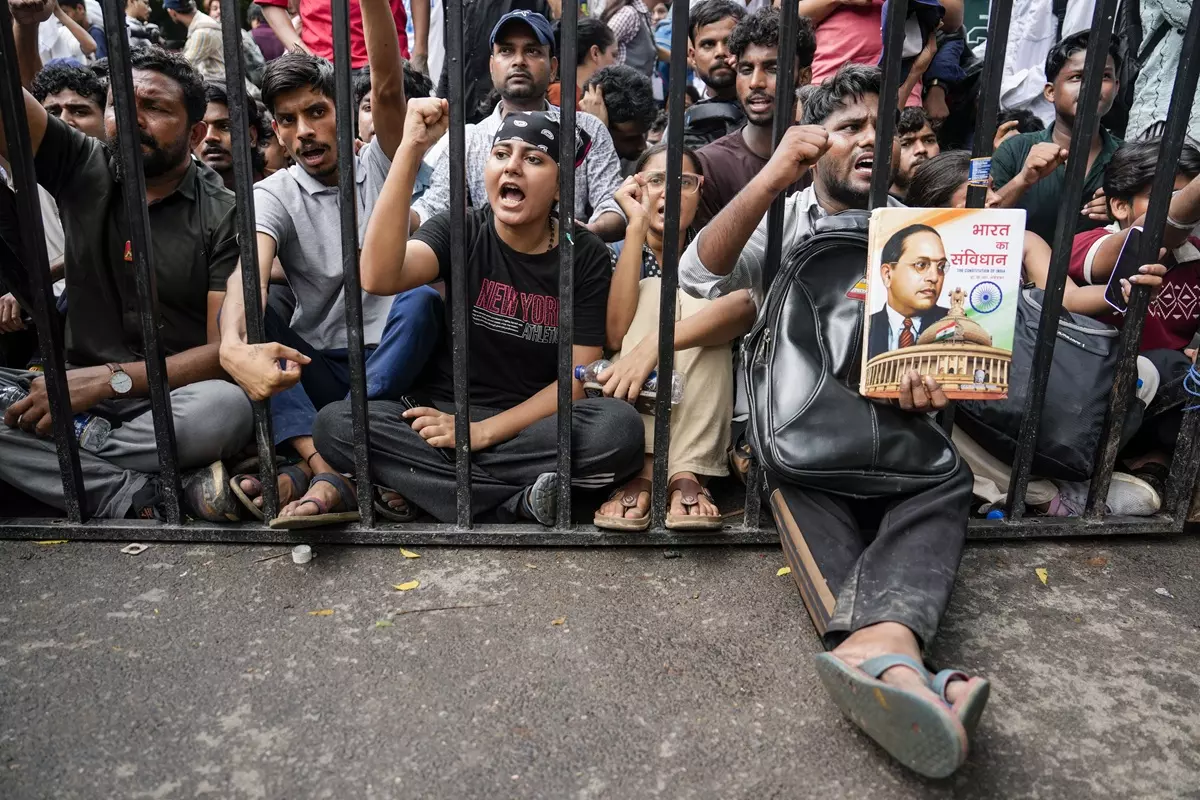
Hyderabad: “We planned a lot to make our protests successful, but they made it successful with their natural ability. Maybe the NEET protest has paved the way by proving that even without elaborate preparation, the determination of young people alone can make a nationwide protest successful.”
That is how AISA leader and researcher Ashutosh Singh, one of the prominent faces of the JNU students' movement, described the NEET agitation while speaking to Deccan Chronicle.
According to many activists and political leaders, the NEET protest has emerged as India's most successful mass movement after the Nirbhaya protest and the year-long farmers' agitation. However, Ashutosh pointed out one major difference.
"The farmers' protest was systematic. They prepared themselves for a long-term movement with food, logistics and every other requirement already planned. But the NEET protest kept growing every single day only because of the continuous efforts and determination of young people," he said.
SFI All India General Secretary Srijan Bhattacharya echoed a similar view. According to him, after the Nirbhaya movement, it was the farmers' protest that restored people's faith that sustained public resistance could bring results. "Now, the NEET protest has changed the thinking process," he said.
Bhattacharya believes that the farmers' movement and the NEET agitation are among the most successful protests of the last two decades. "Farmers stayed at Delhi's borders for almost a year. That was not easy. In the same way, these young people kept the protest alive every day without a single break. That itself is huge," he added.
Former journalist and independent consultant Nikhil Kashyap, who also participated in the demonstrations, believes every successful protest in India has been driven by a different section of society.
"Women felt the Nirbhaya protest most deeply and became its biggest influencers. The farmers' protest was led by a well-organised farming community. But students and children affect everybody because they represent the future of the country. Even supporters of the ruling party were disturbed by the issue because it involved their own children. That's why they realised it was not going in their favour," Kashyap said.
He also believes the movement proved that public emotion could overcome even the influence of social media algorithms. "We should also remember the successful Jat reservation protest of 2016," he added.
For Ashutosh Singh, another striking difference was the attitude of today's generation compared to student movements of the past.
Recalling the 2019 police action inside Jamia Milia Islamia University, where many students were brutally beaten and arrested, he said activists of his generation often felt constrained.
"At that time, we somehow felt depressed. We always believed that any wrong step from our side would be used to question universities and student politics. That hesitation existed. But this generation doesn't seem to have that fear," he said.
According to him, after the police lathi-charge, students regrouped within a short time instead of retreating. At other moments, they adopted Gandhian methods by offering food and water to police personnel even after facing water cannons and tear-gas shells.
"We had never seen anything like this before," he said.
Not only that, Delhi's Jantar Mantar witnessed an extraordinary coming together of people speaking different languages, wearing different attire and holding different opinions.
A 14-year-old school student from Delhi's Patparganj arrived at Jantar Mantar with his friends. He admitted he knew little about the Cockroach Janata Party (CJP) but said he came because he wanted to protest against the pressure imposed by schools.
On the other hand, two elderly women sat holding placards demanding 33 per cent reservation for women in Parliament. A member of the National Federation of Indian Women (NFIW), the women's wing of the CPI, said around 500 women joined the demonstration.
"We came to support the students' demands. At the same time, we wanted to highlight that equality between women and men must begin in the political sphere," she said.
Among the protesters was Purushottam Puri, a 38-year-old visually impaired man from Madhya Pradesh. His demand had nothing to do with NEET. He wanted the government to release his three months' pending disability pension, which he said had pushed his family into financial hardship.
Puri travelled alone by train to Delhi because he believed that when thousands gathered at Jantar Mantar, the government listened to everyone.
Perhaps that is what made the NEET protest different. It started as a movement against an examination-paper leak but slowly became a platform where students, women, persons with disabilities and ordinary citizens came together with different demands but a common belief -that their voices deserved to be heard.