Vande Bharat Driving India’s Growth: PM Modi

In developed countries around the world, the biggest reason for economic growth has been their infrastructure.
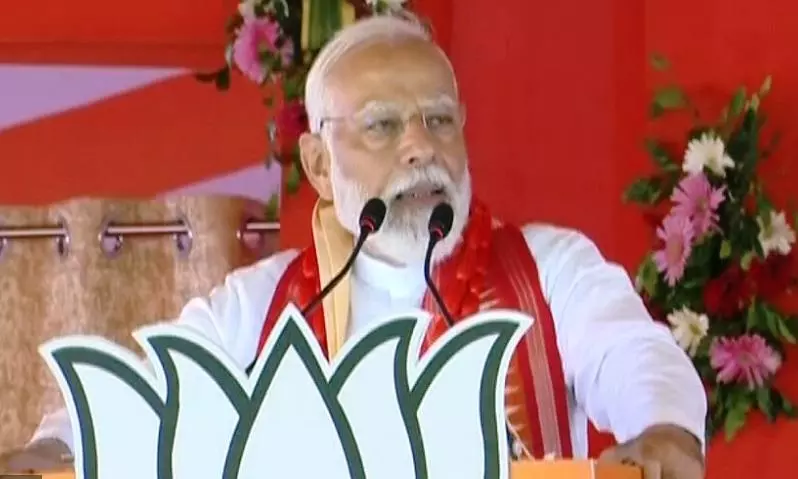
New Delhi: Prime Minister Narendra Modi on Saturday said that infrastructure is a key driver of economic growth in developed countries and that India too is advancing rapidly on the path of development. Speaking after flagging off four new Vande Bharat Express trains from Banaras railway station in Varanasi, his Parliamentary constituency, he said that spiritual tourism has become a major contributor to Uttar Pradesh’s economy, with devotees visiting pilgrimage sites generating thousands of crores of rupees.
“In developed countries around the world, the biggest reason for economic growth has been their infrastructure. In every nation that has achieved major progress, the driving force behind it has been infrastructure development,” the Prime Minister said.
He added, “Infrastructure is not just about big bridges and highways. Whenever such systems are developed anywhere, they trigger the overall development of that region.”
Highlighting India’s rapid progress, Modi said, “With so many Vande Bharat trains running and flights arriving from countries across the world, these developments are now linked to growth. India is moving rapidly on this path.”
“Trains like Vande Bharat, Namo Bharat, and Amrit Bharat are laying the foundation for a new generation of Indian Railways. Vande Bharat is a train of Indians, built by Indians, for Indians, a source of pride for every Indian,” he said, adding that even foreign travellers are amazed by the Vande Bharat trains.
The Prime Minister said that India has launched a campaign to strengthen its infrastructure as part of its goal to become a developed nation, and that these new trains mark a significant milestone in that effort. With the addition of the four new services, more than 160 Vande Bharat Express trains are now operational across the country.
Modi also noted that spiritual tourism has become a major source of income and development in Uttar Pradesh. “For centuries, pilgrimage has been considered a medium of national consciousness in our country. These journeys are not just for the darshan of deities but represent a sacred tradition that connects the soul of India,” he said, citing Prayagraj, Ayodhya, Haridwar, Chitrakoot, and Kurukshetra as key centres of India’s spiritual heritage.
He observed that as these sacred destinations are connected through the Vande Bharat network, India’s culture, faith, and development are also being linked. “This is an important step toward making symbols of India’s heritage a representation of national growth,” he said.
The Prime Minister highlighted the economic dimension of spiritual tourism, often overlooked in discussions. “Over the past 11 years, development work in Uttar Pradesh has elevated pilgrimage tourism to new heights,” he said. “Last year, more than 11 crore devotees visited Kashi for Baba Vishwanath’s darshan, and since the construction of the Ram Temple, over six crore people have visited Ayodhya to seek the blessings of Ram Lalla. These devotees have contributed thousands of crores of rupees to Uttar Pradesh’s economy, providing steady income to hotel owners, transport operators, local artists, and boatmen.”
Noting that this has created new opportunities for the youth, Modi said, “Hundreds of young people in Varanasi are now starting new ventures, from transport to local businesses. As a result, the doors of prosperity are opening in Kashi and across Uttar Pradesh.”
“To realise the dream of a Viksit Bharat (Developed India) through a Viksit Kashi, numerous infrastructure projects are underway. Today, Kashi is witnessing continuous expansion and qualitative improvement, with modern hospitals, better roads, gas pipelines, and internet connectivity,” he said.
“Our goal is to make visiting, staying in, and experiencing Varanasi a special and memorable experience for everyone,” he concluded.
