Mamata Calls For Fairness In Voter Exercise In West Bengal

4 Feb 2026 10:50 AM IST4 Feb 2026 10:50 AM IST
She flagged that married women were being put to notice for shifting to their in-laws' home or using their husbands' surname.
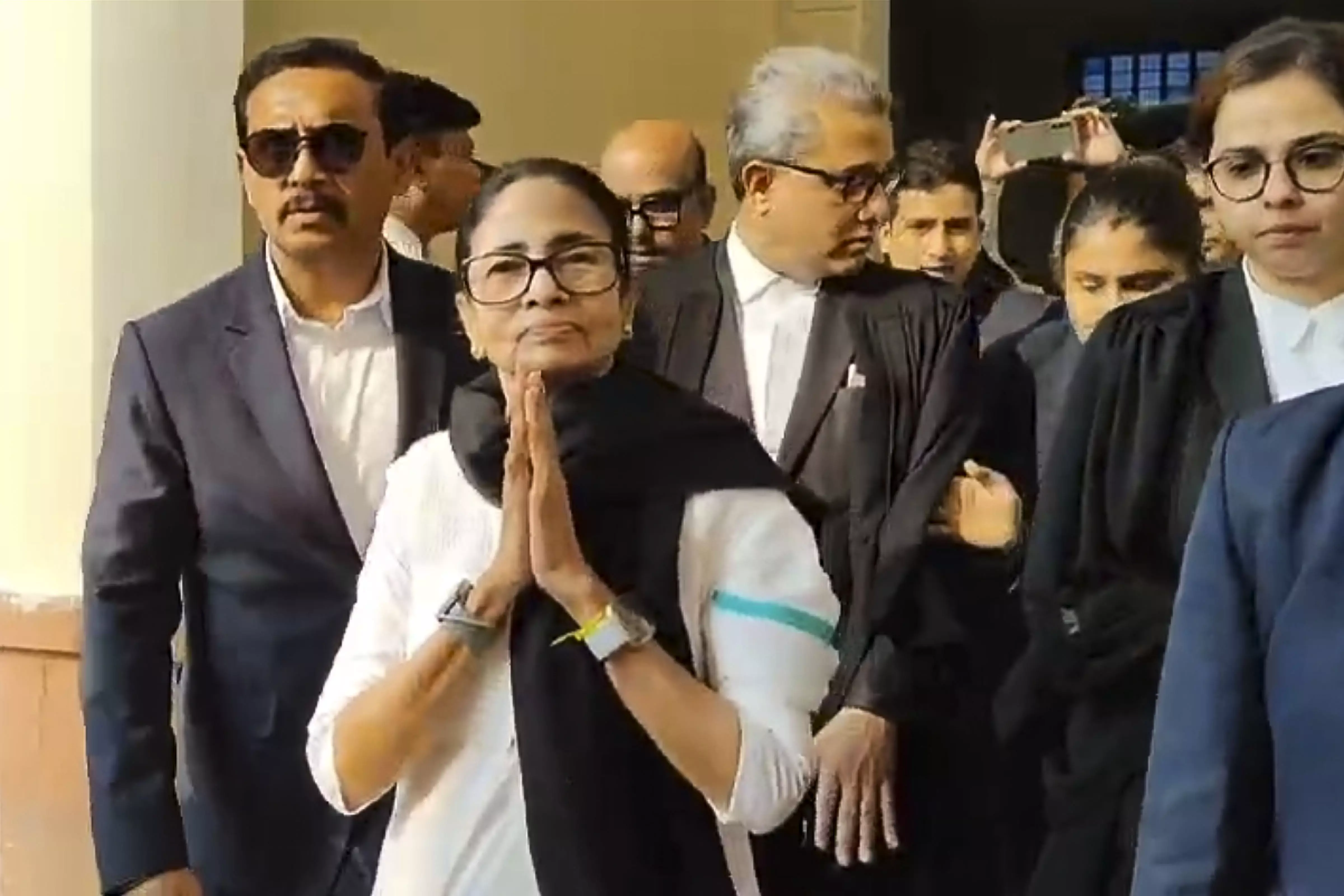
West Bengal CM Mamata Banerjee reaches the Supreme Court premises, in New Delhi (PTI)
New Delhi: In a rare in-person argument, West Bengal Chief Minister Mamata Banerjee on Wednesday personally urged the Supreme Court to intervene in the ongoing Special Intensive Revision (SIR) of electoral rolls in the state, alleging procedural lapses and asserting that West Bengal was being selectively targeted ahead of elections.
A three-judge Bench headed by Chief Justice of India Surya Kant took note of her plea and observed that “genuine persons must remain on the electoral roll”. The Bench, also comprising Justices Joymalya Bagchi and Vipul M. Pancholi, issued notices to the Election Commission of India and the state’s Chief Electoral Officer, seeking their responses by February 9.
The court asked the poll panel to ensure that booth-level officers and electoral roll officers act sensitively while issuing notices, particularly in cases involving minor discrepancies such as spelling variations.
Banerjee, who appeared in person and argued her case after seeking the court’s permission, challenged the SIR exercise in the state and sought a direction to the Election Commission to accept Aadhaar cards as proof of identity in cases involving “logical discrepancies”, without insisting on additional documents.
"In other states, documents like domicile certificate, family register card, etc are allowed... They are only targeting Bengal on the eve of elections. What was the hurry?" she asked.
She alleged that despite earlier court directions permitting Aadhaar as one of the documents, electoral officials were refusing to accept it and were insisting on other proofs. She contended that the SIR exercise was being conducted in an unusually short span of three months, instead of the usual two years, even during festival and harvesting seasons.
Banerjee also flagged the issue of deaths of officials involved in the exercise and deployment of micro-observers in the state.
Referring to discrepancies such as mismatches in parents’ names and age gaps between voters and parents, Banerjee alleged that in some instances living persons had been marked as deceased and that the exercise was “only for deletion, not for inclusion”. She said she had written six letters to the Election Commission on the issue without receiving any response.
Questioning the uniformity of the process, she alleged that similar standards were not being applied in other States. “West Bengal is being targeted… to bulldoze its people,” she said.
Senior advocate Rakesh Dwivedi, appearing for the Election Commission, disputed the allegations and submitted that the state government had provided only 80 Grade-2 officers for supervising the exercise. Banerjee contested this, stating that the state had provided whatever assistance was sought.
She flagged that married women were being put to notice for shifting to their in-laws' home or using their husbands' surname.
Senior advocate Shyam Divan, representing Banerjee, submitted that 1.36 crore voters had been issued notices citing logical discrepancies and that there was little time left for corrective measures, with the SIR process scheduled to conclude on February 14. He urged the Commission to upload reasons for inclusion of names in the discrepancy list.
The CJI referred to a Bengali dialect and observed that at times names could be misspelt in English because of it.
The Bench acknowledged the procedural concerns raised and observed that efforts must be made to ensure that no eligible citizen is excluded from the electoral rolls. Notices have been issued, and the matter will be heard next on February 9.
( Source : Deccan Chronicle )

Next Story