PM's 12th I-Day Focus on Security, Growth, Welfare

Observes Partition Day with NDA leaders, ministers
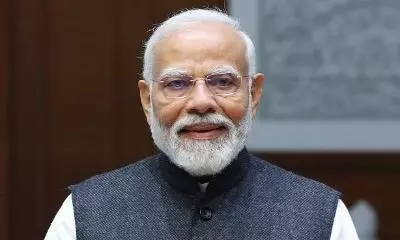
New Delhi: Prime Minister Narendra Modi will deliver his 12th consecutive Independence Day address to the nation on Friday — a milestone that comes months after Operation Sindoor and amid opposition parties uniting over alleged poll irregularities to question his government.
Modi is expected to emphasise India’s uncompromising stand on national security, economic growth, and the expanding welfare model. He may also address the prevailing mood of economic and foreign policy uncertainty triggered by US President Donald Trump’s adversarial stance on trade.
Meanwhile, recalling the upheaval and pain endured by countless people during the “tragic chapter” of Indian history, Modi on Thursday observed ‘Partition Horrors Remembrance Day’ and said the occasion is also a reminder of “our enduring responsibility to strengthen the bonds of harmony that hold our country together.” Several BJP and NDA leaders, including Union ministers, paid tributes to the lives lost during Partition.
“India observes #PartitionHorrorsRemembranceDay, remembering the upheaval and pain endured by countless people during that tragic chapter of our history. It is also a day to honour their grit... their ability to face unimaginable loss and still find the strength to start afresh. Many of those affected went on to rebuild their lives and achieve remarkable milestones. This day is also a reminder of our enduring responsibility to strengthen the bonds of harmony that hold our country together,” Modi posted on X.
The Modi government has been observing August 14 as ‘Partition Horrors Remembrance Day’ since 2021, in remembrance of those who lost their lives during the country’s partition. While making the announcement in 2021, the Prime Minister had said the day would be observed in memory of the struggles and sacrifices of the people, as the pain of Partition can never be forgotten.
Meanwhile, political observers will be closely watching for any signals on the foreign policy front, especially at a time when India’s generally strong ties with the US are under strain following Trump’s repeated claims of mediating a ceasefire between India and Pakistan and his use of tariffs to pressure India on trade.
Trump’s decision to impose a 50 per cent tariff on India, coupled with his occasional praise of Pakistan and ceasefire claims, has given the opposition ammunition to target the Modi government.
With Parliament’s Monsoon Session ongoing and disrupted by Opposition protests over alleged poll irregularities and demands for a discussion on the Special Intensive Revision of electoral rolls in poll-bound Bihar, it remains to be seen whether the Prime Minister will respond to these charges.
Modi’s firm stance against Pakistan-sponsored terrorism and Naxalism has been a regular highlight of his annual speeches, and this year is unlikely to be different. He had sought suggestions from citizens for his address, and it will be keenly observed whether some of these ideas find a place in his speech.
Paying tributes to those who lost their lives during the 1947 Partition, Union home minister Amit Shah accused the Congress of dividing the country and hurting the pride of “Maa Bharati” (Mother India). The senior BJP leader said it was an occasion to express condolences by remembering the pain of those who suffered due to the division of the nation.
"On this day, the Congress party divided the nation, hurting the pride of Maa Bharati. The Partition led to violence, exploitation and atrocities, and millions of people endured displacement… I offer my heartfelt tributes to all those people. The country will never forget this history and the pain of Partition," Shah said in a post on X in Hindi.
The Prime Minister has consistently stressed the goal of making India aatmanirbhar by boosting indigenous expertise and local manufacturing to achieve a Viksit Bharat by 2047. His address on the nation’s 79th Independence Day is likely to echo this vision once again.
Having recently surpassed Indira Gandhi’s record for the longest consecutive tenure as prime minister, Modi’s 12th Independence Day address will place him ahead of her 11 consecutive speeches from the Red Fort, second only to Jawaharlal Nehru in terms of the number of consecutive Independence Day addresses.
Mrs Gandhi served as prime minister from January 1966 to March 1977, and again from January 1980 until her assassination in October 1984, delivering a total of 16 Independence Day addresses.
Modi’s August 15 speeches invariably touch on key national issues, economic progress, and social welfare, often coupled with announcements of policy initiatives and new schemes. In his 98-minute address last year, he made a strong pitch for a “secular” civil code, replacing the current framework he described as “communal” and discriminatory, and called for simultaneous polls. He also announced the creation of 75,000 additional medical seats in the next five years.
Issues such as crimes against women, cleanliness, and the empowerment of women and traditionally disadvantaged communities have also featured prominently in his past addresses.
