Op Sindoor was a Chess Game in Grey Zone: Army Chief

10 Aug 2025 10:10 AM IST10 Aug 2025 10:10 AM IST
Under Operation Sindoor in May, the IAF carried out precision strikes on multiple targets in Pakistan and Pakistan-occupied Kashmir linked to terror groups
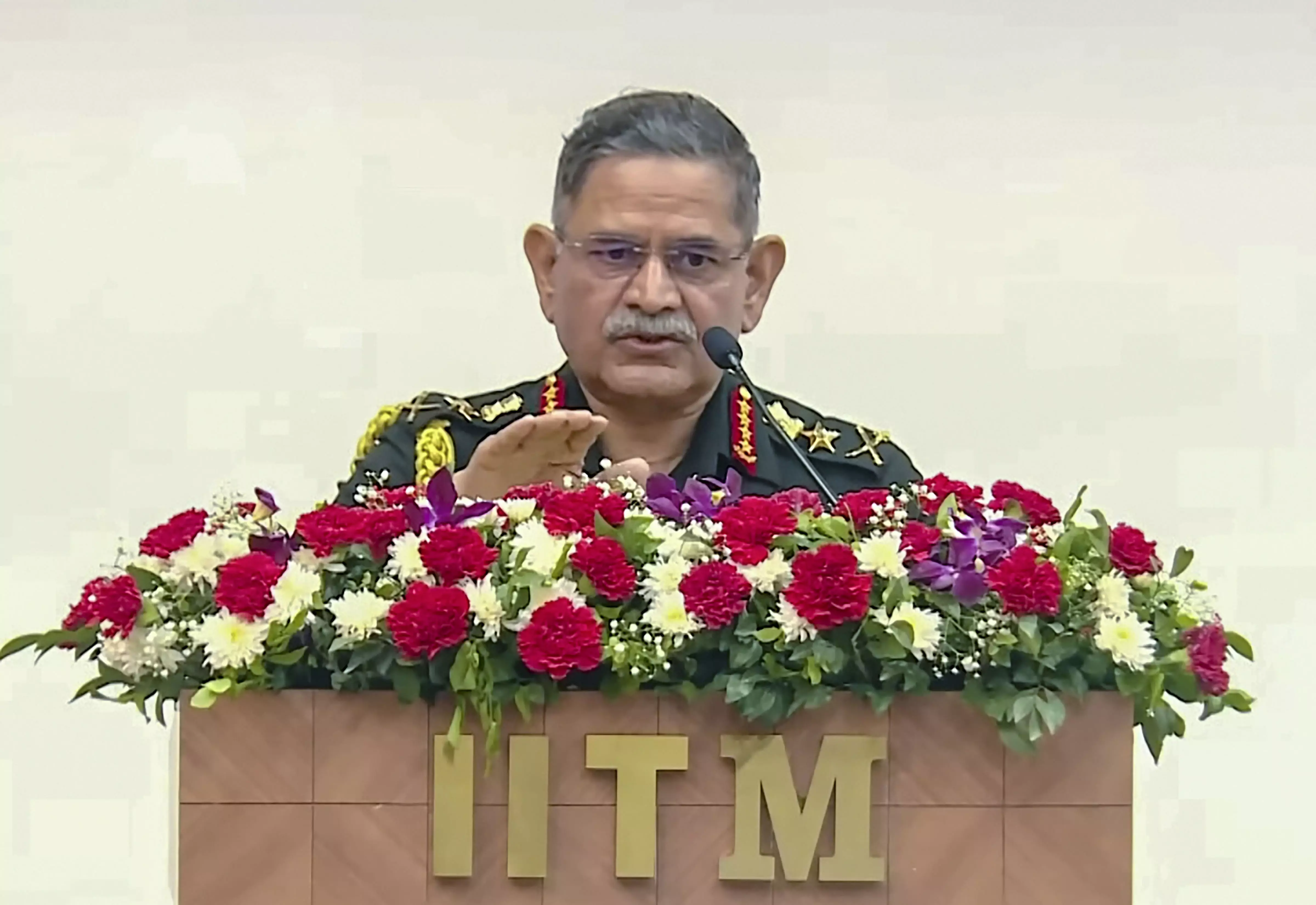
Chief of Army Staff (COAS) General Upendra Dwivedi addresses the gathering at IIT Madras, in Chennai (PTI)
New Delhi: Army Chief Gen. Upendra Dwivedi has likened Operation Sindoor to a game of chess, saying, “We did not know what the enemy’s next move would be,” and noting that although the “test match stopped on the fourth day,” it could have turned into a protracted conflict.
Underscoring the importance of “narrative management” in such situations, as “victory is in the mind,” Gen. Dwivedi said, “If you ask a Pakistani whether you lost or won, he would say, ‘My Army chief has become a Field Marshal, so we must have won. That is why he has become a Field Marshal.’”
The Army Chief made these remarks during an address at IIT-Madras on August 4, the video of which was shared by the Army over the weekend.
Without naming any country, he cautioned about the threat perception, saying, “Next time, it may be much more, and whether that country will act alone or be supported by another, we do not know. But I have a strong hunch… that country will not be alone. That is where we have to be careful.”
Gen. Dwivedi used chess and cricket analogies to describe the intricacies of Operation Sindoor, India’s decisive military action launched in May against terror infrastructure in Pakistan and Pakistan-occupied Kashmir (PoK) in retaliation for the April 22 Pahalgam terror attack. The operation led to a four-day military conflict between India and Pakistan, which ended on May 10 after an understanding was reached following Islamabad’s request for a ceasefire.
“Operation Sindoor, a new normal, is just the beginning. We are living in an age of acceleration and transformation. The journey to uphold peace, even if enforced through strength, synergy, and sovereignty, is the call of the day,” he said.
Explaining the “grey zone” concept, he noted, “In Operation Sindoor, what we did was play chess. We did not know the enemy’s next move, and they did not know ours. The grey zone means we are not conducting conventional operations, but actions just short of that, across all domains.”
He added, “Somewhere we were giving them checkmate, and somewhere we were going in for the kill at the risk of losing our own. That’s life.” He stressed that the grey zone will always exist and that the next war “may happen soon,” requiring joint non-kinetic efforts.
Stating that the military alone will not fight the next conflict, he said India faces a “two-and-a-half front” situation, and in keeping with the national psyche, “the currency of victory will remain land.”
He revealed that during Operation Sindoor, ground forces were “playing chess” with both visible and invisible moves, the latter possibly being made visible to the adversary through external assistance. “This test match could have lasted 14 days, 140 days, or even 1,400 days, we must be prepared,” he said.
Gen. Dwivedi outlined key aspects of force orchestration: force visualisation, force preservation, and force application. He described the operation as a “whole-of-nation approach,” with the military given a “free hand” and “no restrictions,” which boosted morale and allowed commanders to act with full autonomy.
He recalled visiting Northern Command on April 25, where plans were finalised and seven of nine targeted sites were destroyed, killing several terrorists. These precision strikes, he said, hit the “heartland” for the first time, targeting both “the nursery and the masters” of terror. Pakistan, he added, “never expected the heartland to be hit,” and it came as a shock. India, however, was prepared to absorb any blowback.
On the battle of narratives, Gen. Dwivedi said Indian forces countered Pakistan’s messaging through social media and other platforms to influence domestic, adversary, and neutral audiences. The first strategic message, “Justice Done”, generated record global engagement, he noted.
Highlighting the evolving nature of warfare, he said 56 conflicts are currently underway worldwide, involving 92 countries, and India faces “live or semi-live” borders with two potential adversaries capable of orchestrating war jointly or separately.
He stressed the need to adapt to five generations of warfare and to integrate technology at the soldier level. “Our 12 lakh Army personnel should each have one drone, an ‘eagle on the arm’, from muddy trenches to the Internet of Things, that is the arena we must be ready for,” he concluded.
( Source : Deccan Chronicle )

Next Story