Organic, Not Organised: Voices From Jantar Mantar Say Protest Is Driven by People, Not Politicians

Speaking to Deccan Chronicle, several protesters from different parts of the country described the movement as one that grew without central leadership, sustained instead by individual participation and collective resolve
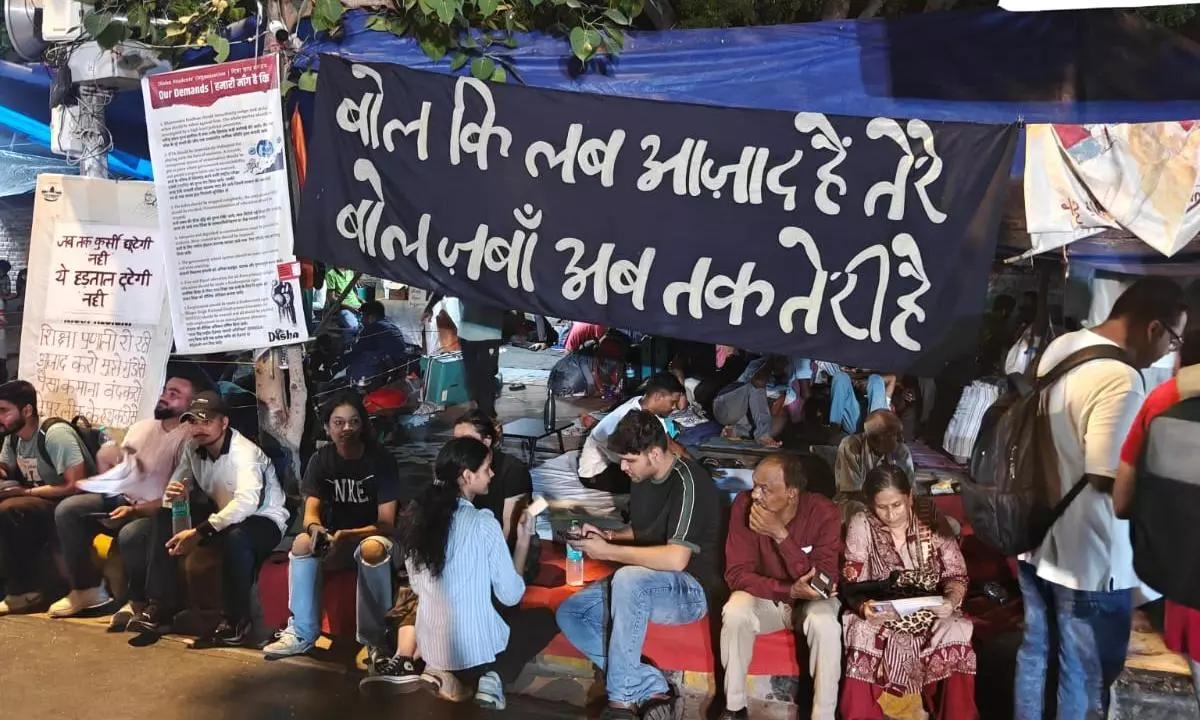
Hyderabad: "This protest is organic, not organised," was a phrase repeatedly echoed by protesters gathered at Jantar Mantar, where students, activists, teachers, farmers and ordinary citizens came together demanding accountability over the alleged NEET paper leak and police action during the demonstrations.
Speaking to Deccan Chronicle, several protesters from different parts of the country described the movement as one that grew without central leadership, sustained instead by individual participation and collective resolve.
One of the senior activists at the protest, Himangshu Kumar, said the gathering reflected an unprecedented coming together of people from different backgrounds. "Jantar Mantar has now become a place where everyone—from farmers to students, from the privileged to people belonging to BPL families—is standing together in one protest," Kumar said. Among those who travelled to Delhi was Saswati Dutta Roy, an activist and teacher from West Bengal. She participated in the 'Sansad Chalo' march and witnessed the police action firsthand.
"It is difficult to stop this generation from asking questions," she told Deccan Chronicle. "Throughout the protest, the so-called Gen Z remained calm and committed to a peaceful demonstration. Right in front of my eyes, police used tear gas and attacked protesters. By God's grace, heavy rain suddenly started, reducing the impact of the tear gas."
Roy said what stood out most was the determination of young protesters despite the violence.
"The protesters were so determined that there was no fear in their eyes. They believed in protecting one another. Many of us formed human chains to shield fellow protesters. I was one of them," she said. For many students, the protest was deeply personal.
Sahad Ali, a NEET aspirant, said the alleged paper leak had shattered the confidence of thousands of candidates.
"We study for nearly 16 hours a day and give our best for this examination. Then the paper leak happens. That is the real bombshell destroying students' lives," he said.
Questions were also raised over the absence of visible leadership during the police crackdown. Some protesters claimed that several key members of the CJP were not present at the main protest site when police action intensified.
Akriti, a Delhi college student, said protesters eventually decided to continue on their own.
"From the previous night, we didn't even know where the protest would begin. But after witnessing the police's attitude and brutality from the very first hour, we decided to take the initiative ourselves and continue the protest independently," she said.
Several participants echoed the sentiment, saying the demonstration continued without any structured leadership.
Activist Joe Sinha from Mumbai, who was detained before the protest along with his friends, alleged that authorities prevented peaceful participation.
"We had planned a peaceful protest against the brutality of the Delhi Police. But before the demonstration even began, students and teenagers were detained, their phones were confiscated, and they were taken into custody. For several hours, we had no way of contacting our families or lawyers," he alleged.
The protest also drew attention to whether it had acquired a political colour. Ahead of the march, CJP founder Abhijit Dipke had appealed that no political flags, except the national flag, should be displayed.
Addressing the issue, Himangshu Kumar said he only noticed supporters of MP Chandrashekhar Azad carrying blue flags bearing the image of B.R. Ambedkar.
"Other than that, I did not see political party flags. Many political leaders visited the protest, including Chandrashekhar Azad and Dimple Yadav, but the protest itself did not appear politically driven. People were naturally helping one another and keeping the movement alive," he said.
The movement also attracted participants with no direct organisational affiliation. Amal, a government employee who travelled from Manali, gave a brief but pointed reason for joining. "I came because I wanted to do something for the country," he said.
A large section of those at the protest were college and school students. Many bore injuries they said were caused during the alleged police lathi-charge. Some were seen crying in pain, yet many insisted they would continue their struggle.
"Lathi-charge is painful," one injured student said. "But if needed, we can face tear gas again and give it back to the police."