India’s AI Data Centres and the Invisible Groundwater Cost

In times of water scarcity, data centres, classified as 'essential services', would be prioritised more than drinking water and sanitation needs of the people
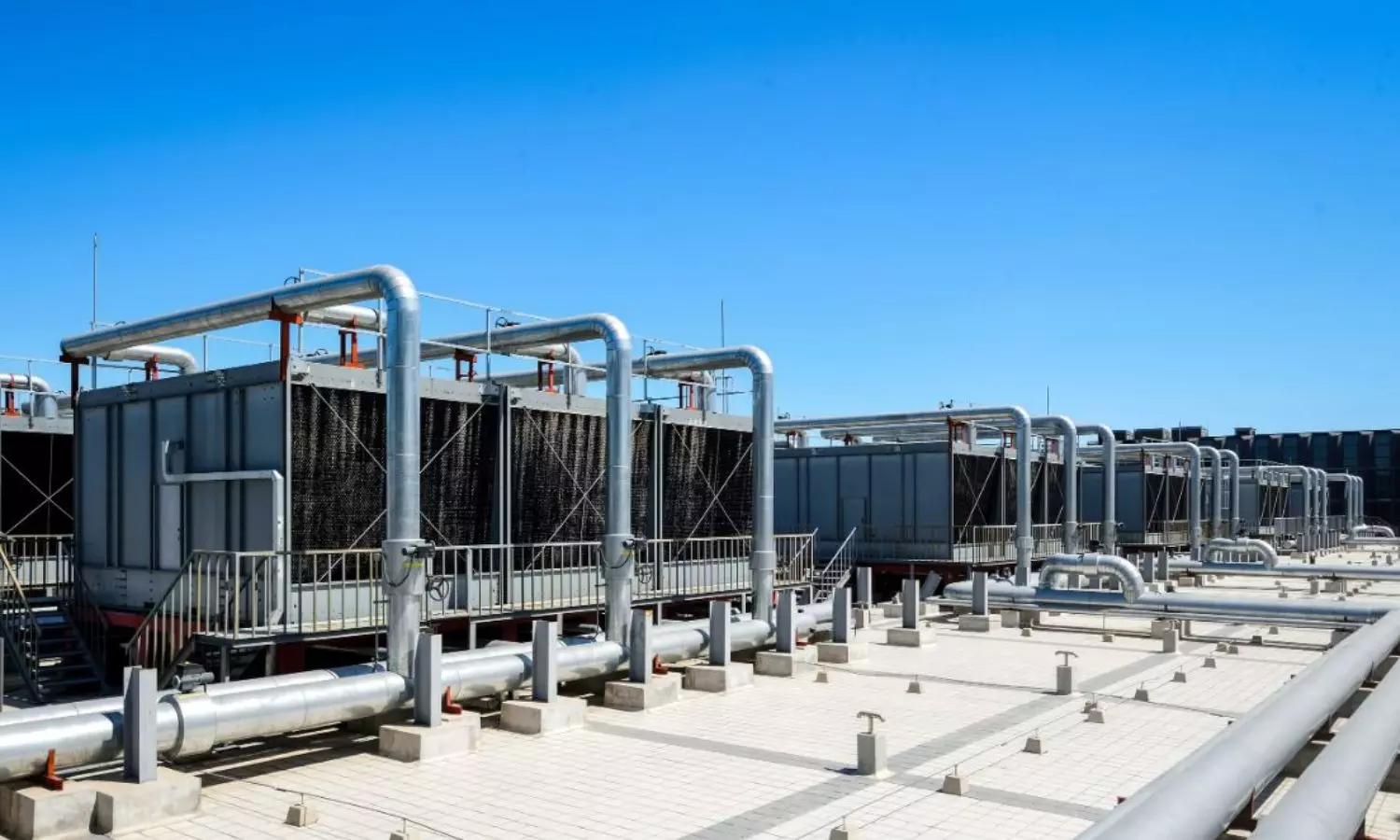
India is currently in a roar with blooming data centres all around the country, with global tech giants and domestic conglomerates racing to establish the nation as a ‘global hub’ for Artificial Intelligence (AI) and cloud computing. However amidst this push, there is dark reality hidden, an unquenchable thirst for water that threatens to drain the wells of local communities and put major cities toward “Day Zero”, a critical moment when a city runs out of usable water.
At What Scale Is The “Digital Thirst” In India?
India accounts for 20% of global data generation and currently hosts 3% of the world's data capacity. To bridge this gap, conglomerates including Reliance and Adani Group have invested 210 Billion Dollars to build gigawatt-scale, AI-ready facilities. A single 100-megawatt data centre consumes approximately 20 Lakh litres of water per day, and these machines require a constant cooling system to function. The water used by these machines in a day is equal to the daily needs of 6,500 households.
The rise of generative AI has tripled these requirements. Even for a simple 100 word response from an AI chatbot, half a litre of water is required for cooling the system. Consecutively, India’s data centres are projected to consume more than double, rising from 150 billion litres in 2025 to 358 billion litres by 2030.
The Vanishing Water Table
The rural communities living in the shadows of these computer warehouses are suffering the most. Residents living in Tusiana village, Uttar Pradesh, located next to a massive hyper scale cluster, report a massive drop in groundwater. The borewell in this area had to be deepened by nearly 180 meters and in some parts it had gone beyond 250 meters. In Telangana, the groundwater levels have dropped to an average of 7.72 metres below ground level as of 2024.
While operators claim they do not draw groundwater, workers on-site have reported the presence of multiple deep rooted borewells inside campuses which eventually dry up the shallow well used by farmers for drinking, irrigation and cattle rearing.
Urban Competition
Data centres are heavily concentrated in urban centres like Mumbai, Hyderabad, Chennai and Delhi, that are already facing severe water shortages.
In Mumbai, declining lake levels recently forced 10% water cut across the city. In Hyderabad, groundwater levels in IT hubs like Gachibowli dropped nearly a metre in just three months in early 2026. Chennai already faces water shortage and an intense competition between drinking water and industrial cooling water.
Data centres are classified as “essential services” in the states of Maharashtra and Telangana. This status facilitates uninterrupted access to water and electricity, meaning in times of water scarcity, data centres would be prioritised more than drinking water and sanitation needs of the people.
The Digital Greenwash
Companies like Microsoft and Amazon, have pledged to become “water positive” by 2023, to counter the environmental criticism. They invest in projects restoring lakes and wetlands in places like Bangalore and Hyderabad. However this approach has been labelled as a potential “digital greenwash” and an ineffective approach. Restoring water elsewhere does not mitigate the localised depletion and the risk of “day zero” faced by the communities.
The promises of these centres do not really reach the locals who lose their resources. Data centres require great investments yet fail to provide adequate jobs to the locals and it is often restricted to low-wage work like security or housekeeping. Beyond these limited gains, host communities face severe risks.
Assigned Lands and Grassroot Governance
This expansion of India’s digital infrastructure is not just a resource challenge; it is also a legal and social one. In states like Telangana, much of these lands being converted for data centres are “assigned land”, government allotted lands intended to provide security for landless households, primarily for Scheduled Class and Scheduled Tribes. Their lands are strictly non-transferable in the open market under the Telangana Assigned Lands (Prohibited of Transfers) Act, 1977, and can only be transacted through the government, creating a power imbalance during acquisition.
Farmers in Mekaguda, Telangana, have filed a petition alleging illegal land encroachment and groundwater contamination, affecting 20,000 people due to improper waste disposal. State level approvals bypass the constitutional roles of Panchayati Raj Institutions (PRIs), leading to residents losing land and water.
Millions of Indians already endure severe water shortages with 600 million people facing extreme water crises and 163 million people not having access to clean water. In major cities, residents are forced to wait in long queues for water delivered via tankers as groundwater has plummeted and women in rural areas have to walk kilometres to fetch basic supplies. Despite this existing suffering, classification of data centres “essential services” and prioritising the cooling of these centres over the survival needs of residents will deepen the already existing inequalities.
Is it necessary to subject the citizens to more hardships? With 40% of Indian cities reportedly to be running out of groundwater by 2030, added industrial demand puts a risk on the nation which it simply cannot sustain.
(The article is written by Archana Prasad, Student of English and Foreign Languages University, interning at Deccan Chronicle.)