Govt Committed To Increasing State Capital Spending to Support Economic Growth: FinMin

The finance minister further said that the foundations of the global order are shifting as the world that emerged after the end of the cold war, which led to the expansion of globalisation, open markets and the pursuit of multilateral cooperation, now appears to be a relic of the past
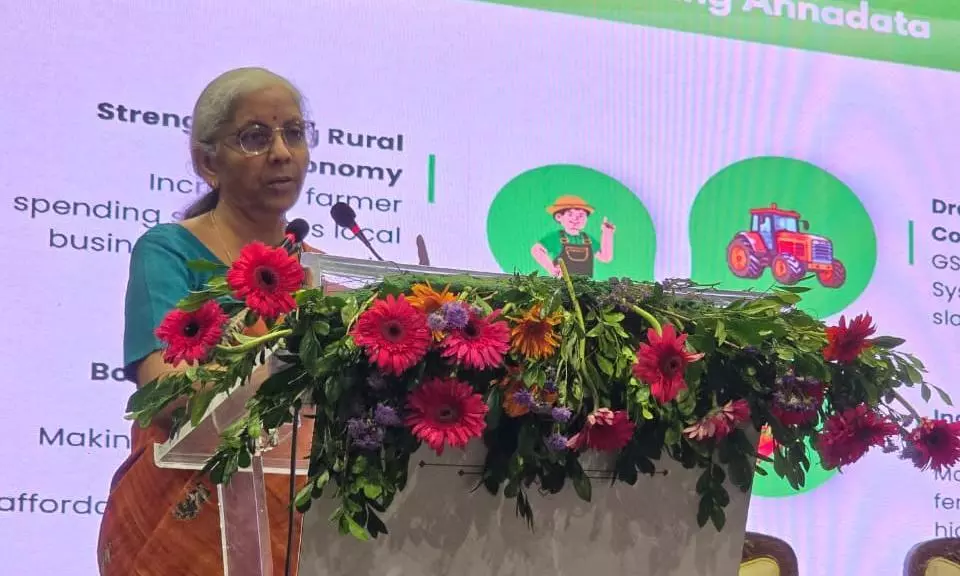
New Delhi: Union finance minister Nirmala Sitharaman on Friday highlighted India’s role as a stabilising force in the global economy, while cautioning against the risks of imbalances and volatility. She also said that the government is committed to increasing state capital spending to support economic growth, stressing that the economy has remained resilient despite global headwinds.
“India’s capacity to absorb external shocks is strong at a time when the world economy is undergoing a structural transformation and the task before nations is not only to manage uncertainty but to confront trade, financial and energy imbalances,” Sitharaman said, while speaking at the Kautilya Economic Conclave 2025, organised by the finance ministry.
On the Indian economy, Sitharaman also said that over the past decade that the government has focused on fiscal consolidation, improving the quality of capital expenditure, and reining in inflationary pressures. “With the steady share of consumption and investment in the overall GDP over the years, India’s growth is firmly anchored in its domestic factors, which minimises the impact of external shocks on overall growth. As a result, the Indian economy is resilient and continues to grow sustainably,” she said.
Concerned with the escalating US tariff issue, Sitharaman also said that geopolitical conflicts are intensifying, and sanctions and tariffs are reshaping global supply chains. “India must continue to remain vigilant, and there is no room for complacency. Wars and strategic rivalries are redrawing the boundaries of cooperation and conflict. Alliances that once appeared solid are being tested, and new coalitions are emerging,” she said.
For India, the finance minister also said that these dynamics highlight both vulnerability and resilience. “Our capacity to absorb shocks is strong, while our economic leverage is evolving. The task before us, therefore, is not simply to manage uncertainty but to confront imbalance. We must ask ourselves — how can we build a global order where trade is fair, finance serves productive ends, energy is both affordable and sustainable, and climate action aligns with development imperatives?” the minister said.
She further said that there is a need to work on ways for international institutions to reflect today’s realities rather than yesterday’s hierarchies, besides ensuring that the voices of developing nations are no longer marginalised in rule-making, and are instead amplified in shaping the future. “Dislocations define this new global era wherein trade flows are being reshaped, alliances are being tested, investments are being rerouted along geopolitical lines, and shared commitments are being re-examined,” she added.
The finance minister further said that the foundations of the global order are shifting as the world that emerged after the end of the cold war, which led to the expansion of globalisation, open markets and the pursuit of multilateral cooperation, now appears to be a relic of the past. “For three decades, a contested equilibrium allowed nations to pursue prosperity through integration and interdependence. That equilibrium has inevitably been upended, and the rules of international engagement are being rewritten,” she added.
