DGCA Proposes Allowing Service Dogs on Flights for Disabled Passengers

To ensure safety of aircraft operations, the maximum number of non-ambulatory persons with disability or reduced mobility permitted to travel in a single flight shall not be more than the number of cabin crew, except when such passengers are accompanied by trained escorts.
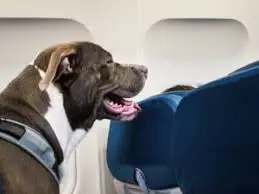
New Delhi: The directorate-general of civil aviation (DGCA) has prepared draft rules with proposed amendment in Section 2 of the Civil Aviation Requirements (CAR), making air travel easier and more accessible to people with disabilities and reduced mobility. The DGCA laid down regulations in order to protect them against any form of discrimination and to ensure that they receive all possible assistance during their travel.
Accordingly, persons with disability, both physical and mental, and those with restricted mobility can travel with service dogs provided the animal is vaccinated and well trained to handle flight journeys in the cabin.
“Airlines shall develop procedures for carriage of guide dogs, if required in the cabin, for the assistance of persons with disability or reduced mobility. Guide dogs may be permitted in the cabin subject to the condition that they are properly trained, remain on the floor at the passenger’s feet, properly harnessed and vaccinated. Passengers with guide dogs shall be required to show written proof to the airline that their guide dog has been trained from appropriate institutions, vaccinated and medicated,” the DGCA draft rules say.
In India, service dogs are allowed in the cabin only by a few airlines like Air India, which defines a service animal as a dog that is individually trained to do work or perform tasks for the benefit of a qualified individual with a disability, including a physical, sensory, psychiatric, intellectual, or other mental disability.
Under the draft rules, no airline shall refuse to carry those with disability or reduced mobility and their assistive aids/devices, escorts and guide dogs, including their presence in the cabin, provided such persons or their representatives, at the time of booking, inform the airline of their requirements.
Passengers who intend to check-in with their own wheelchair shall be given the option of using an airport wheelchair. If the passengers prefer to use their own non-battery and battery- operated wheelchairs, they shall be permitted to use it provided the wheelchair conforms to specifications issued by the civil aviation ministry. Battery-operated wheelchairs shall be permitted provided they conform to specifications as per dangerous goods regulations or airline policy, which are to be displayed on their websites. Such wheelchair shall be capable of manoeuvring through various areas of the airport, security hold and up to the aircraft, whereupon it may be stowed at an appropriate place in the aircraft. At the time of disembarking, the passenger’s wheelchair should be returned to enable transfer from the seat directly into his/her own wheelchair.
The draft rules say no airline shall refuse to carry passengers in a stretcher or incubator, subject to limitation of aircraft, when they are accompanied by an escort, provided such a person is capable of attending to the passenger’s medical needs during embarking, disembarking, in-flight and emergency evacuation.
To ensure safety of aircraft operations, the maximum number of non-ambulatory persons with disability or reduced mobility permitted to travel in a single flight shall not be more than the number of cabin crew, except when such passengers are accompanied by trained escorts.
While airlines and airports are required to provide free wheelchair assistance to passengers with disability or restricted mobility and as per rules, passengers are required to notify their needs at least 48 hours before the time of departure to enable airline make necessary arrangements for special assistance. However, for free wheelchair services, passengers may now have to provide documentation with regard to their physical condition requiring a wheelchair.
The airlines can offer paid services for wheelchair assistance to able-bodied passengers, while keeping services free for people with physical, mental disabilities or restricted mobility, the DGCA has proposed, in order to curb the alleged misuse of wheelchairs at airports. “Airlines may levy an appropriate assistance fee from passengers other than the persons with disability and persons with reduced mobility who opt to use these services,” the proposed rules say.
Airlines may also issue IATA Medical Manual prescribed Frequent Travellers Medical Card (FREMEC) to those passengers with chronic, but stable medical conditions, and those with additional needs, for their future travel. At airports, flight information systems should be positioned in such a way to ensure its readability by people in wheelchairs and those with visual impairment. Provision of audible announcements should be made for people who are not able to use visual displays such as blind people and those with learning disability.
“Airport operators shall ensure that persons with disability or reduced mobility are transported within the airport in the same condition, comfort and safety as those available for other passengers,” the draft rules say.
