Authorities Tighten Curbs Across Kashmir as Protests Continue

By Monday, eyewitnesses reported that movement in Lal Chowk was minimal, with only a handful of people allowed to pass under strict monitoring
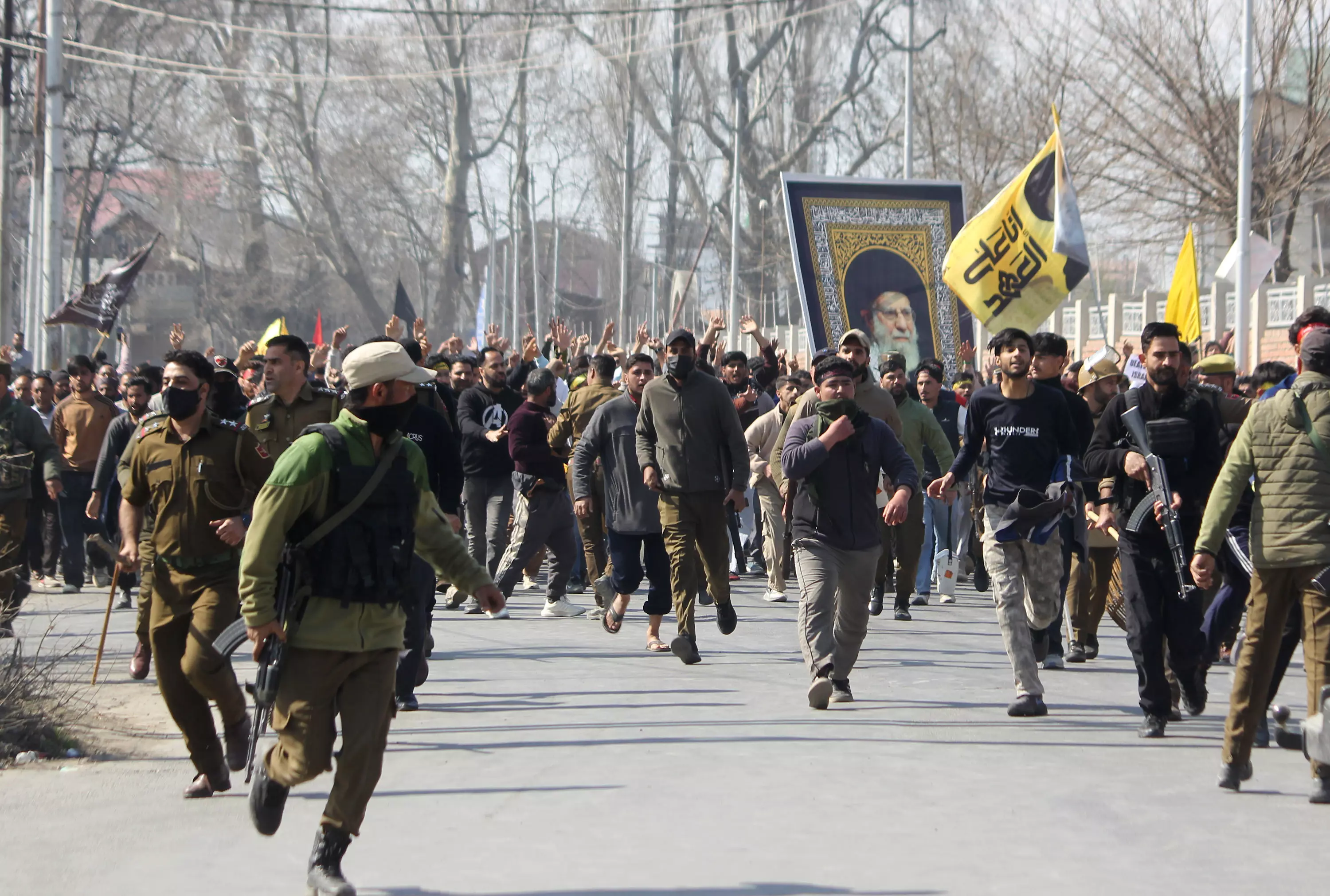
SRINAGAR: Authorities on Monday enforced sweeping restrictions across all districts of the Kashmir Valley in an effort to contain renewed protests over the killing of Iran’s Supreme Leader Ayatollah Syed Ali Khamenei in a joint American‑Israeli air strike. The curbs followed a massive outpouring of grief on Sunday, when tens of thousands of people across Kashmir, parts of Jammu, and Ladakh took to the streets in mourning processions and demonstrations.
Security across Kashmir was placed on maximum alert, with fresh deployments of police and Central Armed Police Forces (CAPFs) in areas assessed as sensitive. In capital Srinagar, the iconic Lal Chowk—the city’s commercial and symbolic centre—was completely sealed off. All entry points were barricaded, pedestrian movement was halted, and vehicular traffic was barred. The area, which on Sunday had been overtaken by one of the largest gatherings of mourners, now wore a deserted look under heavy surveillance.
On the previous day, thousands had filled the square, reciting elegies, beating their chests in traditional mourning rituals, and describing Khamenei’s killing as a “sacrifice against tyranny and aggression.” Protesters had mounted large portraits of Khamenei and other Iranian political, religious, and military figures—many killed in past US‑Israeli operations—on the historic clock tower, turning the city centre into a sprawling visual memorial.
The mourners had also offered Zuhr and Asr prayers consecutively, performing the two obligatory congregational prayers back‑to‑back to maintain unity and spiritual focus amid the charged atmosphere. By Monday, however, eyewitnesses reported that movement in Lal Chowk was minimal, with only a handful of people allowed to pass under strict monitoring. Shops remained shuttered, and public transport stayed off the roads. Similar restrictions were imposed across downtown Srinagar and other sensitive intersections, where checkpoints were set up to regulate movement and prevent gatherings.
Officials described the measures as precautionary, aimed at preventing any escalation after Sunday’s large‑scale demonstrations. No major incidents were reported until the time of filing, though the overall atmosphere remained tense.
Political leaders sharply criticised the clampdown. The office of ruling National Conference (NC) MP Aga Syed Ruhullah Mehdi called the closure of Ghanta Ghar – the clock tower at Lal Chowk- a “disgrace,” arguing that people had assembled peacefully to mourn and express solidarity.
“The closure of Ghanta Ghar is a disgrace. It is available for dance and music parties, which is the symbolic identity you want to attach to it. But when people came out to mourn, to stand in solidarity with the innocent lives being torn apart, it threatens you in spite of the fact that the demonstrations were entirely peaceful. Every single one. No wonder there is word about people from our country named in Epstein files. Do not insult us by treating our grief as a law and order problem. Do not interfere in what are deeply emotional moments for the people of Kashmir. And to those giving these orders: do not side with tyrants. Do not prove the loyalties of your masters to the satanic kings of Israel by suppressing the voices of your own people. This is a shameful act,” the post read.
His party colleague and MLA Tanvir Sadiq echoed the sentiment, saying that thousands had mourned without any breach of law and order. “Mourning is not a crime. Grief is not unrest,” he said, urging the Union Home Minister and the Lieutenant Governor to reconsider the restrictions.
Some religious and political leaders claimed they have been placed under house arrest. One of them, Maulvi Masroor Abbas Ansari, in a post on ‘X’, said, “Although all of yesterday’s protest marches were entirely peaceful, the authorities have arbitrarily imposed restrictions across Kashmir, and I have also been placed under house arrest. These are not precautionary measures; they are deliberate attempts to silence our just voices.”
The decision to impose security restrictions across several parts of the Valley came after a high‑level review meeting held in Jammu and chaired by Lieutenant Governor Manoj Sinha. Senior administrative and security officials, including the Chief Secretary, the Director General of Police, and all district heads, attended the meeting, which focused on assessing the law‑and‑order situation amid rising tensions. According to official statements, the administration emphasised the need for vigilance, inter‑agency coordination, and community cooperation to maintain stability.
Following the meeting, the Lieutenant Governor’s office posted a message on ‘X’, noting that he had reviewed the security situation across the Union Territory and appealed to all communities to remain peaceful and calm. He also commended what he described as the “unwavering, coordinated resolve” of the police, security forces, and civil administration in upholding law and order. The administration reiterated that it was closely monitoring regional developments and coordinating with national authorities to ensure public safety.
Despite the curbs, fresh protests erupted on Monday in several parts of Kashmir, marking the second consecutive day of demonstrations. Officials confirmed that gatherings were reported from Bemina, Gund Hassi Bhat, and Jehangir Chowk in Srinagar, as well as Pulwama town in south Kashmir. Scores of protesters—mostly from Shia‑majority neighbourhoods—marched through the streets, raising anti‑US and anti‑Israel slogans. In some locations, the police fired teargas canisters to disperse the crowds.
In the neighbouring Kargil district of Ladakh, mourning processions and protests also continued for the second day, reflecting the deep resonance of the event across the region’s Shia‑populated areas.
Shia leader and former minister Imran Reza Ansari appealed to the community youth to express their “sacred” grief with dignity. “Hold Majlis, Marsiya, and gatherings in your local Imambargahs and in your own areas. Keep the mourning restricted to your respective areas. Do not allow emotions to be misused or diverted in any direction that harms our community,” he wrote on ‘X’. He, however, also said, “At the same time, if the administration has issued notifications, let us abide by them. Discipline is also part of azadari. I also urge Jammu & Kashmir Police to continue the maximum restraint they showed yesterday. It was commendable. This is an extremely emotional time for the community, and sensitive handling will maintain peace and respect the sentiments of mourners. Our tears are our protest. Our majlis is our resistance. Let us mourn with unity, patience, and responsibility.”
The Muttahida Majlis‑e‑Ulama (MMU), a coalition of leading religious organisations in J&K, had called for a complete shutdown on Monday and urged people to observe it with dignity, calm, and discipline as the region continued to grapple with widespread grief and tension. Former Chief Minister Mehbooba Mufti voiced her support for the shutdown, describing the day as one of collective sorrow and reflection. She said the moment served as a reminder that injustice anywhere reverberates across the entire Muslim Ummah and among all people who stand for truth and human dignity. Mufti added that the people of J&K stood united in grief and solidarity with Iran during what she called a profoundly difficult and painful time.
Responding to the volatile atmosphere, the J&K administration ordered a two‑day closure of all educational institutions across the Kashmir Valley beginning Monday. Schools, colleges, and universities were instructed to suspend in‑person classes, with officials describing the move as a precaution aimed at ensuring the safety of students and staff. Authorities said the temporary shutdown was necessary to prevent students from being caught in potential flashpoints as the situation remained unpredictable.
