Air India Crash Report: Fuel Switch Shifted from Run to Shut Off

It appears this transition may have happened due to technical malfunctioning of the system but AAIB will need more time to reach to this conclusion.
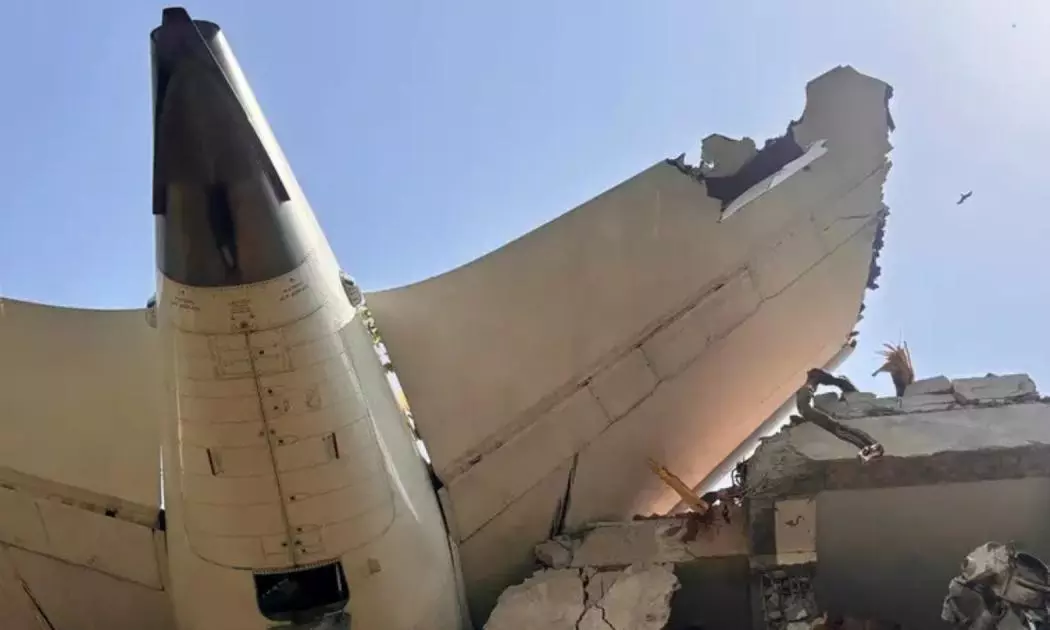
New Delhi: The Aircraft Accident Investigation Bureau’s (AAIB) preliminary report on Air India AI 171 plane crash in Ahmedabad indicates fuel supply shut down to both engines, one after the other, due to fuel switch being shifting from “Run” to “Cut Off” mode immediately after take off which led to engine shut down and crash.
The sound picked up from the Cockpit Voice Recorder of the Boeing 787 that crashed indicated that during the take off the fuel system transitioned from “Run” to “Cut Off” prompting one of the pilots to ask the other why did he shut it off. The second pilot responded saying “he didn’t do it”. The pilots then tried to bring fuel switches back to “Run” mode and attempted to relight the engines due to which Engine 1 showed partial recovery but Engine 2 was incapable of sustaining any recovery as a result RAT (Ram Air Turbine) got deployed to supply hydraulic power as both engines fell below minimum idle rate. The aircraft was airborne for just 32 seconds before crashing into a medical hostel near the runway.
It appears this transition may have happened due to technical malfunctioning of the system but AAIB will need more time to reach to this conclusion. The other possibilities could be of electrical system failure, fuel pump or valve malfunction, software or fuel sensor malfunctioning. While the report rules out a case of bird hit, fuel contamination or any sabotage it does mention an advisory of 2018 by United States Transport Department’s Federal Aviation Administration (FAA) that indicated a possible fuel switch flaw existed in Boeing’s certain category of planes. However, Air India did not carry out inspections on this possible flaw since it was only an advisory, the report said.
But since the report is silent on how this happened or who did it, the pilots body – Airline Pilots Association of India -- has raised objections to the report saying its tone and direction suggests a bias towards pilot error and has sought fair, fact-based inquiry. Referring to the FAA report on fuel control switch gates which indicated potential equipment malfunction, the association asked if recommendations of the FAA bulletin were implemented prior to flight. The pilot’s body also accused the government of lack of transparency in investigation and questioned how the sensitive information on fuel control switches in the report got leaked to international media houses before it was officially released?
However, Civil Aviation Minister Mr K. Rammohan Naidu insisted it is too early to reach to any conclusion and people should wait for the full report. The final report is expected to come after one year.
The report said both pilots were well experienced, medically fit and had adequate rest period prior to operating the flight. They underwent pre-flight Breath Analyzer test and were found fit to operate the flight. The aircraft was within weight and balance limits and had no dangerous goods onboard. It was carrying 54, 200 kg of aviation fuel.
The report, based on the preliminary facts and evidence collected during the investigation of the crash, was made public by AAIB in accordance with rules of the Convention on International Civil Aviation Organization (ICAO) under which the initial report has to be released within 30 days of the accident. The AAIB said the sole objective of the investigation of an accident or incident shall be the prevention of accidents and incidents and not apprortion blame or liability.
The AAIB report also mentions the `Special Airworthiness Information Bulletin’ (SAIB) issued by FAA on December 17, 2018, regarding the potential disengagement of the fuel control switch locking feature on Boeing planes. This SAIB was issued based on reports from operators of model 737 airplanes that the fuel control switches were installed with the locking feature disengaged. However, this was not considered as an such unsafe condition to warrant airworthiness directive (AD) by the FAA. The fuel control switch design, including the locking feature, is similar on various Boeing airplane models which is fitted in B787-8 aircraft VT-ANB.
AAIB said that as per information from Air India, the suggested inspections were not carried out as the SAIB was advisory and not mandatory. The scrutiny of maintenance records revealed that the throttle control module was replaced on VT-ANB in 2019 and 2023. However, the reason for the replacement was not linked to the fuel control switch. “There has been no defect reported pertaining to the fuel control switch since 2023 on VT-ANB,” the AAIB report said.
Responding to the preliminary report, Air India said it is working closely with stakeholders, including regulators. “We continue to fully cooperate with the AAIB and other authorities as their investigation progresses. Given the active nature of the investigation, we are unable to comment on specific details and refer all such enquiries to the AAIB,” the airline said in a statement.
Boeing in a statement said, “We will defer to the AAIB to provide information about AI171, in adherence with the United Nations International Civil Aviation Organisation protocol known as Annexure 13.”
Annexure 13 provides for Accident Data Report, i.e., a detailed final report prepared by the State instituting the investigation and distributed with maximum dispatches to Contracting States together with any safety recommendations.
The initial investigation reveals that the aircraft achieved the maximum recorded airspeed of 180 Knots Indicated Air Speed at about 08:08:42 UTC (Coordinated Universal Time) and immediately thereafter, the Engine 1 and Engine 2 fuel cut off switches transitioned from RUN to CUTOFF position one after another with a time gap of 1 second. The Engine N1 and N2 began to decrease from their take-off values as the fuel supply to the engines was cut off. In the cockpit voice recording, one of the pilots is heard asking the other why did he cutoff. The other pilot responded that he did not do so.
The CCTV footage obtained from the airport showed RAT getting deployed during the initial climb immediately after lift-off. As per the Enhanced Airborne Flight Recorder (EAFR) data both engines N2 values passed below minimum idle speed, and the RAT hydraulic pump began supplying hydraulic power at about 08:08:47 UTC.
Thereafter, the Engine 1 fuel cutoff switch transitioned from CUTOFF to RUN at about 08:08:52 UTC. The Auxiliary Power Unit (APU) Inlet Door began opening at about 08:08:54 UTC, consistent with the APU Auto Start logic. Thereafter, at 08:08:56 UTC the Engine 2 fuel cutoff switch also transitions from CUTOFF to RUN. When fuel control switches are moved from CUTOFF to RUN while the aircraft is inflight, each engines full authority dual engine control (FADEC) automatically manages a relight and thrust recovery sequence of ignition and fuel introduction. The Exhaust Gas Temperature (EGT) was observed to be rising for both engines indicating relight. Engine 1’s core deceleration stopped, reversed and started to progress to recovery. Engine 2 was able to relight but could not arrest core speed deceleration and re-introduced fuel repeatedly to increase core speed acceleration and recovery.
The EAFR recording stopped at 08:09:11 UTC. At about 08:09:05 UTC, one of the pilots transmitted “MAYDAY MAYDAY MAYDAY”. The Air Traffic Control Officer (ATCO) enquired about the call sign but did not get any response and observed the aircraft crashing outside the airport boundary following which he activated the emergency response.
AAIB report says at this stage of investigation, there are no recommended actions to B787-8 and GE GEnx-1B engine operators and manufacturers as investigation is continuing and the team will examine additional evidence, records and information.
