Forest Fire Along LoC Triggers Landmine Blasts; Kashmir Logged 310 Forest Fires in 2025

According to officials, nearly a dozen landmines embedded along the LoC detonated as the flames advanced through the dry vegetation. These forward belts are heavily mined as part of the anti‑infiltration obstacle system designed to prevent cross‑border militant movement
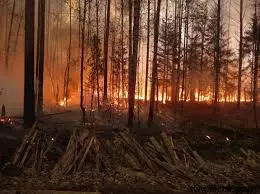
SRINAGAR: A forest fire raging for the second consecutive day along the Line of Control (LoC) in Jammu and Kashmir’s Poonch district triggered a series of landmine explosions, officials said on Tuesday. The blaze, which erupted on Monday afternoon in the Basooni forward area of the Balakote sector, intensified overnight and spread into parts of the adjoining Mendhar sector by Tuesday morning.
According to officials, nearly a dozen landmines embedded along the LoC detonated as the flames advanced through the dry vegetation. These forward belts are heavily mined as part of the anti‑infiltration obstacle system designed to prevent cross‑border militant movement. The explosions, though expected during intense fires in mined zones, have heightened security concerns in the area.
With the possibility of infiltration attempts rising under the cover of fire and smoke, security forces have strengthened multi‑tier deployment and intensified patrolling along vulnerable stretches. Officials noted that such fires—whether natural or human‑induced—can compromise surveillance systems and create temporary gaps in the obstacle grid, prompting heightened vigilance.
Separately, official data shows that the Kashmir Valley witnessed 310 forest fire incidents in 2025, affecting more than 880 hectares of forest land across multiple divisions. While the numbers reflect a decline compared to the previous year, the scale of damage remains significant.
In total, 880.77 hectares of forest area were impacted. The Sindh Forest Division reported the highest number of incidents at 67, affecting 111.06 hectares. Kamraj Forest Division followed with 52 incidents damaging 67.90 hectares. Anantnag recorded 37 fires that affected 60.25 hectares, while Bandipora logged 29 incidents impacting 60.35 hectares, local news agency KNS said, quoting officials.
The Lidder Forest Division saw 25 incidents but suffered a comparatively larger loss of 110.95 hectares. Kulgam, with 22 incidents, recorded the highest area damaged in the Valley—307.85 hectares—making it the most severely affected division in terms of land loss.
Tangmarg and Kehmil divisions reported 18 incidents each, damaging 36.05 hectares and 43.55 hectares respectively. The JV Forest Division recorded 16 incidents affecting 41.21 hectares. Awantipora witnessed nine incidents with 30.70 hectares damaged.
Shopian, Langate, and Pir Panjal divisions each reported five incidents, with losses ranging from 1.70 to 4.02 hectares, while the Urban Forest Division recorded the lowest figures—two incidents affecting just over 2 hectares.
Environmental experts say the data underscores the persistent pressure on Kashmir’s forest ecosystems. They argue that despite a marginal decline in incidents, the overall vulnerability remains high, particularly in divisions like Kulgam, Lidder, and Sindh. Officials echoed this view, noting that division‑wise patterns point to the need for targeted interventions, improved early‑warning systems, and faster response mechanisms to minimise future fire‑related damage.
