CJP's Chalo Sansad March Turns Violent Prompting Police Action

The police said those detained were not students, and their identities were being verified even as authorities stepped up investigation into the violence. The police also said that they are investigating the motive behind the clash, and even "outer-side angles” will also be probed
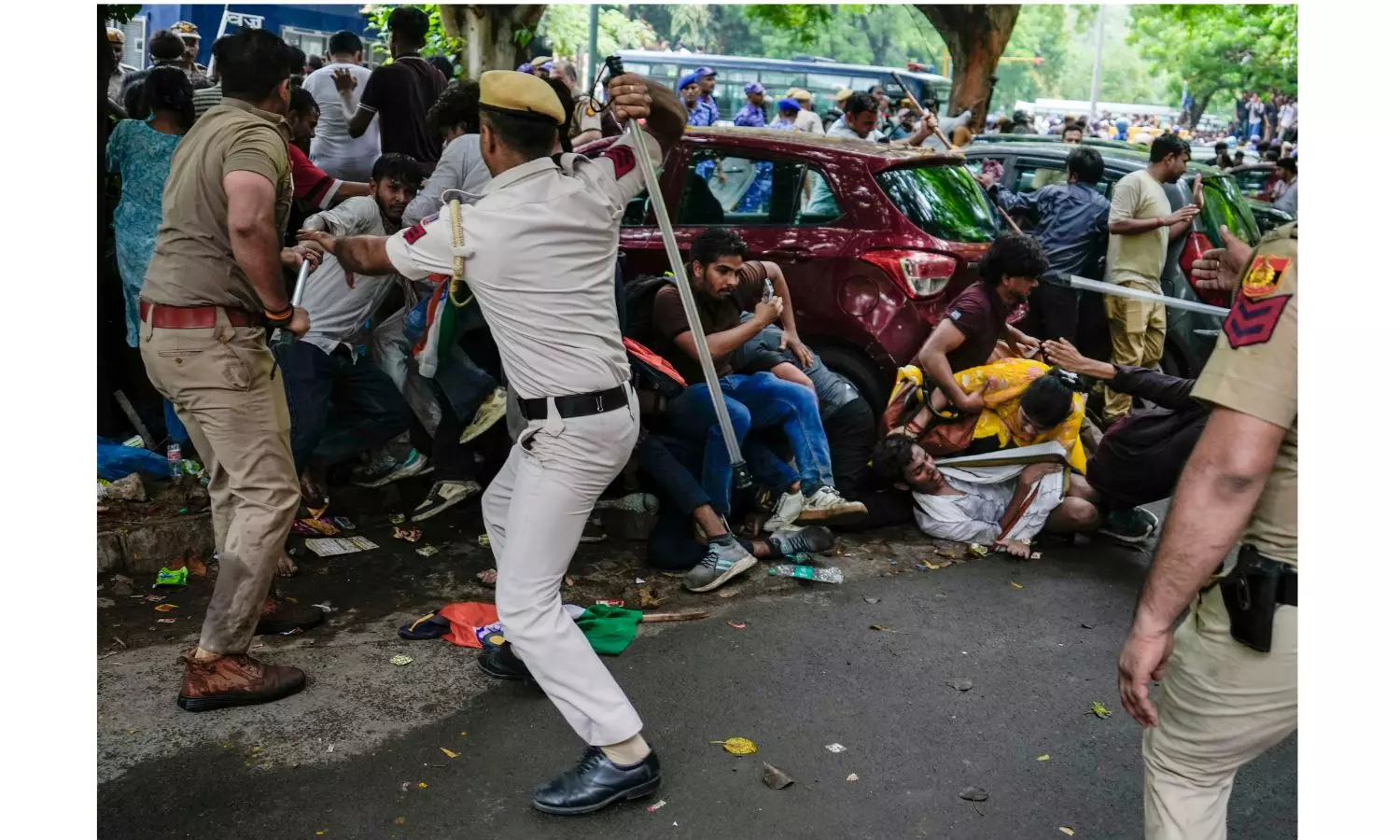
New Delhi: Thousands of students and youths converged on central Delhi on the opening day of Parliament's Monsoon Session on Monday as the Cockroach Janta Party’s (CJP) “Chalo Sansad” march descended into violent clashes, prompting police to use tear gas and baton charges. More than 160 people, including 118 police personnel and several senior officers, were injured, over 100 protesters were detained, and the month-long protest site at Jantar Mantar was dismantled.
Even as security forces cleared the site by evening, the agitation showed no signs of ending, with activist Sonam Wangchuk extending his indefinite hungerstrike and the CJP declaring it would continue its protest until Union education minister Dharmendra Pradhan resigns.
With authorities anticipating a massive turnout, earlier in the day the New Delhi district was turned into a security fortress. More than 5,000 Delhi police personnel, backed by around 40 companies of paramilitary forces and Rapid Action Force teams, were deployed. The Internet remained shut for most parts of the day across central Delhi. Prohibitory orders under Section 163 of the Bharatiya Nagarik Suraksha Sanhita (BNSS) remained in force, multi-layer barricades sealed roads leading to Parliament, Internet services were suspended in parts of central Delhi, and five Metro stations – Rajiv Chowk, Janpath, Patel Chowk, Central Secretariat and Seva Teerth – were closed as a precaution.
Despite the restrictions, thousands assembled at Jantar Mantar from early morning before marching towards Parliament carrying the tricolour and placards. The gathering included school and college students, civil services aspirants, parents and senior citizens. Some protesters wore school uniforms while others dressed in cockroach costumes.
Raising slogans of “Dharmendra Pradhan istifa do”, “Bharat Mata ki jai”, “Vande Mataram” and “Jai Bhim”, protesters attempted to cross police barricades at Parliament Street, Patel Chowk, Constitution Club, Rail Bhavan and Shastri Bhawan.
The police alleged that sections of the crowd resorted to stone-pelting while attempting to breach barricades, forcing security personnel to use tear gas shells and baton charges to disperse them. Protest leaders denied orchestrating any violence, insisting the march was peaceful and accusing police of using excessive force without provocation. There were also reports of vandalism. Connaught Place too bore the brunt as stone pelting damaged police and private vehicles.
The violence also resulted in extensive damage to public property, with around 15 to 20 government vehicles and other government assets allegedly vandalised.
More than 100 protesters were detained, officials said, adding they would be released after verification and completion of legal formalities.
The police sources said they were verifying the authenticity of all the videos and that appropriate legal action would be taken based on the findings. The officer said the Delhi police had initiated the process of registering FIRs in connection with the clashes, damage to police vehicles and destruction of public property during the protest, while security has been further intensified across key locations in the high-security district.
The police said those detained were not students, and their identities were being verified even as authorities stepped up investigation into the violence. The police also said that they are investigating the motive behind the clash, and even "outer-side angles” will also be probed.
The police is also scrutinising social media videos and other digital evidence to establish the sequence of events and identify those who allegedly participated in the violence, the officer said.
They said more than 50 personnel, including IPS and DANIPS officers, sustained injuries during the clashes. Hospital authorities and police sources said over 50 protesters were also injured. Ram Manohar Lohia Hospital alone recorded 65 medico-legal cases involving both protesters and police personnel till 7 pm, while around 10 hunger strikers were medically examined and found stable.
The clashes also disrupted normal life in the national capital. Traffic remained snarled for hours in and around Central Delhi and its periphery while commuters were stranded after the closure of Metro stations and restrictions on movement in the high-security zone.
At the centre of the agitation remained Mr Wangchuk, whose hungerstrike has become the defining symbol of the movement. Mr Wangchuk, who was shifted to Safdarjung Hospital by the Delhi police after 21 days of fasting, announced that he would continue his indefinite fast after witnessing what he described as police action against peaceful protesters.
In a handwritten statement issued from the hospital, Mr Wangchuk said he would continue fasting until student leaders were allowed to meet members of Parliament or he was permitted to do so from the hospital.
Earlier in the day, Mr Wangchuk had written to the hospital’s medical superintendent seeking temporary permission to join the march, saying he felt fit and his health parameters were normal, but the request was declined. Safdarjung Hospital later in the evening said his vital parameters remained stable. Doctors said while Mr Wangchuk’s blood-sugar levels remain on the lower side, other blood parameters have shown improvement following oral rehydration therapy (ORT) and potassium-syrup supplementation.
During a hearing on Mr Wangchuk’s hospitalisation earlier in the day, the Delhi high court directed the heads of the emergency medicine departments of AIIMS and Safdarjung Hospital to appear before it on Tuesday. His counsel said the court had also directed both sides to place all available medical reports on record and sought details of Mr Wangchuk’s medical monitoring.
Even as police dismantled the month-old protest camp at Jantar Mantar by removing the stage, tents and other materials, protesters regrouped within hours.
Hours later, at Jantar Mantar, CJP leaders Abhijeet Dipke, Saurav Das, Gitanjali J. Angmo and other front-line leaders addressed the teeming protest venue.
Addressing supporters after the march from the deck of a tempo, CJP founder Mr Dipke accused the police of using force and asserted that the protest, which took an ugly, violent turn, will continue peacefully.
“The police has been absolutely brutal. They have broken the scalps of many students. A 15-year-old girl was beaten by a male police officer, and they even tried to pull Gitanjali’s hair and drag her away,” Mr Dipke alleged while displaying what he claimed was the torn top of an injured protester.
The Delhi police rejected the allegations as “false and misleading”, denying that Mr Wangchuk’s wife Ms Angmo had been assaulted. The police also dismissed reports that Mr Dipke had been detained, stating he remained “available on stage” during the day.
“This government wants to break the morale of the people. I didn’t come back from the US to back off. We are not leaving until Dharmendra Pradhan resigns,” he said.
In the evening Mr Dipke briefly fainted during sit-in at Jantar Mantar and was escorted away by fellow protesters.
Ms Angmo termed the march “hugely successful” and said, “It awakened national consciousness on education; can’t trust the government until our demands are met.”
The protests also echoed inside Parliament, triggering repeated disruptions in both Houses. Congress leaders Rahul Gandhi and Priyanka Gandhi Vadra accused the government of failing the country’s youth and questioned the lack of accountability over repeated examination paper leaks. AAP convenor Arvind Kejriwal, CPI(M) leaders M.A. Baby and Brinda Karat, Samajwadi Party MP Dimple Yadav, actor Shabana Azmi, Prakash Raj and several Opposition leaders joined demonstrations near Parliament, while solidarity protests were reported from Mumbai, Ahmedabad and other cities.