Congress to Launch Nationwide Stir for MGNREGA from Jan. 10

Venugopal said the VB GRAM G framework fundamentally weakens MGNREGA by converting a statutory Right to Work into a discretionary, Centrally controlled scheme.
New Delhi: The Congress on Saturday announced a nationwide agitation to seek restoration of the Mahatma Gandhi National Rural Employment Guarantee Act (MGNREGA) in its original form. The party said it would launch the ‘MGNREGA Bachao Sangram’ from January 10, with the agitation continuing till February 25. It reiterated its demand for the withdrawal of the VB–GRAM–G Act, restoration of MGNREGA as a statutory rights-based programme, and protection of the people’s Right to Work and Panchayati Raj institutions.
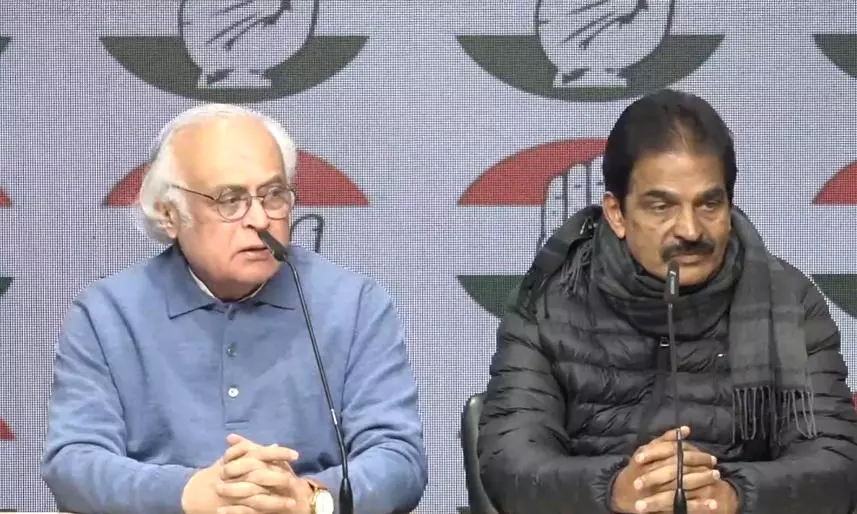
Addressing a press conference at the AICC headquarters in New Delhi, Congress general secretary (organisation) K.C. Venugopal and general secretary (communications) Jairam Ramesh outlined the one-and-a-half-month-long nationwide programme.
Venugopal said the VB GRAM G framework fundamentally weakens MGNREGA by converting a statutory Right to Work into a discretionary, Centrally controlled scheme. He said the new framework replaces a demand-driven law with a budget-capped programme, under which employment would be available only in centrally notified panchayats, leaving millions of rural households without a legal entitlement to work.
He said the introduction of “normative allocations” meant employment would stop once funds were exhausted, regardless of rural distress, thereby eroding the legal enforceability of work under MGNREGA.
Venugopal also expressed concern over the reduced Central contribution, alleging that the Centre was shifting the financial burden to states by limiting its share to 60 per cent of wages, compared to full funding earlier. He said poorer states would be forced either to deny work or divert funds from sectors such as health, education and welfare.
Rejecting claims of 125 days of guaranteed employment as misleading, he said reduced Central funding would effectively translate into fewer workdays.
Detailing the agitation schedule, Venugopal said PCC-level preparatory meetings would be held on January 8, followed by district-level press conferences on January 10. One-day fasts would be organised on January 11 near statues of Mahatma Gandhi or Dr B.R. Ambedkar. From January 12 to 29, panchayat-level chaupals and mass outreach programmes would be held, during which letters from Congress president Mallikarjun Kharge and Leader of Opposition Rahul Gandhi would be personally delivered to gram pradhans, former gram pradhans, rozgar sevaks and MGNREGA workers.
Peaceful sit-ins are planned at ward and block levels on January 30, Martyrs’ Day. District-level ‘MGNREGA Bachao’ dharnas will be held from January 31 to February 6, followed by state-level gheraos in front of Vidhan Sabhas, Raj Bhawans or Central government offices from February 7 to 15. The agitation will culminate in four zonal mega rallies between February 16 and 25.
Speaking on the occasion, Jairam Ramesh said the new framework guarantees only “dangerous centralisation”, arguing that there was neither assured employment nor assured financial support to states. Drawing a parallel with the farmers’ agitation against the three farm laws, he said the MGNREGA Bachao Sangram would be carried out across panchayat, block, district and state levels, rather than being confined to New Delhi.
