Congress Split Deepens on Joining Omar Govt.; High Command To Decide

Karra opposes joining without statehood, while rivals push to accept the NC offer
Srinagar: A fresh and increasingly visible divide has emerged within the Jammu and Kashmir Congress over whether the party should enter the Omar Abdullah–led government. What began as a quiet internal debate has now spilled into the open, exposing competing political instincts, strategic anxieties, and personal disagreements inside the JKPCC at a moment when the party is struggling to retain relevance in the Union Territory.
At the heart of the dispute is a renewed offer from the National Conference (NC) to accommodate the Congress with one ministerial berth in the upcoming cabinet expansion. A significant section of the JKPCC believes the party cannot afford to reject the offer, arguing that maintaining the alliance with the NC is essential for preserving political space in both Kashmir Valley and Jammu.
These leaders contend that even a single cabinet berth carries symbolic value and refusing it could signal disunity within the opposition at a time when cohesion against the BJP is politically crucial. They also acknowledge the practical challenge of selecting a minister from Congress’s small and uneven pool of six MLAs, but insist that the alliance’s stability matters more than the difficulty of choosing an individual.
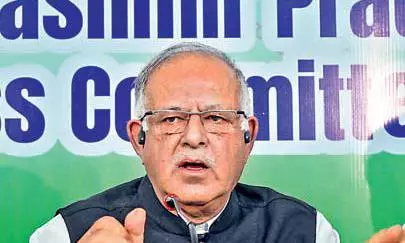
However, an equally strong faction—led by JKPCC chief Tariq Hameed Karra—has taken a sharply different line. Karra has repeatedly asserted that Congress will not join the government until full statehood is restored to J&K. Addressing a public gathering in Reasi on Thursday, he emphasised that the demand for restoring statehood has been the party’s consistent position from the very beginning, and that Congress intends to stand firmly by it until J&K regains its full constitutional status. He reiterated that statehood remains a core demand, making it clear that the party’s stance will not shift unless the Union Territory is granted complete statehood.
Karra’s decision to articulate this position publicly—before the party high command could deliberate—has not gone down well with senior leader Ghulam Ahmed Mir. Concerned that Karra’s remarks may prematurely close the door on negotiations, Mir rushed to New Delhi to meet the party leadership and make a case for accepting the NC’s offer. His intervention reflects a broader worry within the party that Congress, already organisationally weakened, cannot afford to alienate its most consequential ally in J&K.
The AICC leadership has so far maintained a cautious posture. Syed Naseer Hussain, AICC General Secretary in charge of J&K, reiterated on Monday that the party’s stated position is not to join the cabinet until statehood is restored. However, he while speaking to local news agency KNO added that any alteration in this stance rests solely with the party high command. “High command will take a decision,” he said when asked whether Congress might reconsider. His remarks underscore the delicate balancing act underway in New Delhi, where political principle, alliance management, and organisational realities are all being weighed.
This internal churn comes against the backdrop of a complex alliance history. The NC–Congress partnership was forged ahead of the 2024 Assembly elections out of mutual necessity- NC sought to consolidate its dominance in Kashmir while expanding into Jammu, and Congress—reeling after 2019—saw NC as the only viable partner capable of challenging the BJP. Their seat-sharing arrangement yielded strong results- NC won 42 seats and Congress 6, giving the coalition a comfortable majority in the 90-member Assembly. Yet Congress declined to join the government when Omar Abdullah took oath in October 2024, insisting on two cabinet berths rather than the single position offered. When NC cited the legal cap of nine ministers under the J&K Reorganisation Act, Congress reframed its refusal as a principled stand for statehood.
Remaining outside the government also suited Congress’s internal calculations. With only six MLAs, the party feared being overshadowed within the administration and preferred to retain autonomy, rebuild its organisation, and avoid being blamed for governance shortcomings. Over the past year, Congress has adopted a watchdog posture—criticising the government on recruitment delays, administrative centralisation, and most recently, the steep hike in electricity tariffs. These criticisms have strengthened the argument within the party that joining the government without structural guarantees—such as adequate representation and a formal coordination committee—would be politically unwise.
Now, with Omar Abdullah preparing a cabinet reshuffle and the NC renewing its offer, Congress finds itself at a crossroads. One faction warns that rejecting the berth could weaken the alliance and shrink the party’s political footprint. The other insists that entering the government without statehood would dilute Congress’s core demand and undermine its credibility.
As the high command deliberates, the alliance stands at a fragile moment—bound by electoral cooperation but strained by governance disagreements, ministerial arithmetic, and competing visions of political strategy. The decision New Delhi ultimately takes will shape not only the future of the NC–Congress partnership but also the Congress’s own struggle for relevance in J&K.
The coming days will reveal which of the two rival camps inside the J&K Congress manages to persuade the party high command to adopt its line. Each camp is lobbying intensely, each convinced that its position best serves the party’s long‑term interests. The final word now rests with the leadership in New Delhi, and the outcome will determine not only Congress’s role in the Omar Abdullah government but also the future shape of the NC–Congress partnership in Jammu & Kashmir, say the local watchers.
