Chhattisgarh Leads Nation In Conservation Of Rain Water, Proposes State-Specific ‘Catch The Rain’ Plan
Five districts of the state- Surajpur, Mahasamund, Balod, Balodabazar, and Kabirdham- have also secured places among the country’s top ten districts for water conservation, an official press release issued here on Thursday said.
Raipur: Chhattisgarh has ranked first in the country in the third phase of the Ministry of Jal Shakti’s ‘Jal Sanchay Jan Bhagidari’ (JSJB) (water conservation with community participation) campaign, emerging as a national model for community-driven rain water harvesting and groundwater recharge.
Five districts of the state- Surajpur, Mahasamund, Balod, Balodabazar, and Kabirdham- have also secured places among the country’s top ten districts for water conservation, an official press release issued here on Thursday said.
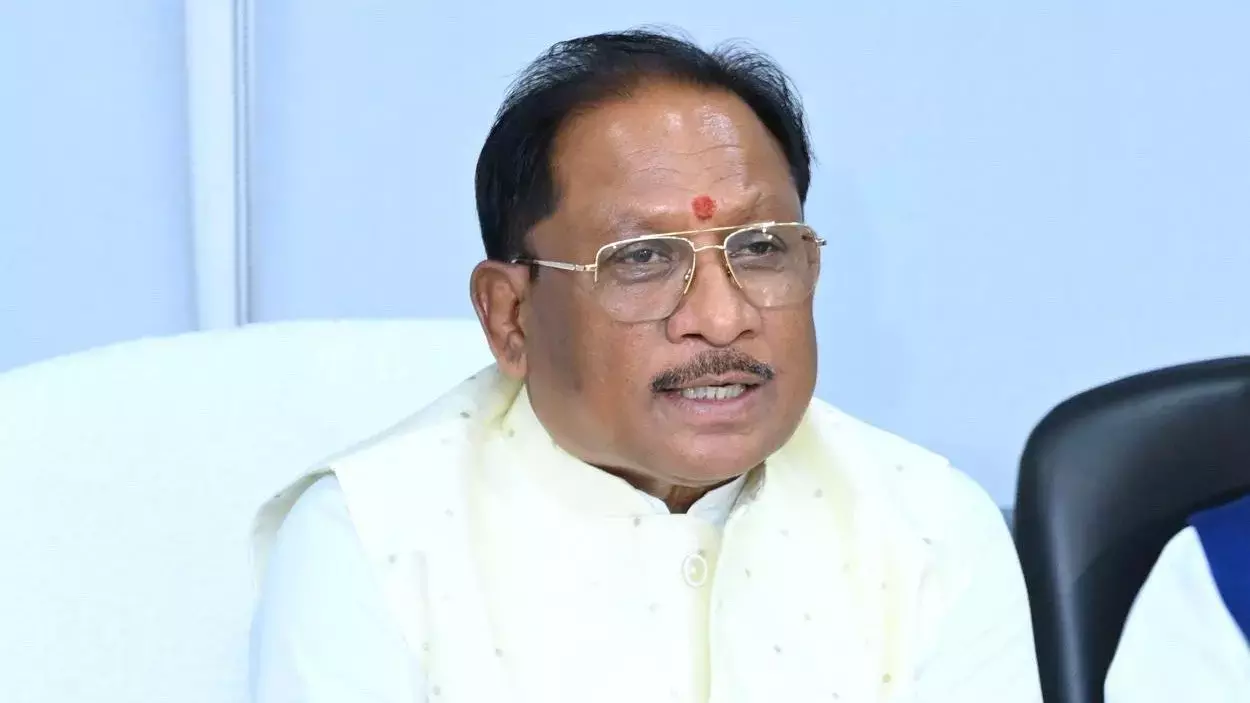
Chief minister Vishnu Deo Sai presented Chhattisgarh’s innovations and community-based water conservation model at the Ministry of Jal Shakti’s departmental summit, held in New Delhi on Wednesday, the press release said.
Prime Minister Narendra Modi was present on the occasion.
During the ‘Catch the Rain’ session of the summit, deputy chief minister Arun Sao gave a detailed presentation on the state’s initiatives in rainwater harvesting, groundwater recharge and protection of drinking water sources.
Mr. Sai said that Chhattisgarh has transformed water conservation from a government programme into a people’s movement by placing farmers, gram panchayats, Jal Sakhis, Jal Mitras, and local communities at its Centre.
According to the press release, Chhattisgarh has consistently remained among the country’s top-performing states across all three phases of the JSJB campaign.
Under the JSJB 1.0, 4,05,561 water structures were created in the state, securing Chhattisgarh the second place nationally.
In JSJB 2.0, 24,07,456 structures were registered, of which 23,07,768 have been completed, with the state again ranking second.
In JSJB 3.0, Chhattisgarh moved to the first position nationally, with 79,775 water structures registered and 77,719 completed.
The campaign focuses on retaining rain water locally, preventing runoff and enabling maximum groundwater recharge through water-harvesting structures suited to local geographical conditions.
Mr. Sai said that the impact of the state’s water conservation efforts is also reflected in groundwater conditions.
The number of water-stressed blocks has declined from 26 to 19, while five critical blocks are expected to move into the normal category.
Along with constructing new water-harvesting structures, the state is focusing on restoring traditional water sources, groundwater recharge, mapping, and geo-tagging of structures, and regular monitoring.
At the national summit, the chief minister proposed that every state prepare its own ‘ Catch the Rain Plan’ based on geography, rainfall patterns, groundwater conditions, and local requirements, enabling clear targets and strategies for water conservation.
He also suggested introducing ‘State Water Awards’ to encourage better- performing states, strengthening mapping of water structures through BISAG-N and conducting quarterly reviews of campaign progress under the chairmanship of the chief secretary.
