Hornbill Restaurants Being Developed In C’garh Reserve To Create Quality Habitat For Endangered Avian Species

The move aims to make provision of food for the hornbills, an endangered avian species, ‘round-the-clock, consequently improving the habitat quality, a senior forest officer said on Thursday.
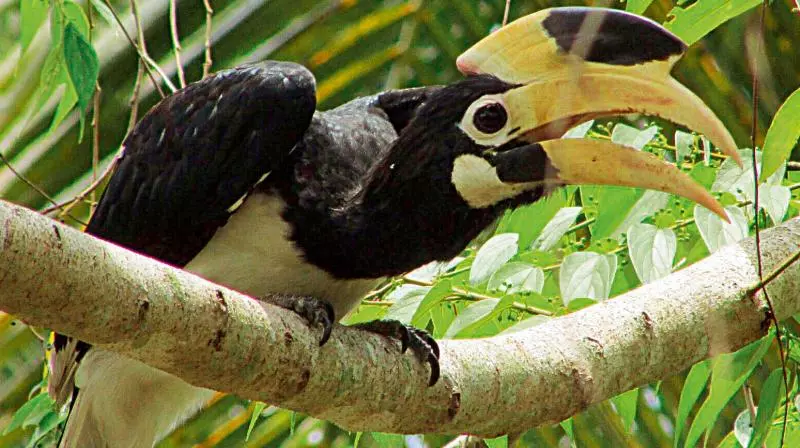
Raipur: After the ‘vulture restaurants’, an innovative conservation model introduced in the Indravati National Park in Chhattisgarh to improve the quality of the habitat of the scavenger birds by creating supply chain of healthy food for them, ‘hornbill eateries’ are now being developed in Udanti- Sitanadi Tiger Reserve (USTR) in eastern part of the state for similar purpose.
The move aims to make provision of food for the hornbills, an endangered avian species, ‘round-the-clock, consequently improving the habitat quality, a senior forest officer said on Thursday.
Six ‘hornbill restaurants’ are being developed in the USTR for conservation of the Malabar pied hornbills in south Udanti and Indagaon forest ranges under the tiger reserve by planting select fruit bearing trees in these identified patches in the forest, deputy director, USTR, Varun Kumar Jain told this newspaper.
“We have already developed a ‘hornbill restaurant’ by planting fruit bearing trees such as peepal and banyan in 40 hectares in Sornammal forest range to make it a good habitat for the avian species. The experiment has yielded encouraging results with hornbills being sighted frequently in the area”, he added.
The population of the avian species in the area has grown from a meagre 20 to around 400 in the last several years.
“Earlier, hornbills were never seen in the area, but the birds are sighted frequently, at least once in two days, now”, the forest officer said.
Two such ‘eateries’ for the hornbills are being developed in Amlor village, two in Ondh village and one each in Kukrar and Aamamora village is being developed, the forest officer has revealed.
All these villages fall under the buffer zone of the USTR.
These villages are surrounded by the Kuradhighat hill range, which is known as the Western Ghat of Central India for their common climatic conditions.
According to Mr. Jain, the data on the food habit of the hornbills has been compiled by observing them for the last three years with employment of the trackers of the avian species.
Based on the data, particular fruit bearing trees have been identified for plantation in these proposed ‘hornbill restaurants’, he said.
Hornbills, listed as ‘Near Threatened’ in the International Union for Conservation of Nature (IUCN), are called ‘forest gardeners’ or ‘farmers of the forest’ because they play a vital role in ecosystem health by dispersing seeds over long distances.
As large frugivorous birds, they consume fruits whole, digest the pulp, and regurgitate or defecate large seeds away from the parent tree, aiding forest regeneration.
They are picky, feeding on ripe fruits, which helps in depositing healthy seeds of many matured tree species.
