Addressing the 10th apex-level meeting of the Narco-Coordination Centre (NCORD), Shah said the Union finance ministry was “relooking” at the NDPS Act and asked states to share suggestions for amending the law.
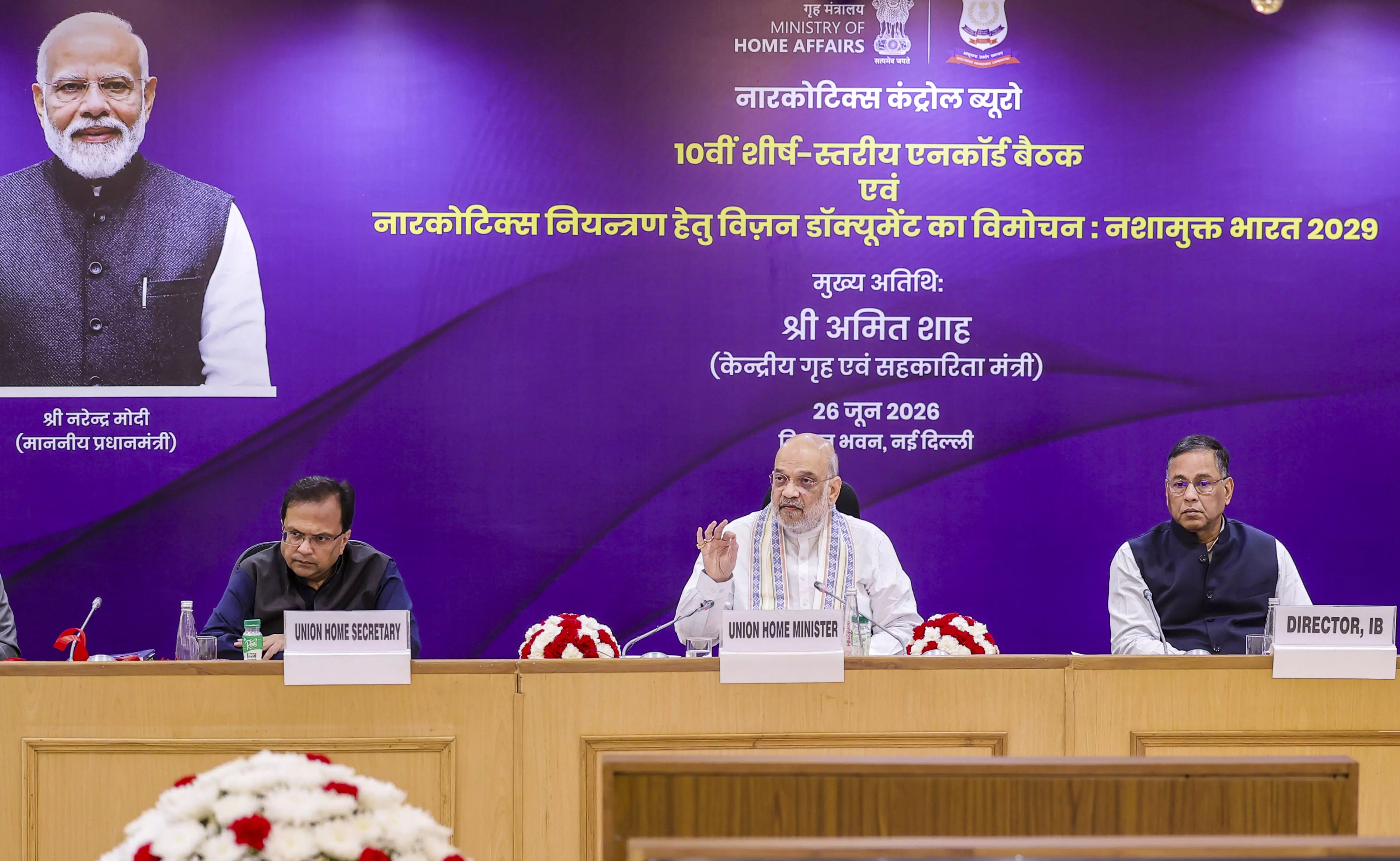
New Delhi:Union home minister Amit Shah on Friday said the Centre is considering amendments to the Narcotic Drugs and Psychotropic Substances (NDPS) Act to plug loopholes exploited by drug trafficking networks. He underlined the need for a ruthless approach towards drug peddlers and suppliers.
Shah unveiled a three-pronged strategy against drug trafficking — detect, disrupt and destroy. He said agencies should adopt a ruthless approach towards traffickers and operatives, and a sympathetic approach towards victims.
Addressing the 10th apex-level meeting of the Narco-Coordination Centre (NCORD), Shah said the Union finance ministry was “relooking” at the NDPS Act and asked states to share suggestions for amending the law.
The home minister directed directors general of police of all states to send their suggestions to the Union home ministry and chief secretaries to the department of revenue under the Union finance ministry.
He called for a four-pillar approach covering enforcement, intelligence collection and dissemination, and operations; control of precursors and synthetic drugs; demand reduction and public awareness; and capacity building, coordination and monitoring by anti-narcotics agencies.
“During 2004 to 2014, 26 lakh kg of synthetic drugs were seized. In contrast, from 2014 to 2026, we seized 1.18 crore kg of synthetic drugs. This shows that our campaign is steadily progressing towards success,” he said.
The value of drugs seized between 2004 and 2014 was nearly ₹40,000 crore, while seizures between 2014 and 2026 were worth around ₹1.84 lakh crore, reflecting a major increase in the effectiveness and scope of government action, Shah said.
He also directed state governments to ensure real-time information sharing. “The Narcotics Control Bureau has developed several portals. I urge all chief secretaries and police chiefs to upload crime details for their respective states to these portals in a time-bound manner. This will enable the government of India to review these cases and provide necessary feedback and suggestions,” he said.
Shah urged chief secretaries and police chiefs to make NCORD meetings result-oriented. “The number of meetings is certainly increasing, but it is also essential that they are result-oriented,” he said.
He said the country was at a delicate stage in the battle against narcotics and the next three years would determine “whether addiction conquers us or we conquer addiction.”
“For the future of our nation over the next 100 years, we must collectively fight this with unwavering resolve. All governments must come together on a single platform. We must also include seers who guide the public, youths who shape the future, and the power of mothers in this endeavour,” he said.
The NCORD meeting brought together stakeholders from 44 Central ministries and departments, along with representatives from state governments and drug law enforcement agencies, in hybrid mode.
The discussions focused on strengthening efforts to achieve a drug-free India. Challenges posed by synthetic drugs, darknet-enabled trafficking and expansion of rehabilitation centres over the next three years were also discussed.
The home minister also unveiled a vision document to strengthen India’s fight against narcotics. It lays out a roadmap to dismantle 100 major inter-state and transnational drug cartels through intelligence-led investigations, coordinated operations, financial disruption and effective prosecution.
The document also stresses tracking the money trail, tightening controls on diversion of pharmaceutical drugs and expanding de-addiction services.
“The roadmap provides a time-bound national strategy to substantially dismantle the narcotics drug ecosystem and protect future generations through coordinated action against trafficking, abuse, illicit finance and organised criminal networks,” the document said.
It marks a shift to network-centric enforcement, under which agencies will move beyond targeting individual drug carriers to identifying and dismantling complete trafficking networks, including suppliers, financiers, handlers, facilitators and organised criminal syndicates.
On tracking the money trail, the roadmap makes financial investigations mandatory in major drug cases and calls for attachment of illicit assets. It also seeks greater use of the Prevention of Illicit Traffic in Narcotic Drugs and Psychotropic Substances Act to target drug kingpins and dismantle the financial foundations of trafficking networks.
The vision document further calls for enhanced surveillance at borders, airports and maritime routes through AI-enabled profiling, anti-drone technologies, container scanning and better inter-agency coordination.
It also envisages a national offensive against synthetic drugs, a crackdown on clandestine laboratories, and greater participation of chemical and pharmaceutical industries in reporting suspicious transactions and preventing diversion of chemicals and pharmaceutical products.

