Centre Launches Seafarer-First Mission Amid West Asia Maritime Crisis

Government orders real-time monitoring of every Indian seafarer in the Persian Gulf, Strait of Hormuz and Gulf of Oman after deadly attacks on commercial vessels.
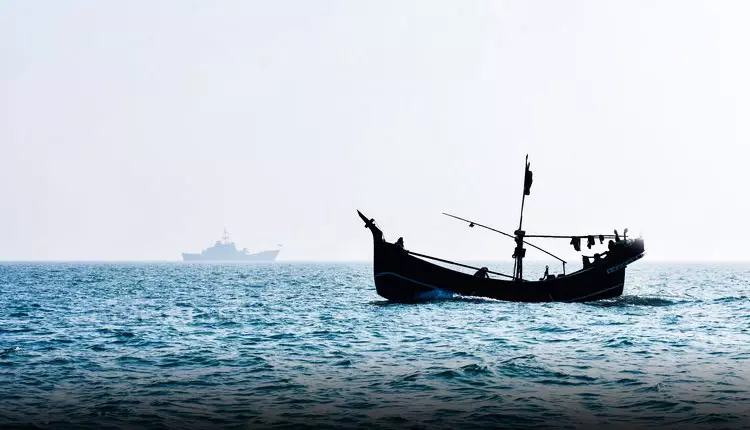
Amid escalating maritime security tensions in West Asia, the Centre has launched a comprehensive "Seafarer-First" emergency response to safeguard Indian seafarers operating in the conflict-hit region, directing authorities to monitor every Indian sailor sailing through the Persian Gulf, Strait of Hormuz and Gulf of Oman, irrespective of the flag under which their vessel operates.
Union Minister for Ports, Shipping and Waterways Sarbananda Sonowal chaired a high-level inter-ministerial review meeting on Tuesday and instructed the Directorate General of Shipping (DGS) to establish a comprehensive vessel-by-vessel operational dashboard that will provide real-time information on Indian crew members aboard ships operating in the region.
According to an official statement, the dashboard will track vessel position, ownership, cargo, crew strength, crew welfare, threat assessment, intended voyage, next port of call and the availability of emergency support facilities.
"There can be no compromise whatsoever on the safety and security of Indian seafarers," Sonowal said, directing officials to ensure that every Indian seafarer in the affected region is individually accounted for.
The minister also ordered the appointment of dedicated liaison officers for every affected Indian seafarer. These officers will act as a single point of contact for families, coordinating medical updates, travel documentation, repatriation, financial assistance through the Seafarers Welfare Fund, pending wages, contractual entitlements and compensation.
The review meeting was attended by senior officials from the Ministry of External Affairs, the Indian Navy, the Directorate General of Shipping, the Ministries of Petroleum and Natural Gas and Chemicals and Fertilisers, along with representatives of Indian missions in Iran and Oman.
The move follows attacks on two commercial vessels — MT Al Bahiyah and MT Mombasa — in the Strait of Hormuz. The ships carried 46 crew members, including 30 Indians. One Indian seafarer was killed and another injured aboard MT Al Bahiyah, while nine Indian crew members were injured on MT Mombasa.
Separately, another merchant vessel was attacked off the coast of Oman on July 12. Ten Indian crew members were rescued, while one marine engineer later died after initially being reported missing.
India also summoned Iran's deputy chief of mission in New Delhi to lodge a strong protest over the attacks on the commercial vessels and reiterated its concern over the safety of civilian shipping in the region.
The government has directed Indian missions in Iran, Oman, the United Arab Emirates and other regional countries to maintain round-the-clock coordination for verified updates on navigational safety, medical evacuation, port access, repatriation procedures and ongoing investigations.
Sonowal further instructed shipowners, vessel managers and Recruitment and Placement Service Licence (RPSL) agencies to ensure that no Indian seafarer is compelled to sail through high-risk waters without adequate information, protection and support.
The minister said India had also raised the issue at the International Maritime Organization (IMO) and with the concerned flag administrations, stressing that attacks on civilian merchant vessels violate international conventions and threaten the safety of global shipping.
The Centre said every vessel transiting the conflict zone would now undergo a fresh threat assessment in consultation with maritime authorities to minimise risks to Indian seafarers as tensions in West Asia continue to escalate.
