Celebration, Contestation and Calls for Constitutional Clarity As Ladakh Marks 7 Years as a UT

Lieutenant Governor hails progress; civil groups demand statehood, Sixth Schedule and elected Assembly.
Srinagar: Ladakh’s Lieutenant Governor Vinai Kumar Saxena on Wednesday described the carving out of the landlocked Himalayan region from Jammu and Kashmir and its establishment as a separate Union Territory on August 5, 2019, as a historic and landmark decision that, in his view, has “worked tremendously for the welfare of its people.”
While the UT administration and the BJP marked the anniversary with celebrations, many local political parties and civil society organisations voiced a sharply different sentiment. For them, the continued denial of statehood, an elected legislature, and constitutional guarantees over land and employment amounted to a breach of trust by the Centre — a betrayal of the assurances given in the past and a curtailment of the rights and aspirations of Ladakh’s people.
Speaking at the vibrant “dPal rNgam Duston 2026” celebrations held at the historic Leh Palace, Saxena said the seventh anniversary of Ladakh’s UT status was not merely a ceremonial milestone but a moment to reflect on the region’s transformation under the Union Government.
The event, marked by traditional music, masked dances, and community participation, drew large crowds from across Leh district. The Lt. Governor congratulated Ladakhis on what he called the fulfilment of their long-standing aspirations under the leadership of Prime Minister Narendra Modi and Home Minister Amit Shah. He emphasised that August 5 had become a defining moment in Ladakh’s modern political history, with “dPal rNgam Duston” evolving into a celebration of Ladakhi identity, cultural resilience and collective aspirations, symbolising unity among its diverse communities.
Saxena said Ladakh’s journey as a UT had been one of “transformation, resilience and collective progress,” highlighting improvements in governance, infrastructure, tourism, healthcare, education, environmental protection and sports. He reiterated the administration’s commitment to building an inclusive, sustainable and future-ready Ladakh while preserving its fragile ecology and unique cultural heritage. As India moves toward the national vision of Viksit Bharat 2047, he said Ladakh would continue striving for a peaceful, prosperous and self-reliant future with equal opportunities for all.
The Lt. Governor listed several initiatives undertaken over the past seven years which include decentralised governance through strengthened hill councils, improved public service delivery, expansion of road connectivity, upgraded medical facilities, new educational institutions, and major tourism infrastructure. He said Ladakh had emerged as a national example of environmentally sustainable development, citing the complete prohibition of chemical fertilisers to make Ladakh India’s largest certified organic region, the launch of Project Him Sarovar for water conservation, the Green Ladakh Campaign, restoration of degraded land, and rapid adoption of renewable energy through solar and geothermal projects.
During the ceremony, Saxena announced the dPal rNgam Award 2026 for His Holiness Gyalwang Drukpa Rinpoche for his contributions to health, education, gender equality, environmental protection and heritage preservation. He also conferred the dPal rNgam Lifetime Achievement Award 2026 upon Late Colonel Sonam Wangchuk, Maha Vir Chakra, honouring his courage, distinguished military service and enduring contribution to the nation.
Across Ladakh, the seventh anniversary of UT status was observed in sharply contrasting ways, reflecting the region’s ongoing political debate. The Ladakh Administration organised official cultural programmes in Leh and Kargil, public outreach events, exhibitions on developmental achievements, and special ceremonies honouring local achievers. Government departments highlighted progress in renewable energy, organic farming, border infrastructure and tourism.
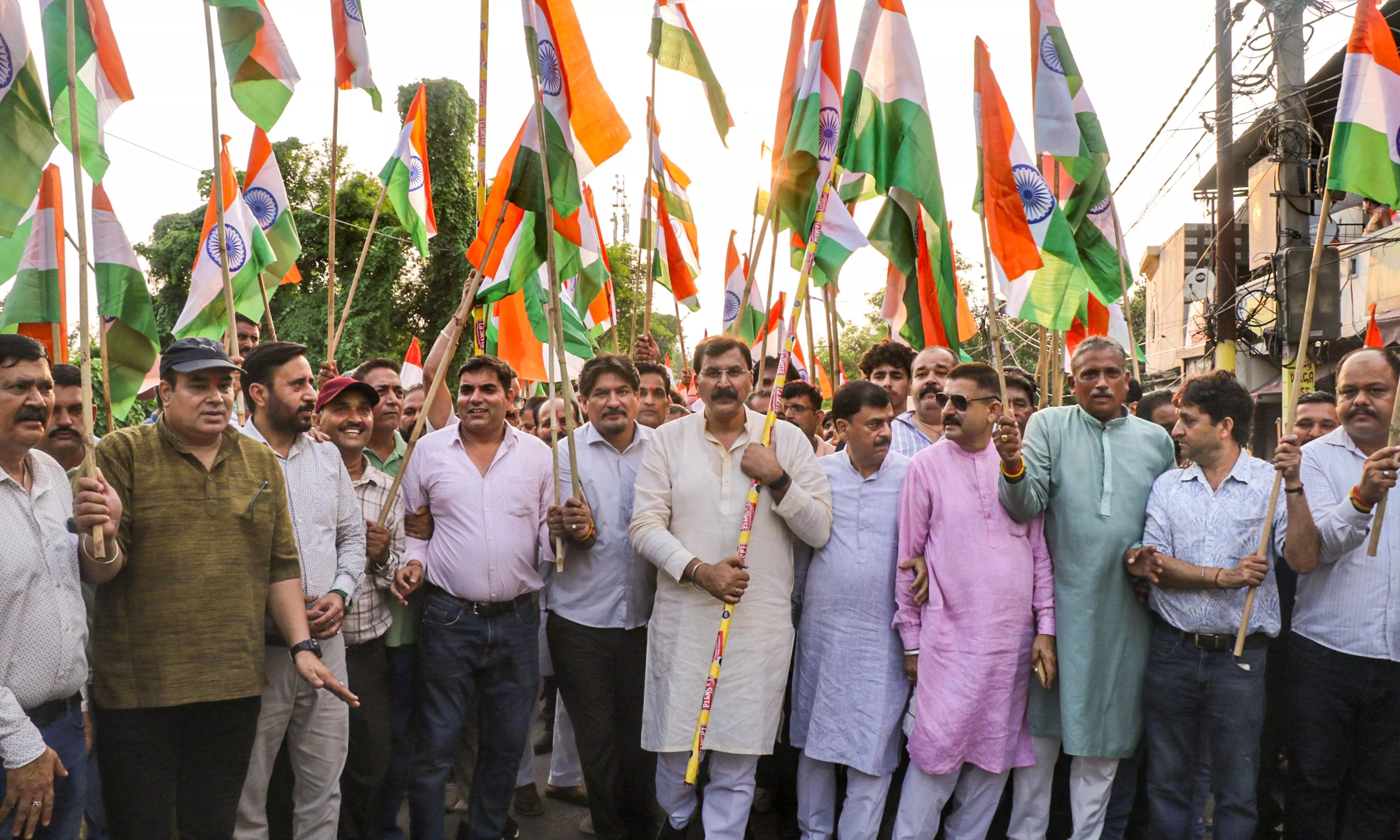
The Bharatiya Janata Party (BJP) celebrated the day as a moment of pride and fulfilment of Ladakhi aspirations. Party leaders held rallies, public meetings and social media campaigns showcasing what they described as unprecedented development since 2019. BJP cadres distributed pamphlets on infrastructure projects, employment schemes and central government support, framing 5 August as a day of empowerment and opportunity.
Civil society groups, however, marked the day very differently. The Leh Apex Body (LAB) and Kargil Democratic Alliance (KDA)—the two powerful socio-political platforms jointly demanding statehood and constitutional safeguards under the Sixth Schedule—observed the day with protest gatherings, public discussions and renewed calls for democratic representation. In Leh, LAB members held a silent march and community meeting, reiterating that Ladakh’s future must be shaped by Ladakhis themselves. In Kargil, the KDA organised a public convention where speakers criticised what they called bureaucratic over-centralisation and the absence of an elected legislature.
Both bodies issued joint statements reminding the Centre that Ladakhis had been waiting seven years for constitutional guarantees, land and job protections, and a clear political roadmap. They emphasised that while development projects were welcome, democratic rights could not be indefinitely postponed.
Kargil Democratic Alliance leader Sajjad Kargili said August 5 “remains a day of betrayal for the people of Jammu & Kashmir and Ladakh.” He argued that Ladakh’s conversion into a UT without an elected assembly or democratic representation had left the region politically vulnerable. Seven years later, he said, Ladakhis were still waiting for statehood and constitutional safeguards.
According to Kargili, the UT structure had failed to address core issues faced by Ladakhis. Instead of resolving long-standing demands, he said the Centre had prolonged discussions through delays and uncertainty. He expressed concern over “undemocratic bureaucratic control, imposition of policy decisions without local consent, and the absence of a clear roadmap for the region’s political and constitutional future.” Ladakh, he said, deserved justice, meaningful democratic empowerment and constitutional protections.
