The three-judge panel headed by Chief Justice Sheel Nagu of the Punjab and Haryana High Court conducted the inquiry for 10 days, examined 55 witnesses and visited the scene of the accidental fire
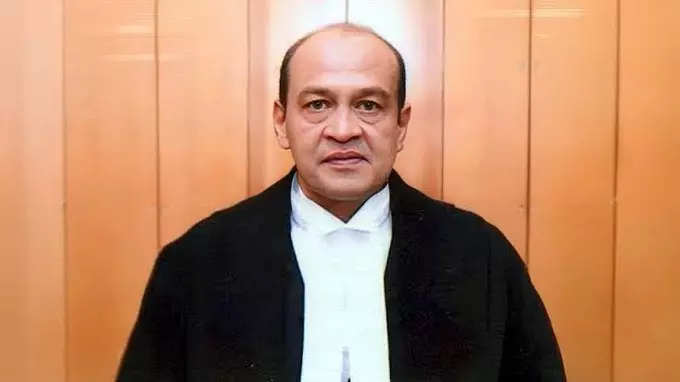
New Delhi: A three-judge panel appointed by the Supreme Court, which conducted an inquiry into the alleged recovery of cash from the house of former Delhi High Court judge Justice Yashwant Varma, has revealed that he and his family members had “covert or active control” over the storeroom where the cash was allegedly stashed.
In its 64-page report, the panel also held that the judge’s “misconduct” was serious enough to seek his removal. Acting on the report, former Chief Justice of India Sanjiv Khanna had written to President Droupadi Murmu and Prime Minister Narendra Modi recommending the judge's impeachment.
The panel headed by Punjab and Haryana high court Chief Justice Sheel Nagu conducted the inquiry for 10 days, examined 55 witnesses and visited the scene of the accidental fire that started at around 11.35 pm on March 14 at the official residence of Justice Varma, who has since been transferred to the parent Allahabad High Court.
Besides Justice Nagu, Chief Justice G S Sandhawalia of the Himachal Pradesh High Court, and Justice Anu Sivaraman of Karnataka High Court, comprised the inquiry panel.
“This committee thus holds that the cash/money was found in the store room of 30 Tughlak Crescent, New Delhi officially occupied by Justice Varma. More so, the access to the store room has been found to be within the covert or active control of Justice Varma and his family members and that by way of strong inferential evidence, it is established that the burnt cash/money was got removed from the store room during the wee hours of 15.3.2025 from 30 Tughlak Crescent, New Delhi,” the report said.
The report added, “Keeping in view the direct and electronic evidence on record, this committee is firmly of the view that there is sufficient substance in the allegations raised in the letter of the Chief Justice of India dated March 22, and the misconduct found proved is serious enough to call for initiation of proceedings for removal of Justice Varma...”
The panel analysed the statements of 55 witnesses including the statement of Justice Varma and rendered its findings under the inquiry procedure laid down by the in-house committee.
Probity of a judge is measured by yardstick which is much more stringent than the probity expected of a civil post holder, it said, adding that the element of probity becomes “predominant, relevant and indispensable” when the offices of higher judiciary are in question.
Referring to "Restatement of values of Judicial Life" adopted by the Supreme Court in its full court meeting in 1997, the panel said, “It is obvious that all the virtues expected from a judge are founded upon the concept of probity.”
“Any deficiency in this regard erodes public trust which ought to be viewed stringently,” the panel said while recommending impeachment motion against Justice Varma.
The panel, constituted by former CJI Khanna on March 22, investigated a late-night blaze that broke out at around 11.35 pm on March 14 at the judge's official bungalow in the national capital.
]What began as a routine fire incident has now culminated in serious charges of judicial misconduct and breach of public trust.
Several witnesses, including firefighters and police personnel, told the panel they saw charred stacks of `500 notes scattered across the floor. One witness described being “shocked” by the sight and said “There was a large pile of cash… I saw it for the first time in my life.”
In its report, the panel was critical of the testimony of Justice Varma’s daughter Diya Varma who was home at the time of the incident.
“From the demeanour of the witness, we noticed that she is a confident young woman, having been subjected to hostel life throughout her education apart from being an independent working woman. This belies her statement that she was totally overwhelmed and panicked by the incidents of the fateful night., which led to her giving an allegedly wrong statement and later seeking to retract it.,” it said.
The report added: “No doubt, it has come on record that she did make phone calls to the concerned fire station which also had been brought on record by screenshots and at one stage had also sought to inform the fire personnel that the fire had been brought under control and that they need not come. The conduct of the said witness is, but natural keeping in view the fact that there was an alarm raised by the domestic staff late at night and since the smoke hadalrady started pouring out of the store room and it would be her natural reaction to call for help.”
The panel trashed the conspiracy theory flagged by Justice Varma in the cash recovery row, asking why he did not file a police complaint.
According to the judge, the storeroom, which was the scene of the discovery, was utilised to store miscellaneous items including unused furniture, bottles, carpets, and public works department materials, and was accessible from both the front and rear entrances of the property-making it susceptible to access by outsiders.
“The unnatural conduct of Justice Varma has already been noticed …and the fact that if there was any conspiracy theory why he chose not to file any complaint with the police officials or bring it to the notice of the Chief Justice of the High Court or the Chief Justice of India regarding the fact that there were planted stories regarding the burning of currency notes in the storeroom which is part of his house,” the panel said.
The committee also scrutinised Justice Varma's act of accepting his transfer to the Allahabad High Court post the fire incident. “Another reason which weighs with us is post incident conduct that Justice Varma knowing the inevitable, quietly accepted the proposal of transfer order which he received on March 20, at 4.15 pm after finishing his judicial work from the office of the Chief Justice of India though he could have responded till 9 am on 21.03.2025 as per the said proposal (sic),” the panel said.
The panel said a "categorical" and immediate" acceptance of the transfer on March 20 without any “demur” would in a normal scenario happen post a discussion with the family members and after an attempt to find out the reason for transfer, particularly after having served in the Delhi high court for the last three years.
“It is his categorical case that he has served diligently for a decade without any complaint. Thus, he would have liked to find out the reason for transfer,” the panel report said.
The report continued, “In the absence of any plausible explanation coming from Justice Varma or his family members or for that matter any other witness, this committee is left with no option, but to hold that the trust reposed in him was belied by him by allowing highly suspicious material in shape of piles of currency notes to be stashed in the storeroom.”
Whether the stashing was done with the tacit or explicit consent of Justice Varma or his family members had little significance given the larger concept of breach of public trust and probity expected of the high constitutional office held by Justice Varma, it said.
The panel framed three substantive issues and dealt with them extensively.
“How does Justice Varma account for the presence of money/cash in the room (store room) located in his premises 30 Tughlak Crescent...?” the first issue read.
It asked Justice Varma to explain the source of money, which was found in the store room.
“Who is the person who had removed the burnt money/cash from the store room in the morning of March, 15,” the third issue read.
The panel dealt in detail and rejected the stand of Justice Varma who said the entrance of the store room was constantly monitored by CCTV cameras and was under control of security personnel and it was highly improbable that the cash was kept in the store room.
The allegation has been repeatedly refuted by Justice Varma in his response to the Delhi High Court Chief Justice and to the apex court-appointed panel.
Underscoring the importance of probity in higher judiciary, the report said: “The expectation of the general public from a member of the superior judiciary is extremely high. Probity is the most important and indispensable attribute of a person holding judicial office and is rather the basic eligibility criteria. Least that is expected of any judicial officer of district or higher judiciary is unimpeachable character and conduct in and outside the courtroom.”
The very existence of judicial office is founded upon the trust of the citizens at large and the quality and quantity of this trust is directly relatable to the behaviour, conduct and performance demonstrated by the judge, not only inside but also outside the courtroom, it added.