Build better anti-terror grid, Shah tells agencies

27 Dec 2025 12:09 AM IST27 Dec 2025 12:09 AM IST
Inaugurating the two-day Anti-Terrorism Conference-2025, organised by the National Investigation Agency (NIA), Shah said operational uniformity was essential for accurate threat assessment, effective intelligence sharing and coordinated counter-action.
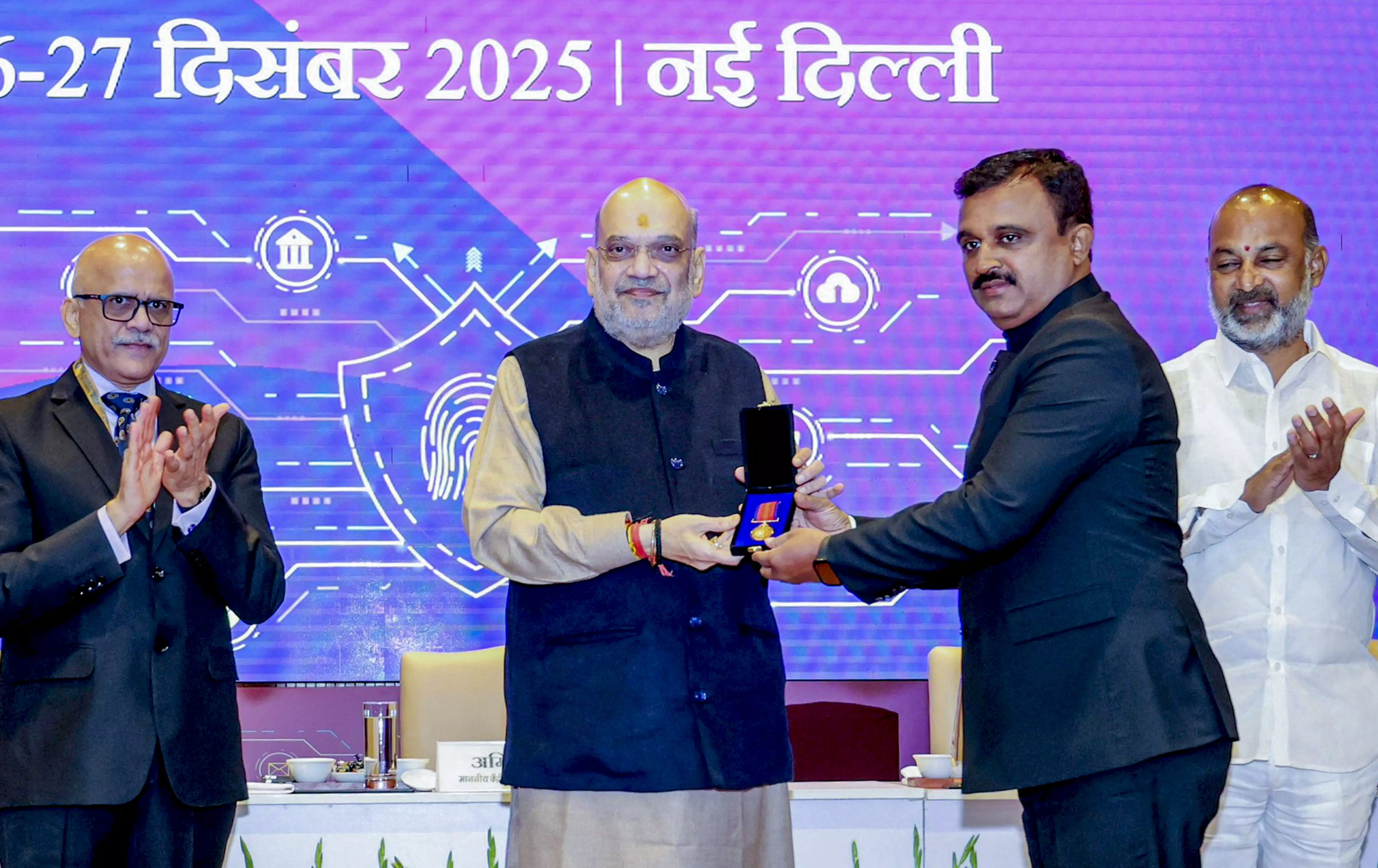
Union Home Minister Amit Shah during the Anti-Terrorism Conference, in New Delhi. Other leaders and officials are also seen. (@AmitShah/X via PTI Photo)(
New Delhi: Union home minister Amit Shah on Friday said all security agencies must analyse every terror incident worldwide to strengthen India’s counter-terrorism capabilities and build an impenetrable, robust anti-terrorism grid capable of meeting all challenges.
Inaugurating the two-day Anti-Terrorism Conference-2025, organised by the National Investigation Agency (NIA), Shah said operational uniformity was essential for accurate threat assessment, effective intelligence sharing and coordinated counter-action. The conference was attended by senior police officials from States, Union Territories and Central armed police organisations.
He said a new plan to launch a “360-degree assault on organised crime” would be rolled out in the coming days, and that integrated databases would form the core asset of the government’s zero-terror policy. Highlighting the nexus between organised crime and terrorism, Shah said criminal networks that begin with extortion and ransom often evolve into terror funding channels once their leaders flee abroad and link up with terrorist organisations.
According to a statement issued by the Union home ministry, Shah directed States to eliminate organised crime networks within their jurisdictions under the guidance of the NIA and Central Bureau of Investigation (CBI), with the cooperation of the Intelligence Bureau, using shared databases.
Referring to the November blast near the Red Fort area, he said around 40 kg of explosives were used, while nearly three tonnes of explosives were recovered before they could be detonated. He said the entire conspiracy team was apprehended in advance and praised the Jammu and Kashmir Police for its investigation into the Delhi explosion.
Stressing the need for a “Duty to Share” approach instead of “Need to Know”, Shah said technology and data developed in silos were ineffective. He called for a seamless national-level framework for technology and data, to be developed jointly by the home ministry, NIA and IB, with States being supported in strengthening their systems.
He said the terrorist and criminal database must be treated as a core pillar of the zero-terror policy and expressed confidence that Directors General of Police would implement the framework in letter and spirit. Shah added that coordination among agencies had improved through platforms such as the DGP Conference, Security Strategy Conference, N-CORD meetings and the Anti-Terrorism Conference.
Shah said the NIA had developed a common Anti-Terrorism Squad (ATS) structure and shared it with State police forces, asserting that a uniform ATS framework across the country would ensure consistent preparedness at all levels.
Referring to the Baisaran Valley terror attack in Jammu and Kashmir, Shah said the objective was to disrupt communal harmony and derail the region’s renewed focus on development and tourism. He said the security forces neutralised all three terrorists based on precise intelligence, delivering a strong message to Pakistan.
He added that this was the first terror incident in which the planners were punished under Operation Sindoor and the attackers neutralised under Operation Mahadev. Shah said the investigation into the Pahalgam terror attack was comprehensive and would be studied globally, and that its findings would place Pakistan in the dock at international forums.
On the occasion, the home minister also launched the Organised Crime Network Database and the Weapons Database for lost, looted and recovered arms, hosted by the NIA, for use by law enforcement agencies across the country.

Next Story