BJP’s ‘Anga–Banga–Kalinga’ Mission Accomplished; Jharkhand Now Only Missing Piece In The East

The BJP’s growth in the East has been gradual yet strategic. Since 2019, the party has focused on strengthening booth-level organisation, broadening its social base and leveraging central welfare schemes to establish direct connections with beneficiaries: Reports
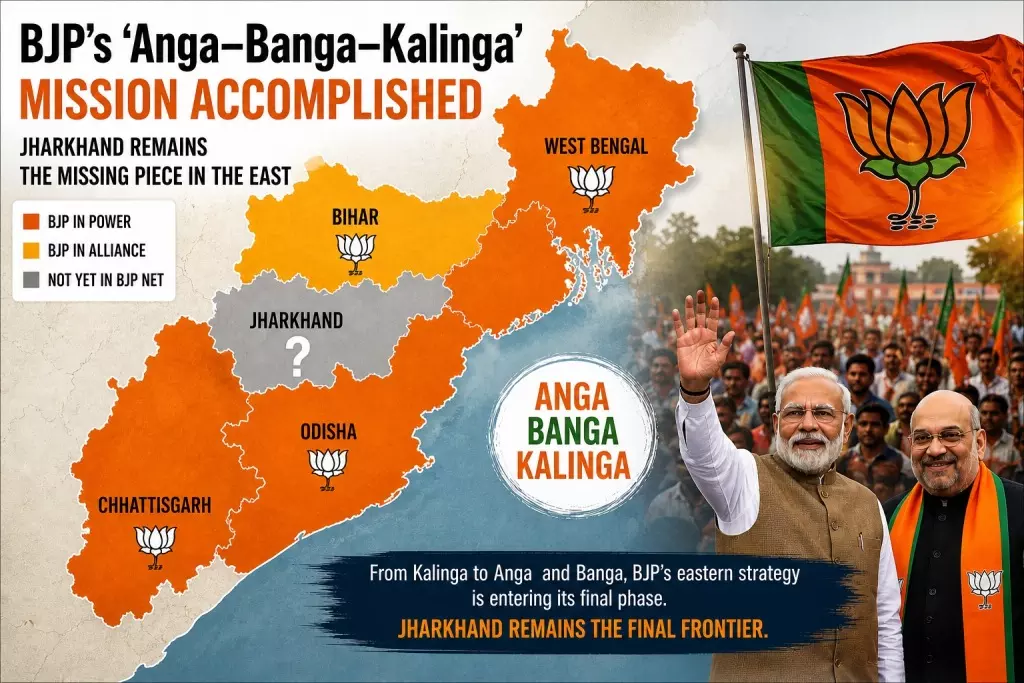
BHUBANESWAR: The Bharatiya Janata Party’s long-articulated ambition of consolidating its political footprint across eastern India—often framed as “Anga, Banga and Kalinga”—appears closer to fruition than ever before. A combination of electoral gains and shifting political currents in Odisha, Chhattisgarh and West Bengal has steadily expanded the party’s presence in the region, leaving Jharkhand as the only eastern state outside its current chief ministerial map.
The most decisive breakthrough came in Odisha in 2024, when the BJP ended the 24-year rule of the Biju Janata Dal (BJD) led by Naveen Patnaik. The victory marked a structural shift in a state long perceived as resistant to the BJP’s expansion. In neighbouring Bihar, the party has reinforced its position within the ruling arrangement, with Samrat Chaudhary assuming office as the first BJP Chief Minister in the state. The BJP already governs Chhattisgarh since 2023, further consolidating its eastern arc.
For decades, entrenched regional forces such as the BJD in Odisha and the Trinamool Congress (TMC) in West Bengal were seen as formidable barriers to the BJP’s growth. Led by strong, centralised leaderships and anchored in welfare-driven governance models, these parties maintained tight organisational control, limiting the BJP’s early inroads.
However, prolonged incumbency often brings its own challenges. Analysts point to administrative fatigue, increasing centralisation of decision-making, and a gradual weakening of grassroots engagement as recurring risks for long-standing regimes. Odisha’s electoral shift in 2024 is increasingly viewed through this lens. The BJD’s governance model, once praised for stability, came under scrutiny over perceived bureaucratic over-centralisation, allegations of corruption, chit fund controversies, mining irregularities and declining local connect. The eventual outcome reflected not a sudden collapse, but the culmination of accumulated public discontent.
A parallel narrative has been unfolding in West Bengal, where controversies around recruitment irregularities, allegations of corruption, concerns over women’s safety and polarised political discourse have shaped public perception. In electoral politics, perception often carries as much weight as proven fact, sharpening the BJP’s campaign narrative around governance and accountability.
“For incumbent governments, such factors can quickly influence voter sentiment, especially when amplified during election cycles,” said political analyst Dr Kishore Chandra Swain.
Another critical dimension is the internal dynamics of regional parties. Observers note that increased centralisation within leadership circles can create unease among grassroots workers.
“In West Bengal, the rising prominence of Abhishek Banerjee alongside Mamata Banerjee triggered debates over internal decision-making. At the same time, evolving voter expectations—particularly among youth and rural communities— shifted electoral priorities towards employment, economic mobility and efficient delivery of welfare benefits. This made the BJP a default beneficiary of electoral gains,” Dr Swain added.
