The National Conference (NC), which leads the current government under Chief Minister Omar Abdullah, responded with particular force
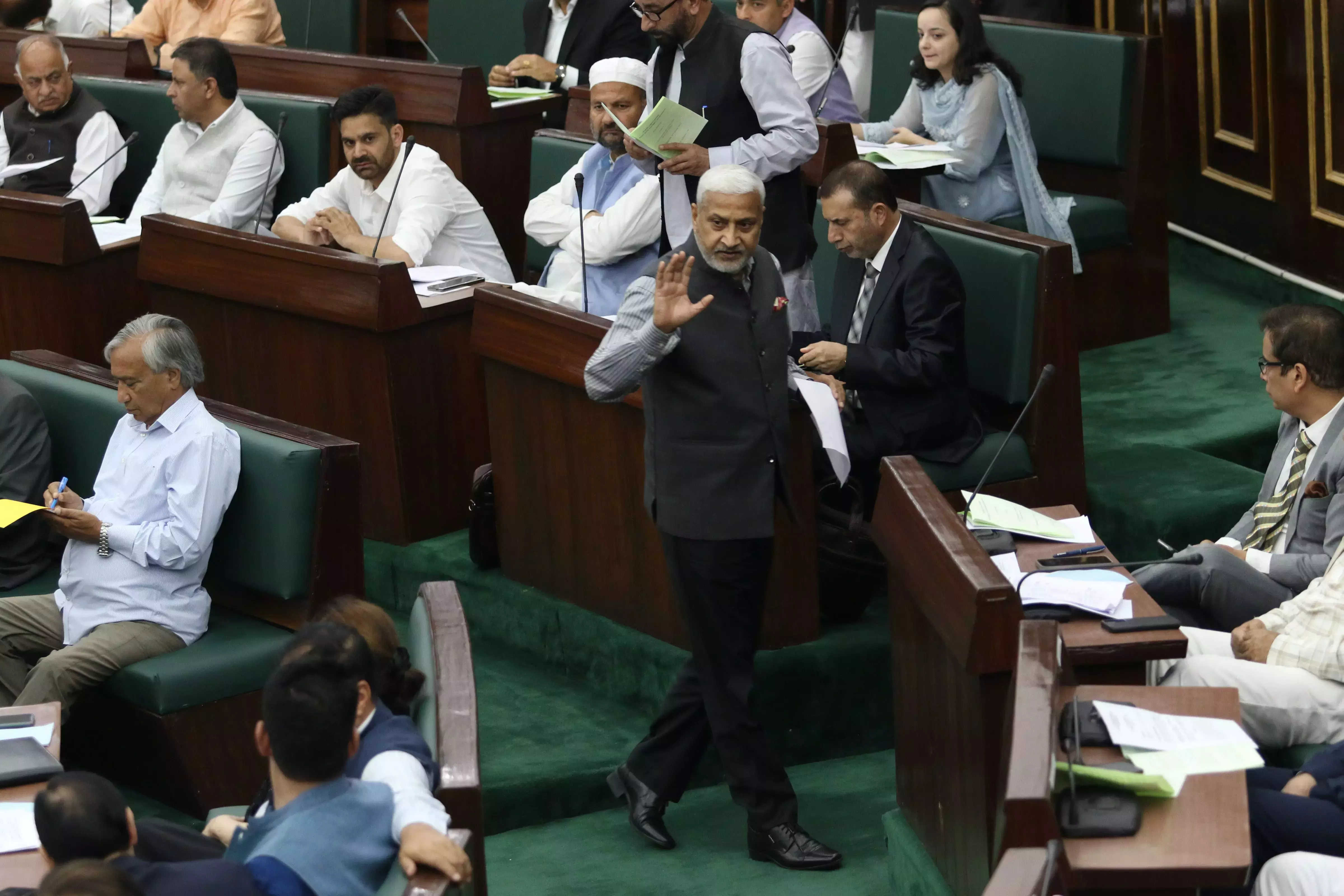
Srinagar: A fresh political storm has erupted in Jammu and Kashmir after BJP MLA Sham Lal Sharma revived his long‑standing demand for separate statehood for the Jammu region.
His remarks have triggered sharp reactions across the political spectrum, drawing criticism from both the ruling coalition and Opposition parties. Even within his own party, the proposal has found no takers. The BJP leadership has moved quickly to disassociate itself from Sharma’s call to carve Jammu away from the predominantly Muslim Kashmir Valley, stressing that his statement reflects a personal position rather than the party’s official stand.
Sharma, who represents the Jammu North constituency, reiterated long‑standing allegations that Jammu has suffered discrimination at the hands of “Kashmir‑based rulers”. He argued that the region deserves equitable treatment in matters of development, representation and governance, even hinting in some contexts at the need for a Hindu chief minister to correct what he views as structural imbalance. Although Sharma has raised similar demands in the past, including during his tenure as a minister in the NC‑Congress coalition government in 2010, his latest remarks triggered immediate and sharp political reactions across party lines.
The National Conference, which leads the current government under chief minister Omar Abdullah, responded with particular force. NC president and former three‑time chief minister Farooq Abdullah dismissed the idea outright, insisting that Jammu and Kashmir are inseparable. During a visit to Jammu’s Narwal Fruit Mandi on Monday, he likened any attempt to divide the two regions to “separating the head from the body”, with Jammu as the head and Kashmir as the torso. He further claimed that even Ladakh, carved out as a separate Union territory in 2019, now wishes to return to the fold of the erstwhile state.
Chief minister Omar Abdullah echoed and amplified this criticism. He accused the BJP of having “ruined” Ladakh after its bifurcation and warned that separating Jammu would replicate the same mistakes, inflicting long‑term harm on the region. Questioning the motives behind Sharma’s proposal, he suggested such demands risk deepening religious divisions. With pointed sarcasm, he said if the BJP wished to “spoil” Jammu as well, they could proceed — but the ongoing protests in Ladakh for statehood and constitutional safeguards should serve as a cautionary tale.
Other NC leaders also weighed in. Senior party figure and jal shakti, forest and tribal affairs minister Javed Ahmad Rana dismissed the idea as “unviable” and “imaginary”, noting no such demand exists in the Pir Panjal (Rajouri-Poonch) or Chenab valley regions of Jammu division. He argued that a separate Jammu state would not include these Muslim‑majority sub‑regions and asserted that “minority cannot rule majority”, suggesting instead that Ladakh should be reunited with Jammu and Kashmir.
NC’s Jammu provincial president Rattan Lal Gupta described Sharma’s proposal as a “dangerous and divisive” ploy by the BJP to distract from its shortcomings on employment, development and the restoration of statehood, warning that such rhetoric risks communal polarisation and undermines national interests.
The Congress also moved quickly to distance itself from any perceived support for the idea. J&K Congress president Tariq Karra rejected comments made by senior leader Chaudhary Lal Singh, clarifying that Singh’s remarks were personal and did not reflect the party’s position. Karra reaffirmed the Congress’ commitment to the unity of Jammu and Kashmir and to the restoration of full statehood for the entire Union territory.
This episode has revived long‑standing regional tensions that have simmered since the 2019 reorganisation of the former state, when Article 370 was revoked and Jammu and Kashmir was bifurcated into the Union territories of J&K and Ladakh. Jammu has historically voiced grievances over perceived neglect in development and political representation compared to the Kashmir Valley. While some civil society groups and occasional BJP figures have floated the idea of “Jammu Pradesh” of “Dugar Desh”, mainstream political parties continue to prioritise the restoration of full statehood to the combined Union territory rather than its further division. Even within the BJP, Sharma’s demand remains a fringe position, with the party leadership emphasising unity.
Opposition voices, particularly from the People’s Democratic Party (PDP), have framed the controversy in even starker terms. PDP president and former chief minister Mehbooba Mufti condemned the demand as rooted in religious considerations tied to Jammu’s Hindu‑majority character. She warned that carving out a separate Jammu state on religious lines would undermine the secular foundations on which Jammu and Kashmir acceded to India in 1947, rejecting Muhammad Ali Jinnah’s two‑nation theory. According to her, dividing the region along communal lines would retroactively validate the idea that Hindus and Muslims cannot coexist within a single political unit. She accused right‑wing groups, including the BJP, RSS and Bajrang Dal, of attempting to reverse the historical choice made by J&K’s leaders and cautioned that the region was being used as a “laboratory” for divisive experiments that could spread elsewhere in the country. Her remarks also came amid separate debates, such as the revocation of permission for the Shri Mata Vaishno Devi Institute of Medical Excellence, which she suggested carried communal undertones.
In the face of the uproar, the BJP leadership swiftly clarified its official position. J&K BJP president Sat Sharma, general secretary Ashok Kaul and spokesperson Altaf Thakur all stated that Sharma’s comments reflected his personal views and not the party’s stance. They reiterated that the BJP supports a united Jammu and Kashmir as an integral part of India and does not endorse any proposal for separation. The party, which won 29 seats in the 2024 J&K Assembly elections -- all from Hindu‑majority areas of Jammu -- improved its tally from 2014 and secured the highest overall vote share of approximately 25.64 per cent, but failed to win any seats in the Kashmir Valley.

