Big Catch In Mahanadi: 100-kg Goonch Catfish Stuns Odisha Town

The rare fish sparks call for river biodiversity revival
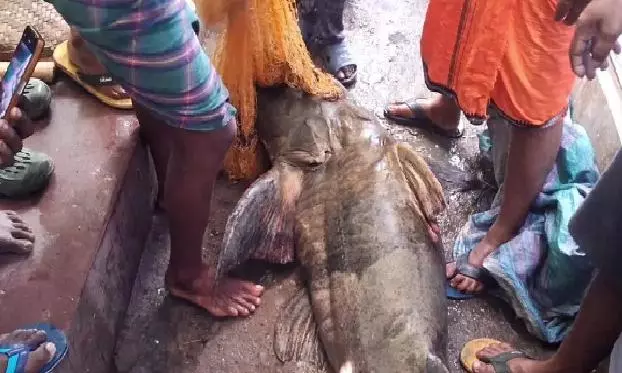
Bhubaneswar: In a rare and awe-inspiring moment, fishermen in Binika town of Odisha’s Subarnapur district hauled in a massive 100-kg Goonch catfish from the Mahanadi River on Thursday, drawing crowds of curious onlookers and renewing calls from experts to preserve the river’s fast-depleting aquatic biodiversity.
Locally known as Bodha, the giant catfish—measuring nearly six feet in length—was caught from the perennial waters of Mahanadi near Binikapada. The sheer size and reputed medicinal properties of the fish stirred widespread excitement among locals, with hundreds gathering to witness the catch.
“This is the biggest fish we have ever caught. In the past, we caught Bodha fish weighing around 30 to 40 kg, but never anything of this scale,” said Anantaram Muduli, one of the three fishermen who netted the creature.
The fish, believed to have therapeutic value in traditional medicine, was later sold in the local market at Rs 300 per kilogram—underscoring its demand and value.
Biodiversity at Risk
While the catch has been celebrated as a triumph for local fishermen, experts warn it may be an exception rather than a trend. Once teeming with native species, Odisha’s rivers are witnessing a steady collapse in freshwater fish diversity and population—posing a serious threat to the livelihoods of over 6.6 lakh fishermen in the state.
Freshwater catch in Odisha has reportedly declined by nearly 80 per cent in the last two decades, according to data from conservationists and local fishery assessments. This has pushed many traditional fisherfolk to abandon their occupation or migrate to other states in search of work.
“This decline is tragic but not surprising. We’ve been urging the state government for over two decades to impose a ban on river and lake fishing during breeding seasons, but no action has been taken,” said Dr Biswajit Mohanty, secretary of the Wildlife Society of Odisha (WSO).
Vanishing species, shrinking incomes
Odisha was once home to over 1,500 native fish species. Now, many like Pohola, Kerandi, and Mahurali are on the brink of extinction. Smaller fish varieties that once cost less than Rs 100 per kg are now being sold at triple the price or more than that due to scarcity, Dr Mohanty noted.
The massive use of chemical pesticides in adjoining farmlands has also taken a toll on river ecosystems, wiping out sensitive species and polluting breeding grounds.
Surveys of key Mahanadi tributaries—including the Luna, Chitrotpala, Birupa, Kathajodi, Devi, Kandal and Paika—have shown dramatic declines in fish catch and corresponding drops in household incomes across fishing communities.
Migration blocked, breeding disrupted
Dr Gourang Rout, a noted environmentalist, warned that barrages and dams along major rivers such as the Mahanadi, Brahmani, and Baitarani are obstructing natural fish migration routes. “During monsoon floods, gravid fish swim upstream to spawn. But they are now trapped in large numbers at barrage gates, canal locks, and annicuts,” he said.
At locations like Naraj, Mundali, and Jobra, fishermen reportedly set up permanent nets across barrage gates to intercept migrating fish year-round—capturing both adult breeders and juveniles, and severely disrupting natural regeneration cycles.
Experts say the installation of fish ladders—passageways that allow fish to bypass such barriers—could help alleviate the problem. But policy action remains absent.
A symbol and a warning
The 100-kg catch may symbolise nature’s resilience, but it also serves as a stark reminder of what’s being lost. Conservationists urge the state government to take immediate steps to revive native fish populations, regulate fishing practices during breeding seasons, and monitor pollution levels in rivers.
“Without urgent intervention, such big catches will become nothing more than memories—and the livelihoods of thousands of traditional fishing families will vanish with them,” said Dr Biswajit Mohanty.
