Avalanche at Zojila Pass Claims Multiple Lives, Rescue Operations Continue

Snow slide buries vehicles; rescue teams battle harsh weather
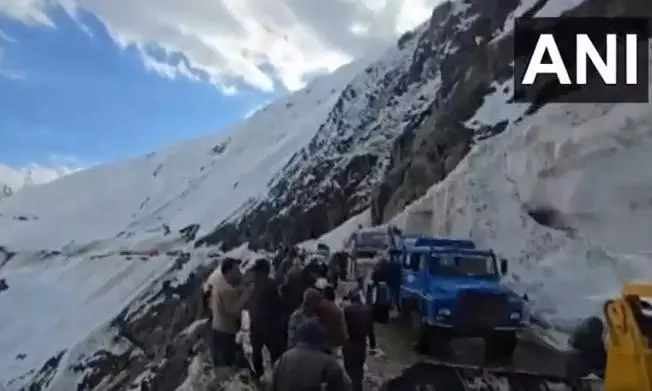
Srinagar: A devastating avalanche struck the high-altitude Zoji (la) Pass on Friday, killing at least six to seven people, injuring five others, and leaving one person missing, who officials fear may also be dead. The incident occurred near Zero Point at an elevation of 3,528 meters (11,649 ft), when a passenger vehicle came under a massive snow slide.
According to officials, the avalanche hit the vehicle with tremendous force, burying it under deep layers of snow and causing the on‑the‑spot deaths of the occupants. Initial reports varied, with some confirming six fatalities, while others later reported seven dead, reflecting the evolving nature of the rescue efforts. Five passengers were pulled out alive with injuries and were immediately shifted to nearby medical facilities for treatment. One individual remains unaccounted for, and authorities believe the person may not have survived.
Rescue teams—including local administration, police units, disaster response personnel, and Border Roads Organisation (BRO) workers—rushed to the site within minutes of the incident, officials said, adding that they launched a large-scale operation to retrieve bodies, evacuate survivors, and clear the debris. The terrain and weather conditions made the operation extremely challenging, as heavy snow accumulation continued to hamper visibility and movement, said a police official over the phone from the area.
Officials confirmed that three to four vehicles, and possibly more, were trapped under the avalanche, temporarily blocking the strategic Srinagar–Kargil highway.
Lieutenant Governor of Ladakh, Vinai Kumar Saxena, expressed deep concern over the tragedy. In a statement on ‘X’, he said he had directed the Deputy Commissioner and Senior Superintendent of Police of Kargil to reach the site immediately and oversee relief and rescue operations. He added that all government agencies, including disaster relief forces and the BRO, had been placed on high alert, and that he was personally monitoring the situation.
Authorities emphasised that rescue and clearance operations are still underway, with teams working to restore the Srinagar-Kargil highway for traffic and ensure no additional passengers remain trapped beneath the snow. Officials have urged travellers to avoid the route until conditions stabilise and the highway is declared safe.
Zoji(la) Pass, long regarded as one of the most treacherous stretches in the Himalayas, is notorious for its steep gradients, narrow corridors, and sudden weather shifts that can turn the route perilous within minutes. During winter and early spring, the region frequently witnesses avalanches, landslides, and road closures, making travel unpredictable and often dangerous. Authorities continue to urge travellers to exercise extreme caution, follow traffic advisories, and avoid unnecessary movement during periods of heavy snowfall or avalanche warnings.
However, a major infrastructure project underway is expected to dramatically transform this reality. The Zojila Tunnel, currently under construction, is one of India’s most ambitious and strategically significant engineering undertakings. Designed as an all‑weather, bi-directional tunnel stretching approximately 14.15 kilometers, it will be one of the longest road tunnels in Asia upon completion. The project aims to provide year-round connectivity between Srinagar, Drass, Kargil, and Leh, regions that are otherwise cut off for months due to harsh winter conditions.
Once operational, the tunnel will bypass the hazardous Zoji(la) Pass entirely, eliminating the need for vehicles to traverse the avalanche-prone slopes and high-altitude bends where incidents like Friday’s tragedy often occur. It is expected to reduce travel time across the pass from the current 3–4 hours to just 15–20 minutes, while offering a safe, weather-proof corridor for civilian movement, military logistics, and essential supplies. Engineers are incorporating advanced safety systems, including ventilation, emergency exits, surveillance, and real-time monitoring, to ensure uninterrupted and secure passage throughout the year.
Authorities and experts believe that the tunnel will not only enhance regional connectivity but also significantly reduce the risk to human life by removing the need for travellers to navigate one of the most dangerous mountain passes in the country. Until the project is completed, however, Zoji(la) Pass remains vulnerable to natural hazards, underscoring the importance of strict adherence to travel advisories and continuous monitoring by disaster management agencies.
