Astrophysicist Jayant Narlikar Passes Away at 87

Dr. Narlikar gained international acclaim for developing the Hoyle–Narlikar Theory in collaboration with British astrophysicist Sir Fred Hoyle
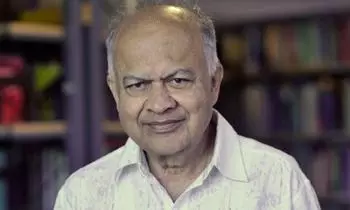
Mumbai: Renowned astrophysicist Jayant Narlikar, a pioneering figure in Indian science, died aged 87 in Pune on Tuesday. He was best known for his pioneering contributions to cosmology and for advocating alternative models to the widely accepted Big Bang theory.
According to family sources, Dr Narlikar died in his sleep early Tuesday morning. He had recently undergone hip surgery in a city-based hospital. He is survived by three daughters.
Calling him a luminary in the field of astrophysics, Prime Minister Narendra Modi said the death of Jayant Narlikar is a “monumental loss to the scientific community.”
He wrote in a post on X, “The passing of Dr. Jayant Narlikar is a monumental loss to the scientific community. He was a luminary, especially in the field of astrophysics. His pioneering works, especially key theoretical frameworks, will be valued by generations of researchers. He made a mark as an institution builder, grooming centres of learning and innovation for young minds. His writings have also gone a long way in making science accessible to common citizens. Condolences to his family and friends in this hour of grief. Om Shanti.”
Dr. Narlikar gained international acclaim for developing the Hoyle–Narlikar Theory in collaboration with British astrophysicist Sir Fred Hoyle. They proposed the Hoyle–Narlikar theory of conformal gravity as an alternative to the Big Bang theory. Unlike the Big Bang model, which suggests the universe began from a singular explosive event, their theory posits that the universe has no beginning or end in time – it has always existed in a steady state. To account for the universe’s expansion, they introduced the idea of continuous matter creation, which allowed the overall density to remain unchanged over time.
Although strong observational evidence continues to support the Big Bang theory, the Hoyle–Narlikar theory remains a significant and influential contribution to theoretical cosmology.
Born on July 19, 1938, in Kolhapur, Maharashtra, Dr Narlikar completed his early education at Banaras Hindu University (BHU), where his father, Vishnu Vasudeva Narlikar, served as a professor and Head of the Mathematics Department. He later attended Cambridge University for higher studies, where he achieved the distinction of Wrangler and Tyson Medallist in the Mathematical Tripos.
Upon returning to India, Dr. Narlikar joined the Tata Institute of Fundamental Research (1972-1989). During his tenure, he expanded the Theoretical Astrophysics Group, which gained international recognition. In 1988, the University Grants Commission invited Dr Narlikar to set up the Inter-University Centre for Astronomy and Astrophysics (IUCAA), where he served as Founder Director until his retirement in 2003. Under his leadership, IUCAA earned a worldwide reputation as a centre of excellence in teaching and research in astronomy and astrophysics. He was also an Emeritus Professor at IUCAA.
For his contributions, Dr. Narlikar was honoured by UNESCO in 1996 with the Kalinga Award for popular science works. He was awarded the Padma Bhushan in 1965 at the young age of 26 and in 2004, he received the Padma Vibhushan. The Maharashtra government also honoured him with the state’s highest civilian award, the Maharashtra Bhushan, in 2011.
Dr. Narlikar was known as a gifted writer in Marathi, Hindi, and English. His literary works, including Antaralatil Bhasmasur (The Demon of Space), Vaman Parat Na Ala, Virus and Char Nagarantle Maze Vishva (My Universe Across Four Cities), made science accessible and engaging for readers. In 2014, the Sahitya Akademi, India’s premier literary body, selected his autobiography for its highest prize in regional language (Marathi) writing.
