50% Tariff Kicks In; Modi Refused Four Trump Calls

Significantly, India has till Tuesday evening not officially denied the German media report.
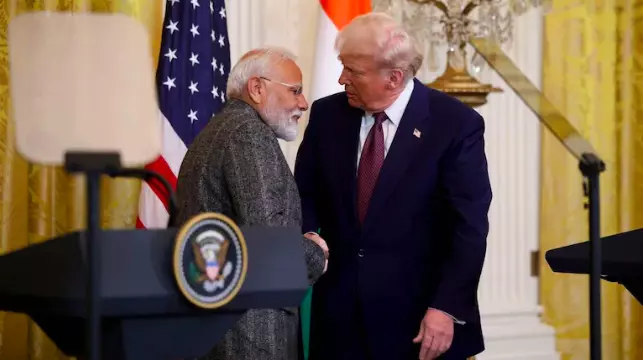
New Delhi: The additional 25 per cent tariff imposed by US President Donald Trump on India for its purchases of Russian oil came into effect Wednesday, bringing the total amount of levies imposed on New Delhi to 50 per cent. The Department of Homeland Security (DHS), in a draft order published on Monday, said the increased levies would hit Indian products that are "entered for consumption, or withdrawn from warehouse for consumption, on or after 12:01 am eastern daylight time on August 27, 2025."
Trump had announced reciprocal tariffs of 25 per cent on India that came into effect on August 7, when tariffs on about 70 other nations also kicked in.
On August 7, the US president announced doubling tariffs on Indian goods to 50 per cent for India's purchases of Russian crude oil, but gave a 21-day window to negotiate an agreement.
On Monday, Prime Minister Narendra Modi asserted he can't compromise on the interests of farmers, cattle-rearers, small-scale industries, cautioning "pressure on us may increase, but we will bear it."
"Products of India, except those set forth in section 3 of Executive Order 14329, that are entered for consumption, or withdrawn from warehouse for consumption, on or after 12:01 a.m. eastern daylight time on August 27, 2025, will be subject to the additional ad valorem rate of duty," the DHS order read.
However, Indian products will be exempt from the new 50 per cent tariff if they were "already loaded on a ship and in transit to the US before 12:01 am (EDT) on August 27, 2025, provided they are cleared for use in the country or taken out of a warehouse for consumption before 12:01 am (EDT) on September 17, 2025, and the importer certifies this to US Customs by declaring the special code HTSUS 9903.01.85."
Commenting on the additional tariffs on India, Mark Linscott, Senior Advisor with Washington DC-based business consulting and advisory firm The Asia Group, said that "unfortunately, the US and India have managed to convert what appeared to be a true and unprecedented win-win on trade into a remarkable lose-lose."
"For the moment, the trade talks on reciprocal tariffs are on thin ice while the two sides stew over how to reach an understanding on Russian oil purchases. Hopefully, cooler heads who understand the value of the relationship will prevail in finding the path forward," Linscott said.
Partner at The Asia Group Nisha Biswal said the 50 per cent tariffs on India — now the highest of any US trading partner — will be hugely disruptive, pricing Indian textiles and garments out of the US market.
"US businesses have also lost the unprecedentedly low tariff rates that USTR (United States Trade Representative) had previously negotiated. The move also casts doubt on the China+1 strategy, creating uncertainty for companies that had shifted production to India," she said.
"The short-term impact of these tariffs will be undoubtedly severe, but a path forward remains possible if Modi and Trump engage directly to restore trust and strike a workable agreement," Biswal added.
Managing Principal at The Asia Group Basant Sanghera said the secondary tariffs will be highly damaging to US-India economic ties and India's manufacturing ambitions.
"Without some level of leader-level engagement, the trade relationship will remain in the doldrums, with risk of further damage," he said.
US Treasury Secretary Scott Bessent has accused India of "profiteering" by reselling Russian oil. India has called the tariffs imposed by the US "unjustified and unreasonable."
Meanwhile, in a sensational revelation a German publication ‘FAZ’ on Tuesday reported that US President Donald Trump had attempted to speak to Prime Minister Narendra Modi four times in recent weeks but that a furious Modi had refused to take the calls.
Significantly, India has till Tuesday evening not officially denied the German media report.
This came on a day when the US issued a draft notice detailing plans to implement the additional 25 per cent tariff on Indian exports that came into effect from August 27. President Trump had earlier announced imposition of tariffs totalling 50 per cent on India, including 25 per cent as a “penalty” for Indian imports of Russian oil. A 25 per cent tariff by the US had already come into effect earlier this month.
India and the US, meanwhile, on Tuesday held a virtual India-US 2+2 (foreign affairs and defence) inter-sessional dialogue and “discussed trade and investment; energy security, including strengthening civil-nuclear cooperation; critical minerals exploration; counternarcotics and counter-terrorism cooperation”. New Delhi said late Tuesday evening that the two nations “also looked forward to increasing defence cooperation, including signing a new ten-year Framework for the India-US Major Defence Partnership”. They also “reaffirmed their commitment to promoting a safer, stronger, and more prosperous Indo-Pacific region through the Quad”, New Delhi added.
India had earlier termed the US tariffs as “unjustified and unreasonable” and said that, like any major economy, it will take all necessary measures to safeguard its national interests and economic security. Earlier this month, India had said “it is extremely unfortunate that the US should choose to impose additional tariffs on India for actions that several other countries are also taking in their own national interest”.
President Trump had launched a tirade against India in the past few weeks over its tariffs as well as import of Russian oil. The German publication on Tuesday apparently reported that Modi had been angered by President Trump’s actions.
Despite India’s refutation at the highest levels, Trump’s repeated claims that it was his administration which had brokered a ceasefire between India and Pakistan by using trade as a pressure tactic also strained ties.
