1949 Letter Reveals Nehru’s Stand on January 26 Despite Astrological Objections

26 Nov 2026 10:10 PM IST26 Nov 2026 10:10 PM IST
In his letter, Nehru said, "I am afraid I have no faith in astrology and certainly I should not like to fix up national programmes in accordance with the dictates of astrologers."
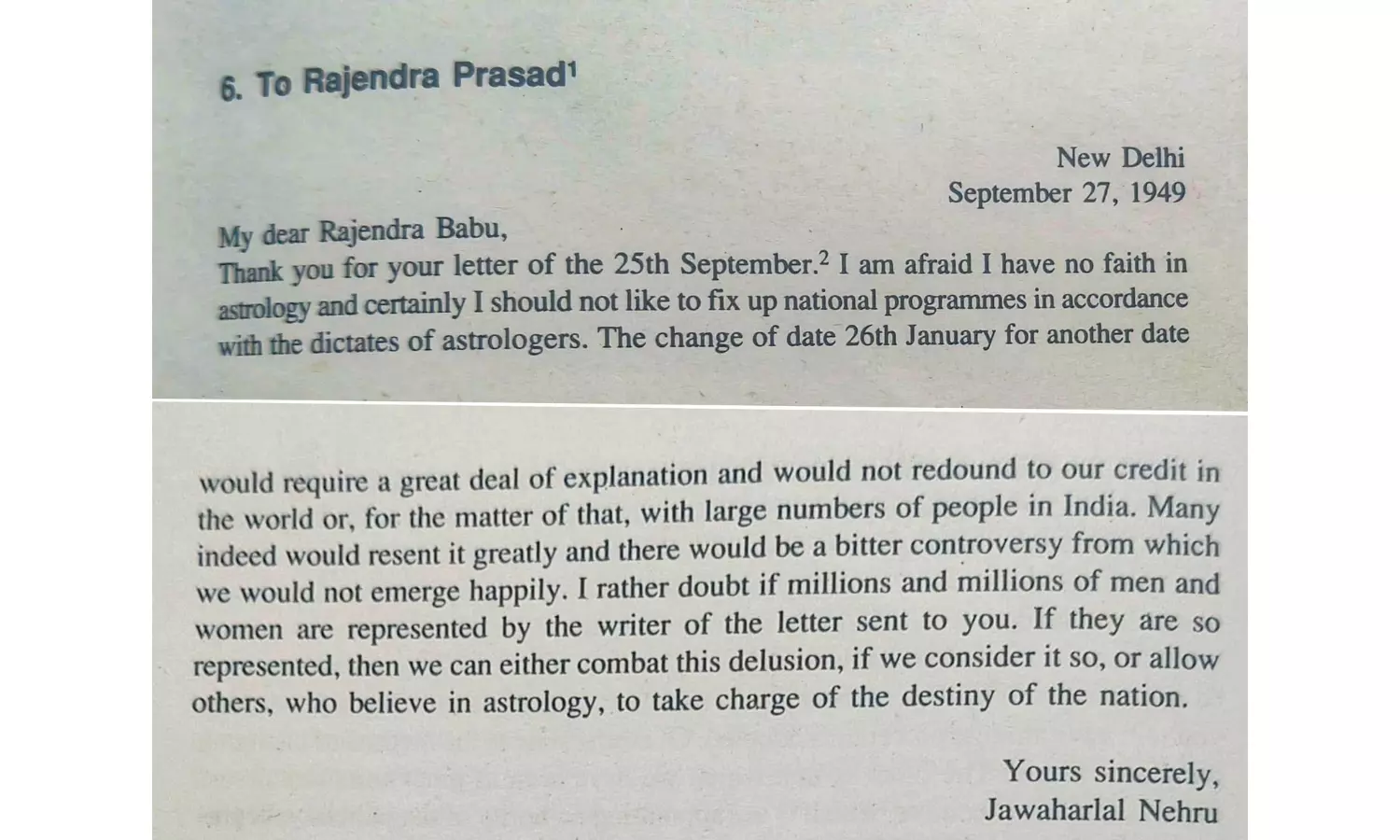
In this image received on Nov. 26, 2026, A letter exchanged between former president Rajendra Prasad and former prime minister Jawaharlal Nehru on the date of the Constitution coming into force. (Handout via PTI Photo)
New Delhi: Jawaharlal Nehru did not favour changing January 26 as the date for India's new Constitution to come into effect despite concerns about the day being considered inauspicious, as a 1949 letter to Rajendra Prasad shows, offering a glimpse into the moments leading up to the adoption of the document, marked every year on November 26 as Constitution Day.
In a letter accessed by PTI, dated September 27, 1949, the first prime minister of independent India told Prasad that he had no faith in astrology and did not favour deciding national programmes on its basis. He was responding to concerns that January 26 was considered inauspicious for the inauguration of the new Constitution.
Prasad, who was then president of the Constituent Assembly, had written to Nehru two days earlier, enclosing a letter from an unidentified person who suggested that another date be considered.
In his letter, Nehru said, "I am afraid I have no faith in astrology and certainly I should not like to fix up national programmes in accordance with the dictates of astrologers."
Prasad, in his letter to Nehru, said, "When we act not in an individual capacity but as representatives of millions and millions of men and women who have that faith, it may be improper not to consider their feelings in the matter."
In his letter from Pilani in Rajasthan, Prasad recalled that August 15, 1947 had been fixed as the date for the transfer of power without consulting astrologers. Some had described it as inauspicious and predicted trouble, but their views had not been considered.
Prasad also pointed out that January 26 carried a certain significance for people and suggested that the matter could be explored informally to identify a day considered auspicious for the Constitution's inauguration.
In his reply, Nehru said changing January 26 would require considerable explanation and could lead to differences of opinion among people in the country. He also questioned whether the person who had written to Prasad truly represented the sentiments of millions, as suggested in the letter.
Nehru added that if such beliefs were widely held, the leadership could either try to counter them or allow those who believed in astrology to take charge of the country's destiny.
The Constitution was adopted by the Constituent Assembly on November 26, 1949, after nearly three years of deliberations, and came into effect on January 26, 1950. The date was chosen to commemorate the Purna Swaraj declaration of complete independence made by the Congress in 1930.
November 26 is observed every year as Constitution Day, also known as Samvidhan Divas, to mark the adoption of the country's Constitution. Prasad, who presided over the Constituent Assembly during its drafting, later became independent India's first President, while Nehru was its first prime minister.
( Source : PTI )

Next Story